You’re spending thousands on medical tourism marketing, but international patients still aren’t booking. Here’s the uncomfortable truth: 97% of medical tourists choose providers based on trust signals you’re probably ignoring—and those critical judgments happen before they ever contact you.
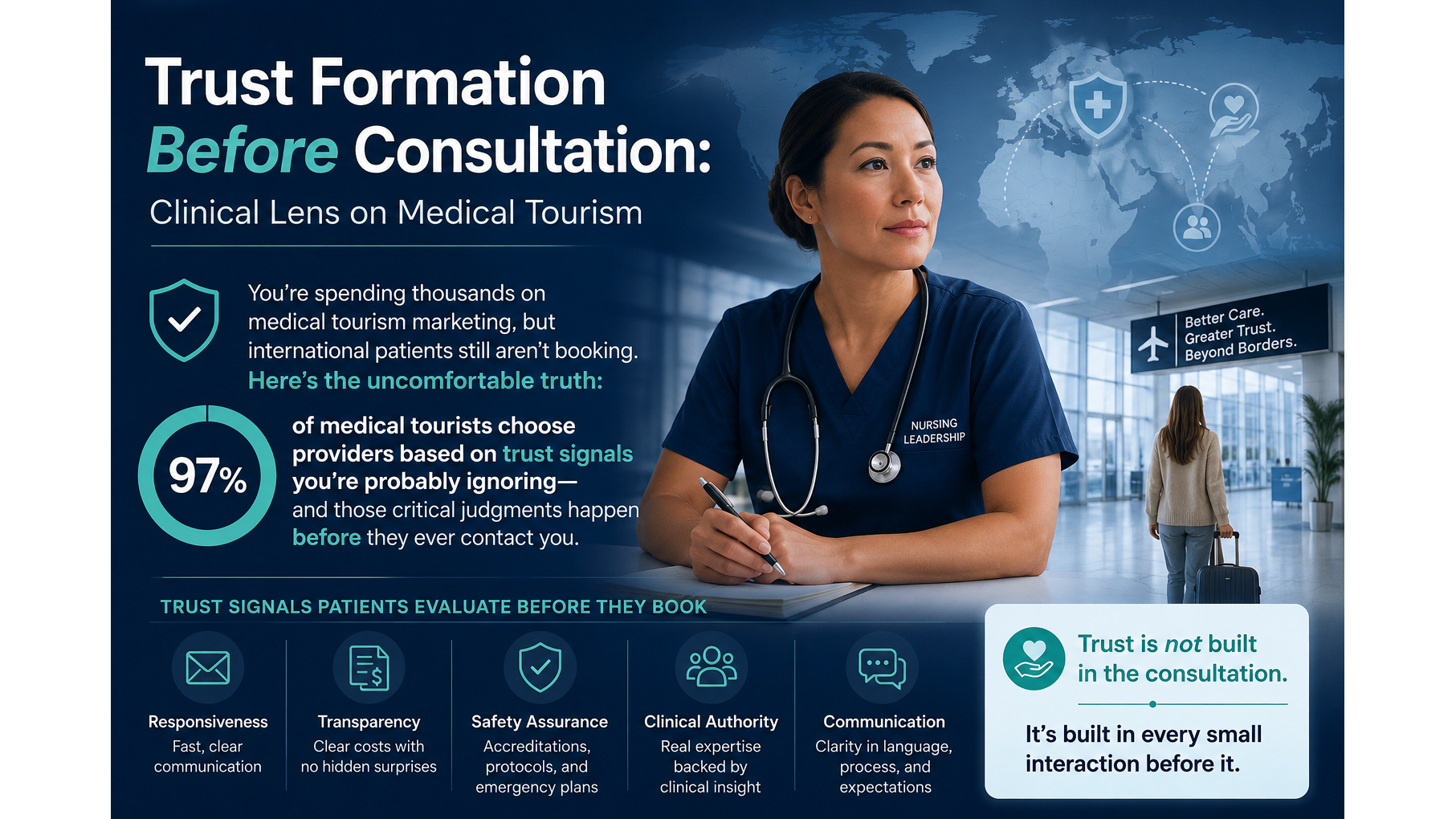
Medical tourism marketing often fails because it treats trust formation as a secondary concern rather than the primary driver of patient selection. North American patients evaluate healthcare providers through a fundamentally different lens than domestic patients, weighing perceived safety and clinical authority against cost savings and accessibility.
Medical services represent what researchers call "credence goods" - products whose quality remains difficult to assess even after consumption. This inherent uncertainty becomes magnified when patients cross borders for treatment, creating a psychological barrier that pure marketing cannot overcome.
Research shows 97% of medical tourists consider trust a paramount factor when selecting healthcare providers abroad. Yet most medical tourism organizations continue investing heavily in visibility campaigns while neglecting the trust architecture that actually drives selection decisions. According to Alison Prentice, CEO of JCH Digital and a former Director of Nursing, many international healthcare organizations misunderstand where patient hesitation actually begins, often treating trust formation as a marketing problem instead of a clinical and operational one.
The disconnect becomes clear when examining patient behavior patterns. Prospective medical tourists may spend months researching facilities, reading testimonials, and comparing credentials - but abandon consideration after a single interaction that feels commercially focused rather than clinically grounded. This pattern reveals that being seen is not the same as being selected.
Traditional marketing approaches prioritize reach and impressions while overlooking the trust signals international patients actually use to evaluate providers. Polished promotional materials can inadvertently trigger skepticism if they appear disconnected from clinical reality. Patients seeking cross-border care are often dealing with complex medical situations that require nuanced understanding - not simplified sales messaging.
Medical tourism requires patients to assess risk from a distance. When patients cannot directly observe care, they look for evidence that the organization is prepared, responsive, coordinated, and capable of supporting them if something goes wrong.
By the time North American patients reach a consultation, major judgments about provider credibility have already crystallized. These pre-consultation evaluations happen through seemingly minor interactions: response time to initial inquiries, clarity of cost breakdowns, transparency about potential risks, and evidence of coordinated care processes.
North American patients frequently express concerns about post-treatment follow-up care, safety standards, provider expertise, and potential hidden costs before committing to treatment abroad. Organizations that address these concerns through clinical expertise rather than marketing reassurance demonstrate the authority patients seek.
Academic research confirms that patient decisions in medical tourism are influenced more by perceived risk than actual risk statistics. This psychological dimension of trust formation requires understanding how international patients process safety information differently than domestic patients.
For example, accreditation credentials may carry less weight with international patients than clear communication about discharge planning and emergency protocols. Patients want evidence that providers understand the vulnerability of being far from home during recovery, not just proof of technical competence.
Nursing leadership brings unique insights to international patient trust formation because nurses witness firsthand how patients and families evaluate care quality. From a clinical operations perspective, trust emerges from visible competence in managing patient vulnerability - not from marketing messaging about excellence.
This perspective reveals why many medical tourism marketing efforts miss their mark. Patients don't just want to know about surgical success rates; they want evidence that someone will advocate for them if complications arise. They need reassurance about communication protocols, pain management approaches, and family involvement policies.
Nursing leaders understand that patient trust involves providing ample time for questions, viewing patients as individuals with unique fears rather than medical cases, and demonstrating cultural competence in cross-border care scenarios.
International patients, particularly from North America, often interpret operational details as safety indicators in ways that surprise marketing-focused organizations. Response time to emails, consistency in cost estimates, clarity about what's included in treatment packages, and evidence of coordination between different departments all contribute to perceived safety.
Nurses involved in medical tourism require cultural competence and strong administrative skills to effectively interact with diverse stakeholders - competencies that improve patient safety and satisfaction beyond what traditional patient relations approaches achieve. These frontline insights reveal which organizational behaviors actually build confidence versus which ones create doubt.
Trust architecture begins with recognizing that international patients need different types of responsiveness than domestic patients. Quick acknowledgment of inquiries matters, but the quality of initial responses carries more weight. Patients want evidence that their questions are understood within a clinical context, not just processed as sales leads.
Effective communication clarity involves addressing the concerns that families and support systems raise about cross-border care. International patients rarely make treatment decisions independently - they need information that helps them build consensus among people who may be skeptical about medical tourism.
Healthcare organizations achieve stronger authority positioning through clinical grounding than commercial polish. Patients seeking international care want evidence of medical expertise throughout the entire journey, not marketing sophistication. This means featuring clinical decision-making processes, interdisciplinary care coordination, and evidence-based protocols rather than amenity descriptions or tourism activities.
Regulatory guidelines emphasize transparency through accurate, detailed information about facilities and professional qualifications. However, patients also need context about how these qualifications translate to their specific situations and recovery needs.
International medical decisions, including in North America, involve multiple stakeholders beyond the patient. Family members often influence healthcare choices more than formal decision-makers recognize, particularly when those family members have concerns about safety and accountability in foreign healthcare settings.
Trust architecture must account for family dynamics and provide information that helps patients address skepticism from loved ones. This includes clear explanation of follow-up care arrangements, communication protocols during treatment, and processes for handling unexpected complications.
North American patients do not trust providers because they are visible. They trust providers because the organization demonstrates an understanding of patient vulnerability before treatment begins. The providers who consistently communicate safety, coordination, responsiveness, and advocacy are often the ones selected long before formal comparisons ever take place.
The medical tourism industry increasingly operates through a "digital-first" and "trust-led" approach where patients prioritize trusting online information over merely confirming travel feasibility. Organizations that combine clinical understanding with digital positioning create competitive advantages that pure marketing approaches cannot replicate.
This nursing lens on authority building addresses ethical concerns about medical tourism promotional strategies that exaggerate success rates or obscure potential risks. When clinical expertise guides international positioning, organizations naturally avoid the information asymmetries that undermine informed consent and long-term reputation.


