You know that frustrating moment when a hot lead suddenly goes silent? It’s not random ghosting—it’s a predictable psychological countdown that starts the second they click submit. And if you’re waiting more than 5 minutes to respond, you’ve already lost them.
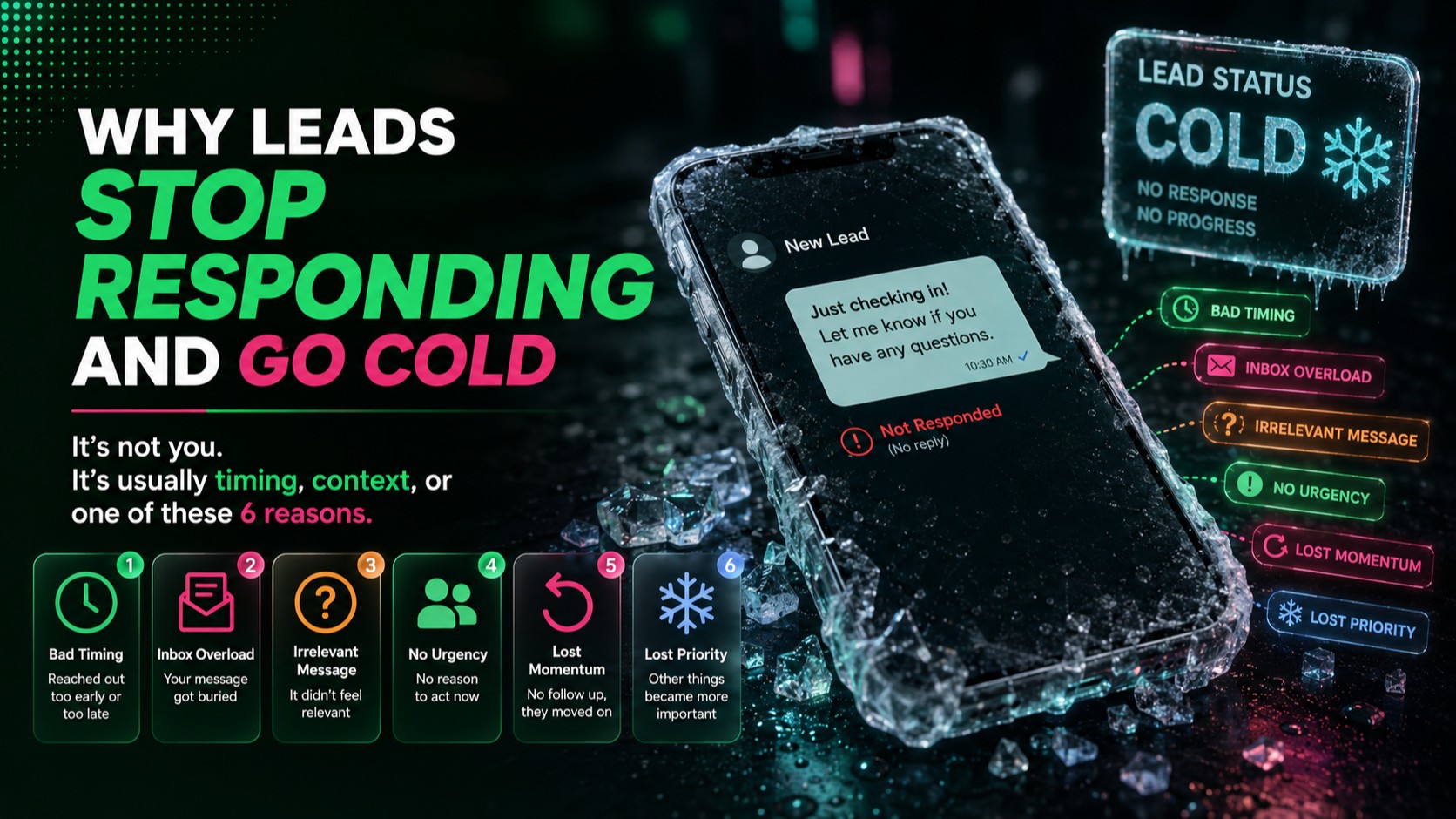
Every business owner has experienced the frustration of leads that seem interested one moment and disappear the next. What appears to be random "ghosting" is actually a predictable process that can be understood, measured, and reversed.
The moment a prospect submits their information, a psychological countdown begins. Their urgency is at its peak - the problem feels vivid, and the desire for relief drives immediate action. But this emotional state is temporary and fragile.
Research reveals a harsh reality: the odds of contacting a lead decrease by over 10 times if the first attempt is made after 5 minutes. This isn't just about being first to respond - it's about catching prospects while their buying intent remains hot. As time passes, competing priorities intrude, the perceived pain softens, and the effort of evaluating options becomes more daunting than the problem itself.
Status quo bias kicks in hard. Doing nothing feels safer than making a change, especially when buyers fear making the wrong decision more than they value potential benefits. Understanding this psychology helps businesses calculate the true cost of slow lead response and implement systems that preserve momentum from the first moment of contact.
The momentum decay process operates like a four-stage breakdown that transforms hot prospects into cold leads. Understanding each component reveals why traditional follow-up methods often fail and how modern solutions can intervene at critical moments.
Buyer intent has an expiration date. The urgency that drove someone to fill out a form or request a quote begins deteriorating immediately. Within hours, that "must-have-now" feeling transforms into "maybe-I-should-think-about-this."
This decay happens faster in some industries than others. A homeowner with a burst pipe has intent that expires in minutes. An enterprise buyer evaluating software has a longer window, but even they face budget cycles, stakeholder changes, and shifting priorities that can derail momentum over weeks or months.
As urgency fades, emotional resistance grows. Prospects begin second-guessing themselves, imagining worst-case scenarios, and feeling overwhelmed by options. This isn't rational evaluation - it's loss aversion in action.
Buyers fear a bad decision more than they value a good outcome. When faced with uncertainty, silence becomes the path of least resistance. It preserves flexibility while avoiding the discomfort of potential confrontation or the effort required to make a definitive choice.
While your prospect wrestles with emotional friction, competitors are actively reaching out. Industry data shows that 78% of B2B buyers purchase from the vendor that responds first. This isn't necessarily about superior products or pricing - it's about timing and trust formation.
The first business to respond catches prospects while they're still engaged with the problem. Every subsequent interaction builds on that initial momentum, while delayed responses face the uphill battle of re-engaging someone who's already moving through another vendor's process.
Many cold leads aren't lost to competitors or changing minds - they're manufactured by internal operational failures. Slow routing systems, unclear ownership between sales and marketing, and gaps in follow-up processes create artificial delays that kill natural buying momentum.
A lead might technically exist in the CRM but sit in a batched queue for hours. By the time human follow-up occurs, the delay itself becomes a negative signal about competence and attention to detail.
The Harvard Business Review's landmark study on online sales leads revealed that firms responding within an hour were dramatically more likely to qualify leads than those waiting longer. More detailed analysis showed the odds of qualification were about 21 times higher when contact occurred within 5 minutes versus 30 minutes.
Recent audits paint an even starker picture of industry performance. A study of 1,000 B2B SaaS companies found an average response time of over 29 hours, with 635 companies providing no response at all. Among 114 B2B companies tested, only one sent a personalized email within 5 minutes, and zero companies called within that critical window.
The gap between knowing and doing remains vast. Sales teams juggle existing clients, proposal writing, and administrative tasks. Even with the best intentions, responding to every new lead within minutes is humanly impossible at scale.
This creates a systematic disadvantage against competitors who have solved the speed-to-lead challenge through automation. The businesses that win aren't necessarily those with the most leads - they're the ones that preserve momentum most effectively.
Interest and need can coexist with uncertainty and overwhelm. A prospect who submits a form at peak motivation may genuinely require the solution but lack the emotional energy to continue the evaluation process days or weeks later.
Decision fatigue compounds this effect. Mentally overloaded prospects defer effortful choices, especially when those choices involve potential risk or require explaining decisions to colleagues or family members.
Rejecting a vendor requires emotional effort and potential confrontation. Silence preserves optionality while avoiding uncomfortable conversations. Prospects can revisit the decision later if circumstances change, without burning bridges or dealing with persistent sales pressure.
This explains why "if they were interested, they would respond" thinking fails so often. Interest and responsiveness operate on different emotional and psychological tracks, especially as time creates distance from the original buying trigger.
The most damaging delays often occur before anyone realizes there's a problem. Marketing assumes sales has taken ownership; sales assumes the lead isn't qualified; RevOps sees stage confusion and SLA failures. Meanwhile, the prospect experiences radio silence from a business they thought was interested in helping them.
Lead routing systems create additional friction. Complex qualification criteria, territory assignments, and capacity-based distribution can add hours or days to what should be an instant handoff process.
First contact success often creates false confidence. Many businesses excel at generating initial response but fail after the first meeting. Demos become generic product tours, proposals arrive late, pricing remains unclear, and next steps feel vague.
This post-meeting decay represents a massive opportunity loss. The hardest work - capturing attention and earning initial trust - has already been accomplished. Poor execution in the middle stages wastes that investment entirely.
Marketing generates the lead, sales owns the relationship - but what happens in between determines success or failure. Poor handoffs create confusion about timing, context, and expectations that damage trust before meaningful conversations can begin.
When handoffs lack proper context about lead source, specific interests, or interaction history, sales teams start from scratch instead of building on marketing's momentum-building work.
SMS marketing achieves significantly higher engagement than email, with open rates approaching 100% and reply rates consistently hitting 30-50% for well-crafted messages. The key lies in conversational, two-line formats that feel personal rather than promotional.
Unlike email, which competes with dozens of other messages in crowded inboxes, SMS commands immediate attention. Recipients read text messages in full, creating opportunities for meaningful engagement that email rarely achieves in modern business environments.
Effective automation handles speed, consistency, and initial qualification while escalating nuance and trust-building to human team members. AI excels at instant acknowledgment, basic question answering, and appointment scheduling - tasks that require speed but not deep relationship building.
The most successful implementations use automation to catch prospects in the critical early window, then seamlessly transition to human interaction when complexity or emotional considerations require personal attention.
Traditional lead reactivation required significant upfront investment in staff time and technology, making it economically unviable for most businesses. Performance-based AI solutions eliminate this barrier by charging only for successful outcomes.
This model alignment creates powerful incentives for continuous optimization. Providers succeed only when clients see measurable results, naturally driving toward techniques and technologies that maximize conversion rather than activity volume.
Every established business sits on a database of prospects who expressed interest but never converted. These aren't failed leads - they're unrealized assets waiting for the right approach and timing to unlock their value.
Modern AI and automation technologies make systematic lead reactivation economically viable for the first time. What previously required expensive human resources can now be accomplished at scale, with precision targeting and personalized messaging that feels authentic rather than mechanical.
The businesses winning in today's market aren't necessarily those generating the most new leads. They're the ones maximizing value from every prospect interaction, preserving momentum through speed and relevance, and systematically recovering value from previous investments in lead generation.
Success requires understanding that momentum decay is predictable and preventable, not inevitable. With proper systems, timing, and technology, the leads currently gathering dust in spreadsheets can become a significant revenue source - often more profitable than acquiring entirely new prospects.
Discover how MAXED AI helps businesses counteract momentum decay and reactivate dormant leads through performance-based AI solutions at https://maxed.ai.


