Still slicing with your SF1 driver? The SF2’s forged titanium face hits USGA’s maximum legal ball speed limits—something carbon composite physically can’t achieve. But face speed is only half the story of why titanium transforms slice correction.
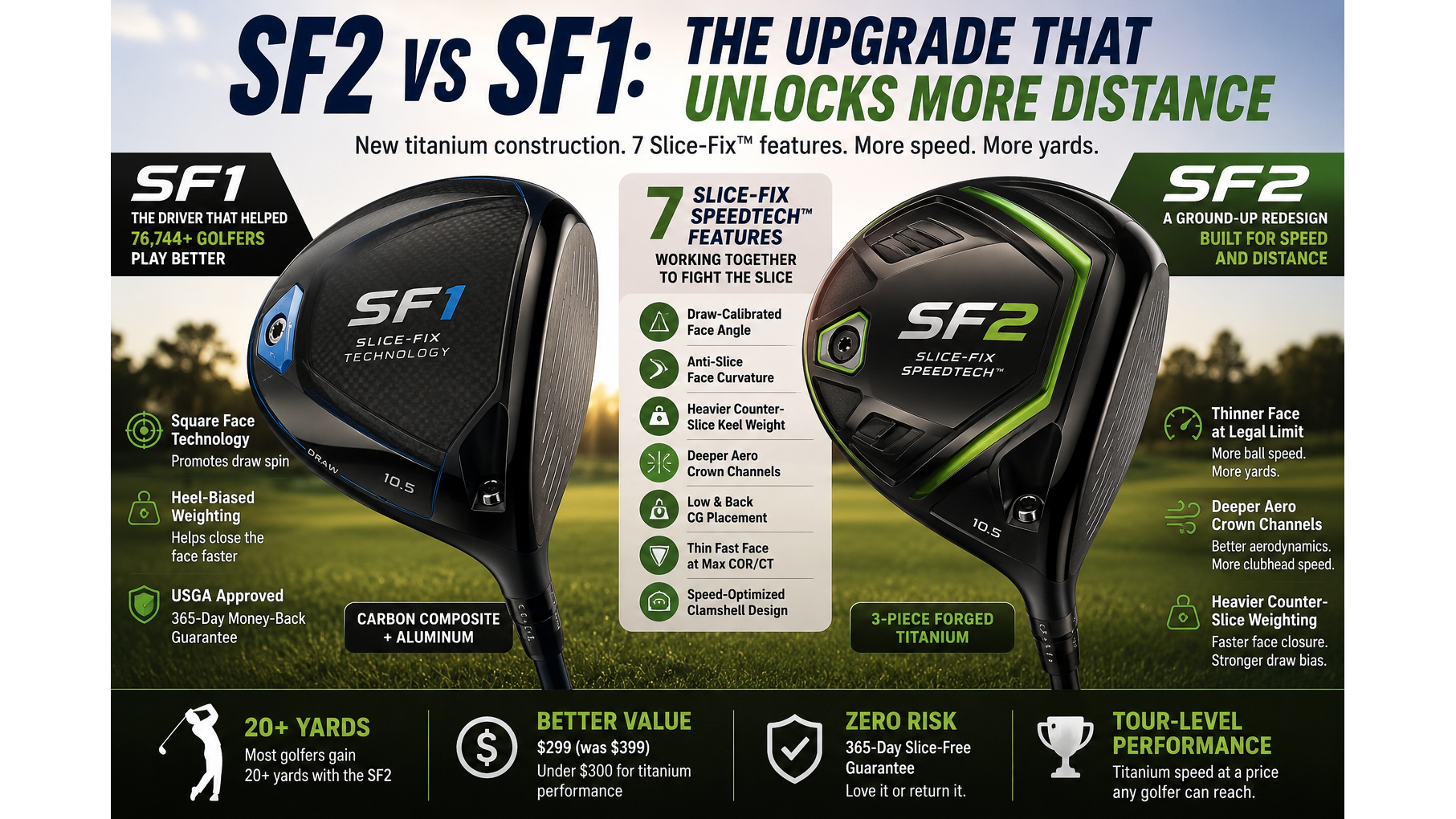
The jump from carbon composite to forged titanium represents more than a material upgrade—it's a fundamental shift in what's possible when engineering a driver specifically for golfers who struggle with persistent slices. While the SF1 helped thousands of golfers reduce their slice, its construction materials imposed hard limits on face speed and energy transfer that no amount of engineering could overcome.
The SF2 driver represents a complete material philosophy change from its predecessor. Where the SF1 used carbon composite and aluminum components to keep costs manageable while providing basic slice correction, the SF2 commits fully to a 3-piece forged titanium construction that unlocks performance capabilities the older design simply couldn't access.
This isn't just about premium materials for their own sake. Forged titanium's unique properties—exceptional strength combined with lightweight characteristics—allow engineers to push the boundaries of face thickness, weight distribution, and aerodynamic design in ways that carbon composite construction actively prevented.
The result is a driver that delivers both maximum slice correction and maximum legal ball speed simultaneously, rather than forcing golfers to choose between accuracy and distance. Affordable Golf Courses Review shows exactly how these material differences translate to measurable performance gains on the course.
Understanding the SF2's advantages requires recognizing the specific limitations that held back the SF1's performance potential. Carbon composite offered certain benefits—lower cost, adequate strength for recreational use, and the ability to position weight strategically. However, these materials imposed strict engineering constraints that prevented optimization for maximum ball speed.
While carbon composite faces can be engineered to approach USGA limits, the material physics make it more challenging to consistently achieve ultra-thin face construction for maximum energy transfer compared to forged titanium. This thickness requirement directly limits how much the face can flex at impact, which determines energy transfer efficiency to the golf ball.
The USGA allows drivers to reach a maximum Coefficient of Restitution (COR) of 0.830 and Characteristic Time (CT) of 257 microseconds—measurements that define how much energy a clubface can legally transfer to the ball. A COR of 0.830 means the ball's rebound velocity cannot exceed 83% of the speed at which it approached the clubface. Carbon composite construction often falls short of these limits due to engineering challenges in achieving the ultra-thin face construction required for maximum legal performance.
Energy transfer at impact depends on the face's ability to flex and spring back during the brief moment of ball contact. Carbon composite materials, while lighter than steel, lack the specific strength characteristics needed for optimal flexion response. The material tends to dampen energy rather than amplify it, resulting in reduced ball speed compared to what titanium construction can achieve.
Additionally, the aluminum components in the SF1's hybrid construction added weight in areas where it couldn't contribute to performance. This excess weight had to be compensated for elsewhere in the design, limiting how much mass could be positioned strategically for slice correction or aerodynamic optimization.
Forged titanium eliminates every major constraint that limited the SF1's performance ceiling. The material's exceptional strength-to-weight ratio creates engineering flexibility that transforms what's possible in driver design, particularly for golfers who need both slice correction and maximum distance.
The SF2's titanium face reaches the maximum legal COR of 0.830 and CT of 257 microseconds—the absolute limit of what USGA rules permit for energy transfer. This means every solid strike transfers the maximum allowable energy to the ball, something the SF1's material stack couldn't physically achieve.
This face technology isn't borrowed from tour drivers and adapted for slice correction—it's engineered specifically for golfers who need help closing the clubface while still delivering tour-level ball speeds. The combination of maximum legal energy transfer with slice-correcting geometry creates a unique performance profile that addresses both distance and accuracy simultaneously.
Titanium's superior strength allows engineers to remove material from structurally unnecessary areas and redistribute that weight where it impacts performance most. The SF2 uses this advantage to create heavier counter-slice keel weighting in the heel—mass positioned specifically to encourage faster face rotation through impact.
This heel weighting is significantly more aggressive than what was possible with the SF1's construction. The additional weight helps close the clubface automatically, reducing the timing precision required from the golfer's swing mechanics. For players with deeply ingrained slice patterns, this enhanced correction force can be the difference between minor improvement and complete ball flight transformation.
The SF2's titanium construction enables a lower, sleeker clamshell profile with deeper aerodynamic crown channels carved into the clubhead surface. These channels aren't cosmetic—they redirect airflow during the downswing to reduce drag forces that slow clubhead speed before impact.
Aerodynamic research shows that deeper crown channels delay flow separation, the point where smooth airflow breaks away from the clubhead surface and creates turbulent drag. Independent testing indicates that these crown features can preserve approximately 1 mph of additional clubhead speed, which translates to about 4 yards of additional carry distance without requiring any change in swing technique.
The practical difference between carbon composite and forged titanium construction shows up most clearly in ball speed measurements. While both drivers can fix slice patterns, only the SF2 delivers maximum legal energy transfer on every swing.
The USGA's COR limit of 0.830 represents the maximum energy return allowed from a clubface during ball contact. This measurement signifies that the ball's rebound velocity cannot exceed 83% of the speed at which it approached the clubface, representing the maximum allowable energy return from impact.
Reaching this legal limit requires precise face thickness engineering that's only possible with high-strength materials like forged titanium. The SF1's carbon composite construction typically achieved COR values in the 0.78-0.82 range—good performance, but not the maximum allowed by regulations. The SF2 consistently hits the 0.830 ceiling, extracting every legally permissible mile per hour of ball speed from each swing.
Most golfers switching from the SF1 to SF2 report distance gains, which comes from two compounding factors. First, straighter ball flight eliminates the distance loss inherent in sliced shots—a ball that travels straight covers more forward ground than one curving right. Second, the hotter titanium face generates genuinely higher ball speeds even when both drivers hit the ball perfectly straight.
This dual improvement creates a multiplicative effect rather than simple addition. The slice correction ensures more energy goes toward forward distance rather than sideways curve, while the improved face technology ensures there's more total energy in the system to begin with. For golfers with swing speeds above 80 mph, this combination often produces significant distance gains from equipment changes.
Superior materials don't just enable better ball speed—they allow for more aggressive slice correction features that weren't feasible with the SF1's construction constraints. The SF2 uses titanium's advantages to implement slice-fighting technology that works more automatically and requires less precise timing from the golfer.
The SF2's heel weighting system contains significantly more mass than the SF1 could accommodate while maintaining proper swing weight balance. This additional weight creates a stronger rotational force that helps close the clubface through impact, essentially doing more of the slice correction work automatically.
For golfers with deeply ingrained over-the-top swing patterns or those who consistently contact the ball with an open clubface, this enhanced weighting provides correction force that doesn't depend on perfect swing mechanics. The club's design compensates for common swing faults rather than requiring the golfer to eliminate those faults through technique changes alone.
The crown channels on the SF2 are carved deeper into the titanium surface than was structurally possible with carbon composite construction. These channels function as aerodynamic devices that maintain attached airflow over the clubhead during the downswing, reducing the drag forces that typically slow the club before impact.
Independent aerodynamics testing shows that deeper crown channels can preserve approximately 1 mph of additional clubhead speed compared to smoother crown designs. This speed difference translates to approximately 4 yards of additional carry distance—meaningful improvement that compounds with the other performance advantages built into the SF2's design.
While the SF2 represents a clear technological advancement over the SF1, not every golfer will see proportional benefits from the upgrade. The titanium construction creates the most dramatic improvements for specific types of players whose games are limited by the constraints that held back the SF1's performance.
Some players have slice patterns so severe or deeply ingrained that they need every possible structural advantage to achieve consistent straight ball flight. These golfers may have seen improvement with the SF1 but couldn't eliminate the slice entirely, leaving them frustrated with partial correction rather than complete ball flight transformation.
The SF2's enhanced counter-slice keel weighting and more aggressive draw-calibrated face angle provide significantly more correction force than the SF1 could deliver. For golfers who reduced but didn't eliminate their slice with the previous model, this additional correction capacity often represents the difference between ongoing frustration and genuine confidence off the tee.
Golfers who successfully corrected their slice with the SF1 but remain unsatisfied with their distance off the tee represent the ideal upgrade candidate for the SF2. These players have already solved the accuracy problem and are ready to address the speed problem without rebuilding their swing mechanics.
The SF2's max-legal COR/CT face technology delivers immediate distance gains that don't require swing speed increases, timing changes, or technique adjustments. Players can maintain the same swing that already produces straight shots while gaining carry distance purely from improved energy transfer efficiency.
At $299 (often discounted from $399), the SF2 delivers forged titanium construction typically found in drivers costing $500-600 from major manufacturers. However, unlike those tour-focused drivers that optimize for workability and spin control, the SF2 engineers titanium specifically for slice correction and maximum forgiveness—a combination that creates unique value for recreational golfers.
The 365-day money-back guarantee fundamentally changes the risk equation when evaluating the upgrade cost. With a full year to test the driver in actual playing conditions, golfers can make the purchase decision based on real performance rather than theoretical benefits, knowing they have complete protection if the results don't meet expectations.
For golfers who have spent years purchasing drivers hoping technology would solve their slice problem, the SF2 represents the first driver actually engineered around the specific physics of slice correction rather than trying to adapt tour-level technology for recreational use. The titanium construction enables slice-fighting features that simply cannot exist in traditional driver designs, creating performance that's difficult to find at any price point.
Ready to experience how forged titanium construction can transform your driving distance and accuracy? Affordable Golf Courses provides expert guidance on golf equipment that delivers real performance improvements for everyday golfers.


