Radiologists waste an average of 52 seconds hunting for patient data. Direct EMR integration cuts that to six. Here is how remote contrast coverage fixes radiology’s most agonizing bottleneck while effortlessly clearing the federal government’s permanent virtual supervision mandates.
Hospitals are caught in a vise. Administrators must push patients through scanners faster than ever to maintain margins, yet regulatory bodies are constantly tightening the screws on clinical compliance. Plugging remote contrast coverage straight into Electronic Medical Record (EMR) systems offers an exit route. It swaps out messy, analog administrative tasks for hard-coded data pipelines. The result is a fundamentally faster diagnostic workflow and a foolproof shield against federal audits.
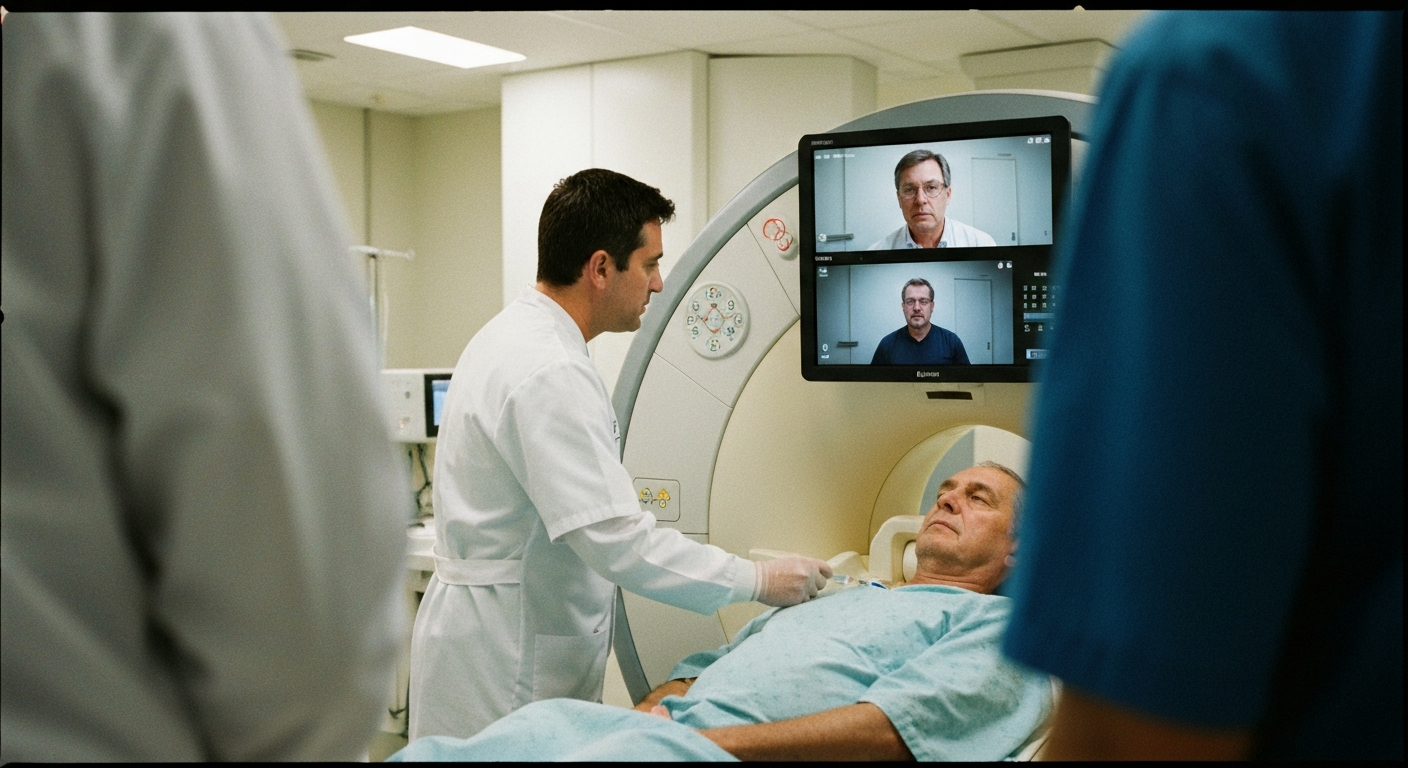
Remote contrast coverage—often called virtual direct supervision—lets radiologists watch over contrast dye injections from miles away. It runs on high-fidelity, two-way audio and video networks. Instead of a doctor sitting idle in a dark room down the hall just in case someone has an allergic reaction, modern hospitals are spinning up networked command centers.
When built right, these remote platforms plug directly into a hospital's data ecosystem. Of course, this type of oversight cannot be through a webcam bolted to a wall; it relies on two-way communication and, recently, software integration. Remote doctors get a live, zero-latency feed of the imaging suite right alongside the patient's complete EMR. Before authorizing an iodine or gadolinium push, EMR integration allows a physician to pull up fresh kidney function labs, active medication lists, and historical allergy profiles.
But hospitals cannot simply slap a tablet on a tripod and call it compliant. IT departments have to figure out what CMS and ACR (American College of Radiology) mandates, EMR requirements, and build infrastructure that prevent lethal clinical blind spots. If clinical directors can get the digital plumbing right, patients can get their scans on time, and safety is never compromised.
The federal rules governing who needs to be in the room when contrast dye is injected have finally caught up to the technology. Virtual models are now a permanent fixture, forcing hospital IT departments to rewire their EMR touchpoints to keep pace.
The Centers for Medicare & Medicaid Services (CMS) has officially made virtual direct supervision permanent for diagnostic tests, including contrast-enhanced CTs and MRIs. The rule demanding a doctor's physical presence in the imaging suite is now gone.
To legally count as "direct supervision" now, the overseeing doctor just needs to be instantly reachable via real-time video and audio. A standard phone call will not cut it. This permanent green light means hospitals can safely sink capital into virtual infrastructure knowing the government won't suddenly pull the plug on the policy. Virtual contrast workflows must reflect this new reality; scheduling dashboards now require direct, one-click communication APIs linking the remote doctor to the scanner room and the patient's EMR.
If a facility wants Medicare to pay out, it needs proof of supervision. CMS demands forensic-level documentation inside the EMR. When auditors come knocking, hospitals have to produce exact logs: the identity of the supervising physician, the precise millisecond the video feed started and stopped, and cryptographic proof that audiovisual tech was actively used.
Relying on tired technicians to type this out manually is a guaranteed way to fail an audit and trigger massive clawbacks. Integrated software fixes this by scraping and logging timestamps, connection metrics, and video data in the background. The EMR is configured with dedicated, unalterable fields specifically for virtual supervision, entirely removing the busywork from the clinical floor.
Injecting heavy metals and iodine into human bloodstreams carries a rare but real risk of anaphylaxis. Virtual supervision platforms must have a fail-safe, zero-latency panic button connecting the remote doctor to the technicians on the floor.
If a patient crashes, the remote radiologist issues instructions while the on-site crew may push epinephrine or other medications. Hospitals must map out these emergency response pathways and hardcode them into the EMR and supervision infrastructure. Regulators typically require all on-site staff to hold advanced life support certifications.
Jamming remote supervision platforms and legacy EMRs together cannot be a theoretical IT exercise because it changes hospital metrics. Besides, operational gains must be balanced with patient safety and well-being.
One study tracking the fusion of Picture Archiving and Communication Systems (PACS) with EMR platforms caught a massive drop in data retrieval times. Before the systems were linked, radiologists spent 52 seconds hunting through drop-down menus for a patient's latest clinical note. After the systems merged, that delay dropped to six seconds.
That kind of speed rewires how a radiologist operates. When the patient's history loads at the same time as their lung scan, doctors do not hesitate to check the context. The study showed EMR utilization by radiologists spiked from 36.7 to 44.9 percent. Shaving 46 seconds off every single read compounds fast. It allows doctors to burn through massive case queues without dropping their diagnostic guard.
Data integration physically alters testing patterns. Research looking at EMR data-sharing between primary care clinics and specialist hubs tracked a 39.6 percent plunge in ordered radiographies.
When doctors can actually see a patient's previous scans and notes from a different hospital, they stop ordering redundant tests. This software handshake cuts baseline healthcare costs, limits how much ambient radiation patients absorb, and clears out scheduling logjams. That same study found that the wait time to see a specialist dropped by over two weeks simply because the software finally allowed disparate clinics to talk to each other.
Virtual contrast administration providers suggest that such results may be replicable in imaging centers and hospitals, although results could vary based on patient load, center performance, and other factors.
Contrast injectors now communicate directly with the hospital's central servers. They log the exact volume, flow rate, and pressure of the contrast dye straight into the patient's chart via HL7 messaging. Techs no longer have to squint at a screen and manually type numbers into a medical record.
Automated data collection has the advantage of precision. By scraping the real-time injection metrics of thousands of scans, hospital directors can spot trends, optimize contrast protocols, and track allergic reactions across specific demographics. It yields a massive dataset that allows them to ensure that clinical guidelines are actually followed, rather than just written down in a binder.
You cannot run a compliant remote contrast program on a patched-together Zoom call. It requires hospital-ready, enterprise-grade hardware. Consumer tech will fail federal compliance checks and risk patient safety.
Virtual direct supervision eats bandwidth. Hospitals need dedicated, symmetrical fiber lines—pushing at least 25 to 50 Mbps—to handle zero-latency audio and 4K video feeds simultaneously. And they need physical redundancy; if the primary network drops during a scan, a backup cellular or secondary fiber line must instantly take over.
On the doctor's end, the hardware is just as rigid. Remote radiologists must read on 3-megapixel, FDA-cleared diagnostic monitors. They also require separate, dedicated screens exclusively for the EMR and the live video feed. A doctor should never have to minimize a life-or-death diagnostic image to check a patient's pulse.
The entire setup lives or dies on interoperability. The virtual platform must slot perfectly into the hospital's existing Radiology Information System (RIS) and PACS. That means relying on standard architectural protocols like DICOM and HL7 FHIR to translate the data.
Contrast orders bypass the general reading pile and route directly to the active remote doctor's specific screen. Any approval clicked or note typed by that remote doctor is instantly injected back into the hospital's central EMR. There is only one source of truth, and it updates across the entire network in real time.
There are not enough radiologists to go around. Smart deployment of remote coverage systems offers a structural hack to, in part, overcome this crippling bottleneck.
When a hospital cannot find a doctor to sit in the building, the scanners shut down. Remote contrast supervision severs the link between the doctor's physical location and the imaging suite. Clinical directors can tap into a national grid of available physicians.
Hospitals can pull coverage from doctors three time zones away to keep the machines running through the night. By letting experienced doctors take remote shifts from their home offices, hospitals fight off radiologist burnout and keep valuable experts in the workforce longer than ever before.
For massive health networks managing a dozen suburban imaging clinics, paying a radiologist to sit in every single building isn't viable. Virtual supervision lets one doctor cover multiple sites at once.
By funneling every contrast approval from six different clinics into one centralized dashboard, a single physician easily handles the surge of peak-hour case volumes. This setup is a lifeline for rural hospitals. Instead of scrambling to hire a local specialist who doesn't exist, they connect into the remote network or virtual contrast supervision platform, so that patients out in the counties still get access to the appropriate diagnostic technology.
Forcing decades-old EMR systems to play nicely with bleeding-edge video networks requires serious technical capability. Partnering with experts in remote contrast coverage integration gives IT departments the exact blueprints they need to execute these rollouts without crashing the system.
Turning on virtual direct supervision requires flawless data mapping, brute-force network architecture, and intense staff training. Hospitals have to fix their workflows to catch every single data point the CMS demands for an audit.
By locking EMR integration together with high-fidelity video feeds, hospitals flip a regulatory burden into an operational advantage. It clears out the administrative junk, squeezes more productivity out of every doctor and radiology tech, and builds an audit-proof safety net around contrast administration.


