For golfers losing 20-40 yards off the tee because of a persistent slice, the problem might not be their swing—it could be the driver’s face angle. But specialist mechanically designed clubs could fix the issue.
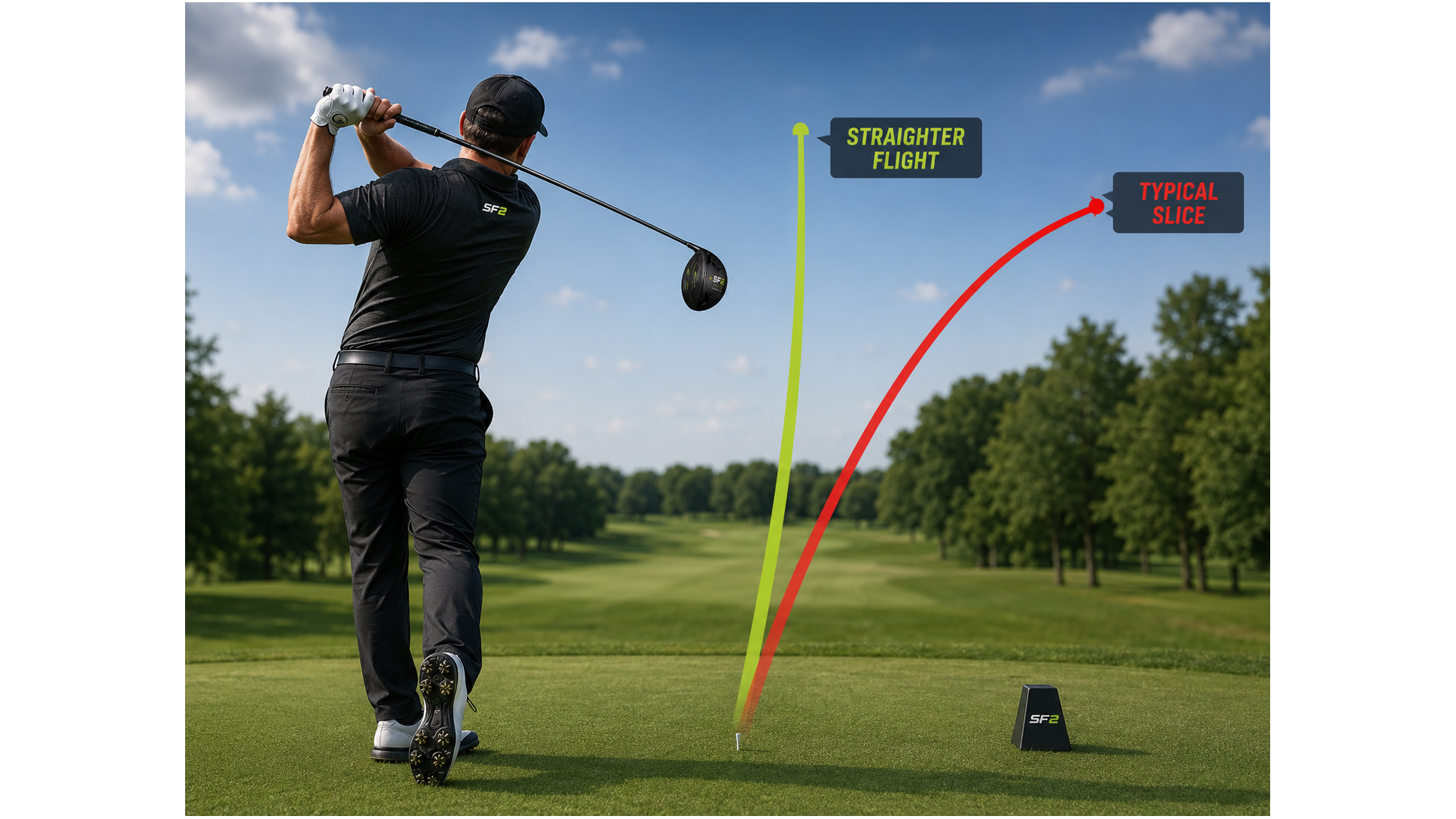
Golf slices plague roughly 70% of amateur golfers, stealing distance and accuracy from every round. Understanding exactly how slice-correction technology works helps golfers make informed equipment decisions that can transform their games. But is there a club that can fix the slice?
A golf slice occurs when the clubface remains open relative to the swing path at impact, imparting left-to-right sidespin on the ball. The Performance Golf SF2 Driver attacks this fundamental problem with a 3-degree closed face angle - meaning the clubface points slightly left of the target at address position.
Most standard drivers feature either a square face or even a 1-degree open face angle. The SF2's closed face provides a mechanical head start toward squaring the clubface at impact. Even when golfers arrive at the hitting zone with their typical open-face position, the net result moves closer to square contact.
This built-in offset works independently of swing changes. For golfers struggling with consistent hand release through impact, the closed face compensates for incomplete clubface rotation. Testing data shows how the SF2's mechanics address common slice causes. The closed face essentially gives slicers a 3-degree forgiveness buffer before their swing even begins.
The SF2 positions weight deep in the heel section of the clubhead, fundamentally altering how the driver behaves through impact. This heel-side center of gravity placement encourages the clubhead to rotate closed more aggressively during the downswing.
When weight sits in the heel, physics naturally assists the squaring motion that golfers' hands should produce. For recreational players whose hand release remains inconsistent, heel weighting picks up the slack. The clubhead wants to close, reducing reliance on perfect timing and technique.
Traditional driver designs often place weight toward the back or center of the clubhead for forgiveness. The SF2 sacrifices some moment of inertia to prioritize slice correction, making heel weighting the dominant design characteristic.
Standard driver faces feature curved bulge designed to correct off-center hits through gear effect. When golfers strike the toe, the bulge imparts corrective spin to push the ball left, compensating for gear effect that naturally moves it right. The SF2 modifies this relationship specifically for slice-prone golfers.
The driver flattens the bulge curvature in the heel area where slicers typically make contact. This flatter heel face reduces the corrective spin that would normally fight against the other anti-slice features. Instead of working against slice correction, the modified bulge supports it.
Heel strikes on traditional drivers often worsen slice spin through gear effect. The SF2's draw-calibrated bulge eliminates this problem, ensuring that heel contact doesn't compound slicing tendencies.
The SF2 features a fixed 12-degree loft - significantly higher than the 9-10.5 degrees most amateur golfers gravitate toward. This increased loft serves multiple slice-correction purposes beyond simple trajectory adjustment.
Higher loft reduces the effective loft loss that occurs when golfers present an open clubface at impact. Slicers typically lose effective loft due to their swing characteristics. The SF2's 12-degree starting point ensures adequate launch angle even with these swing tendencies.
The fixed loft eliminates adjustability, forcing golfers to work with the driver's intended specifications rather than chasing lower lofts that exacerbate slice problems. This constraint actually benefits most slicers who typically choose insufficient loft for their swing speeds and attack angles.
Severe slice ball flights sacrifice carry distance because the ball travels at an angle rather than straight toward the target. A drive that starts 30 yards left of target and curves 50 yards right isn't achieving its full forward distance potential.
Sidespin creates additional aerodynamic drag, reducing both carry distance and roll. Balls with heavy right-to-right spin also tend to land at steeper angles, minimizing ground coverage after touchdown. The cumulative effect often costs slicers 20-40 yards of total distance per drive.
While the SF2's primary distance benefit comes from eliminating sidespin and recovering lost yardage, the manufacturer also claims the driver's thin, fast face contributes to increased ball speed. However, the most significant gains come from redirecting existing energy into straighter ball flight rather than generating additional velocity. This distinction matters when evaluating realistic performance expectations.
For a golfer with 90 mph swing speed who previously sliced most drives, potential improvements include moving from 180 yards effective carry to 200-215 yards straight or drawing ball flight. While significant distance recovery is expected for many golfers, individual results can vary. Some users report shorter carry distances than their previous driver despite achieving straighter shots.
The SF2's distance benefits plateau once slice correction is achieved. Golfers shouldn't expect continued distance increases beyond straightening their ball flight. Raw ball speed improvements require swing speed increases or more advanced face technology.
Marketing claims often blur the distinction between recovered distance and generated distance. Understanding this difference helps set appropriate expectations and evaluate whether slice correction addresses individual distance goals.
The Ping G430 SFT offers a different approach to slice correction through adjustable heel weighting and variable settings. The G430 features a 22-gram tungsten weight positioned near the heel, with Draw and Draw+ settings providing varying levels of right-to-left correction.
Where the SF2 provides fixed, aggressive slice correction, the G430 SFT allows golfers to dial in their preferred amount of draw bias. The Ping also includes loft and lie adjustability, making it suitable for golfers whose needs may evolve over time.
The SF2's approach is more specialized and intensive. Its 3-degree closed face creates more dramatic visual feedback at address, while the G430 SFT maintains a more neutral appearance. For golfers requiring maximum slice correction without adjustment complexity, the SF2 delivers more aggressive intervention. Those wanting flexibility and gradual correction might prefer the G430's adjustability.
Skilled golfers who play a controlled fade will find the SF2's anti-slice features disruptive to their shot shaping. The 3-degree closed face and heel weighting will fight against intentional fade ball flights, potentially creating hooks or pulls.
Single-digit handicappers typically possess the hand-eye coordination and swing consistency to manage clubface position without equipment intervention. The SF2's aggressive slice correction becomes counterproductive for golfers who don't need it.
Better players, however, benefit more from adjustable drivers that allow fine-tuning rather than fixed correction. The SF2's lack of adjustability limits shot-making versatility that skilled golfers expect from their equipment.
Players who already hit consistent draws or hooks should avoid the SF2 entirely. Adding anti-slice features to a swing that naturally closes the clubface will exaggerate right-to-left ball flight into uncontrollable hooks.
The SF2's heel weighting and closed face will amplify existing draw tendencies rather than correct them. Golfers hitting draws typically need neutral or fade-biased equipment to balance their ball flight.
Draw players often benefit from toe weighting and open face angles to encourage straighter ball flights. The SF2 moves in the opposite direction, making it unsuitable for this swing type.
Golfers who prefer to experiment with loft, lie, and weighting adjustments will find the SF2 limiting. The fixed hosel and weight distribution prevent customization that many modern drivers provide.
Players working with instructors on swing changes need adjustable equipment that can evolve with their technique. The SF2's fixed specifications may become inappropriate as swing improvements occur.
Course conditions, weather variations, and personal preferences often require equipment adjustments throughout the season. The SF2's lack of adjustability makes it less versatile for golfers who value customization options.
The Performance Golf SF2 Driver succeeds in its specific mission: providing aggressive, mechanical slice correction for recreational golfers. The combination of closed face angle, heel weighting, and modified bulge creates genuine ball flight changes for the target audience.
Distance gains occur through slice elimination rather than speed increases, which represents real value for golfers losing significant yardage to sidespin. The 20-40 yard improvements many users experience come from recovering distance that poor ball flight was stealing.
The driver's limitations - lack of adjustability, aggressive correction features, and specialized design - make it unsuitable for skilled players or those with neutral ball flights. However, for mid-to-high handicappers struggling with consistent slicing, the SF2 addresses their primary distance and accuracy challenges through proven mechanical solutions. The key is to ensure amateur golfers are selecting the best club for their swing.


