Most Texas pediatric practices are losing patients before the phone ever rings—because they’re invisible during the research phase when parents are actually making decisions. Here’s how families really choose pediatricians today, and why your traditional marketing approach is costing you thousands of potential patients.
When Texas families need pediatric care, their decision-making process begins long before they pick up the phone. Most pediatric practices focus their marketing efforts on the moment families are ready to call, completely missing the crucial research phase where the majority of parents are actively evaluating their options across multiple digital platforms.
The invisible research phase is costing Texas pediatric practices thousands of potential patients annually. While practices wait for referrals or rely on expensive pay-per-click advertising, families are spending hours researching pediatricians online. They're reading reviews, watching videos, and comparing practices across social media platforms before ever making contact.
Traditional pediatric marketing approaches fail because they target families who are already ready to choose a provider. By that point, families have typically narrowed their options to 2-3 practices based entirely on their online research. Practices that aren't visible during this research phase never make it onto the consideration list.
The shift in parent behavior is dramatic. In recent years, most families chose pediatricians through word-of-mouth recommendations from friends, family, or their obstetrician. Today's parents still value recommendations, but they verify every suggestion through extensive online research before scheduling appointments.
Social media platforms have become vital discovery channels for pediatric practices to build community trust and engage effectively with patients and their families. Parents frequently use Facebook groups, Instagram, and TikTok to seek advice, share experiences, and discover new healthcare providers for their children. ReachLocal Media recognizes this shift and helps Texas pediatric practices establish meaningful presence across these critical platforms where families are actively researching healthcare decisions.
Unlike traditional advertising, social media allows pediatric practices to demonstrate their expertise through educational content, behind-the-scenes glimpses of the practice, and responses to common parent concerns. Parents view social media content as more authentic and trustworthy than traditional advertisements, making it a crucial channel for building relationships before families ever visit the office.
Modern parents are increasingly turning to AI-powered health tools and educational content to understand their children's symptoms and treatment options. Platforms like ChatGPT, Google AI Overview, and health-focused AI assistants are being used for initial health information. Parents research questions like "when should I worry about my toddler's fever" or "signs my child needs to see a pediatrician" before deciding to schedule appointments.
Important Note: While these AI platforms are growing in popularity, parents should always verify health information with licensed healthcare professionals, as AI-generated health advice may contain inaccuracies that could be harmful.
This creates a significant opportunity for pediatric practices that publish educational content optimized for AI discovery. Practices that consistently answer common parent questions through blog posts, videos, and social content position themselves as trusted authorities when AI platforms recommend healthcare providers.
Local SEO remains critical for pediatricians, as the majority of their patient base comes from nearby geographic areas. Parents search for terms like "pediatrician near me in Plano" or "children's doctor in Fort Worth" when evaluating options. However, local search has expanded beyond Google to include social media platforms, review sites, and healthcare-specific directories.
The most successful pediatric practices appear consistently across all local search channels, not just Google Maps. This omnipresence creates a compound effect where families encounter the same practice name across multiple platforms, building familiarity and trust before the first appointment.
The MultiCasting method addresses the reality that different parents prefer different content formats. Some parents learn best from written articles, while others prefer videos or infographics. One pediatric topic—such as "Managing Your Child's First Fever"—can be transformed into a blog post, short-form video, podcast episode, infographic, slideshow, news article, social media posts, and longer educational video.
This approach maximizes the impact of each piece of content while accommodating different parent learning preferences. Engaging content formats such as videos, infographics, and interactive posts are highly effective for explaining common pediatric issues and increasing follower engagement on social media platforms.
Multi-channel distribution strategies generate 300% more leads and deliver 4.9x sales boost compared to single-channel approaches. For pediatric practices, this means publishing content across search engines, social media platforms, video channels, podcast directories, and healthcare-specific sites where parents research children's health information.
Strategic distribution ensures pediatric content reaches parents regardless of where they begin their research process. A parent searching on Google, browsing Facebook groups, watching YouTube videos, or asking AI assistants about pediatric concerns will encounter the same practice's helpful content across multiple touchpoints.
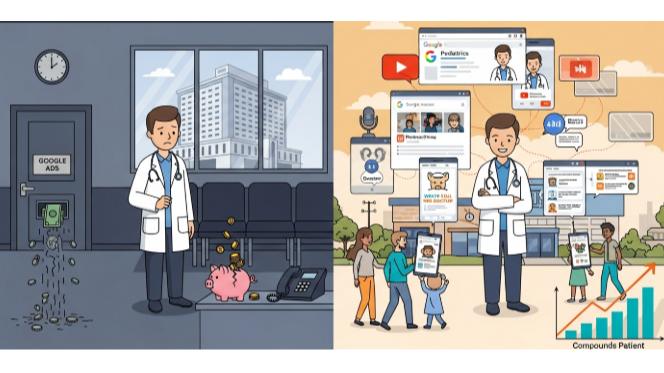
Traditional pediatric practice advertising relies on "rented visibility" through pay-per-click ads that disappear the moment advertising budgets stop. Content marketing builds "owned visibility" that compounds over time. A well-written article about childhood vaccinations published today will continue attracting families for years, unlike an ad that stops working when payments cease.
The return on content spend (ROCS) for pediatric practices typically ranges from 5-9x over time, compared to traditional advertising return on ad spend (ROAS) of 1-3x. Content becomes a practice asset that appreciates in value as it builds search rankings, social media followers, and brand recognition among local families.
Parents want to know who will be caring for their children before they visit a practice. Content highlighting physician credentials, specialized training, years of experience, and practice philosophy helps build trust and credibility. This includes information about the practice's approach to common pediatric issues, office policies, and what parents can expect during visits.
Team-focused content performs particularly well on social media, where parents appreciate seeing the faces and personalities of healthcare providers who might treat their children. Behind-the-scenes content showing normal practice operations helps humanize the healthcare experience for anxious parents and children.
Educational content addressing common pediatric health concerns serves as the foundation of effective content marketing for pediatric practices. Parents actively search for information about topics like developmental milestones, nutrition guidelines, sleep challenges, behavioral concerns, and when to seek medical attention for various symptoms.
Digital marketing strategies emphasizing educational content are vital for improving patient engagement and retention within pediatric practices. Parents who find helpful information from a practice before they need services are more likely to choose that practice when healthcare needs arise.
Trust-building content goes beyond medical expertise to address the emotional aspects of pediatric care. Parents want to know their chosen practice understands the challenges of parenting and will provide compassionate care during stressful moments. Content that acknowledges parent concerns, celebrates childhood milestones, and shares encouraging messages helps build emotional connections with families.
A strong online presence characterized by positive reviews and helpful content is fundamental for building trust and credibility for pediatric clinics among prospective families. Engaging, relatable posts create opportunities for parents to share experiences and build community around the practice.
Traditional pediatric practice advertising follows a linear model: spend money, generate leads, stop spending, leads disappear. Content marketing follows an exponential model where early investments compound over time. A pediatric practice that publishes consistent educational content builds search rankings, social media followers, and brand recognition that continues growing even during months when no new content is published.
The mathematical difference is significant. Traditional advertising might generate a 2x return on investment, meaning $5,000 in advertising generates $10,000 in revenue. Content marketing can deliver 10x, 20x, or even higher returns over time as content continues attracting families months or years after publication. Content that initially cost $500 to create might generate tens of thousands in practice revenue over its lifetime.
Artificial intelligence is increasingly influencing how families discover pediatric practices. AI-powered search results, recommendation engines, and health information platforms rely on extensive online content to evaluate and recommend healthcare providers. Practices with substantial educational content libraries have significant advantages in AI-driven search results.
Local search dominance requires consistent presence across multiple platforms where families research pediatric care. Google Maps rankings improve when practices have strong online presence across websites, social media, review platforms, and healthcare directories. This omnipresence signals to search algorithms that the practice is established, trustworthy, and actively serving the local community.
ReachLocal Media's specialized approach to healthcare content marketing aims to generate documented results for medical practices across Texas. The MultiCasting methodology transforms single pediatric topics into content campaigns that reach families across all research channels. Unlike traditional advertising agencies that focus on immediate lead generation, ReachLocal Media builds long-term visibility that compounds over time.
The agency offers an exclusive county-based approach that aims to ensure pediatric practices receive focused attention without competing against other practices in their service area. This territorial exclusivity allows for concentrated effort on dominating local search results and building strong community presence for each client practice.
Measurement and accountability remain central to ReachLocal Media's approach. Pediatric practices receive detailed reporting showing content distribution across platforms, search ranking improvements, and website traffic growth. The focus on measurable outcomes helps practices track return on investment and make informed decisions about their marketing strategies.
For Texas pediatric practices ready to build owned visibility that compounds over time rather than relying on expensive advertising that disappears when budgets stop, ReachLocal Media provides content marketing solutions that position practices as trusted authorities in their communities.


