Most mortgage brokers wait until October to prepare for Q4. By then it’s too late. There’s a 90-day window starting in July that separates brokers with full pipelines from those scrambling — and it comes down to how AI search decides who to recommend.
The 90-Day Mortgage Broker Playbook: Why Summer Is the Only Window That Sets Up Q4
Key Takeaways
Summer is not a slow season — it's the best window of the year to build digital marketing infrastructure without the pressure of peak-season production demands.
Q4 is the most critical sales period for mortgage brokers, making early preparation non-negotiable, not optional.
AI search authority — the kind that gets your name recommended by ChatGPT, Google, and other AI platforms — requires consistent signal-building over roughly 90 days before initial progress becomes visible, with meaningful inbound leads typically developing over a 3- to 6-month horizon.
A structured, month-by-month approach to local SEO, reviews, and online visibility during July through September creates a compounding advantage that competitors who wait until October simply cannot close in time.
Brokers who start building now can enter Q4 with an established pipeline — while those who wait start Q4 from scratch.
Every year, two types of mortgage brokers exist by October. One has a full pipeline, consistent inbound leads, and a verified presence across every platform a potential client might search. The other is scrambling to rebuild the momentum they let slip in July. The difference between them was never talent or market conditions. It was what they chose to do with the 90 days most people write off as the slow season.
Start Building in July or Hand Q4 to a Competitor
The math here is uncomfortable but simple. Q4 — October through December — is one of the most high-stakes sales windows in the mortgage calendar. The peace dividend is building. Buyer confidence is returning. Homebuyers who deferred their decision are beginning to act. And those decisions almost always go to the loan officer who shows up first, looks most credible, and has the reviews to back it up.
The problem is that the digital infrastructure required to show up in that moment — a verified Google Business Profile, consistent directory listings, a track record of five-star reviews, local SEO authority, and visibility on AI search platforms like ChatGPT and Gemini — doesn't get built overnight. Establishing initial progress takes roughly 90 days of consistent signal-building, with meaningful inbound leads typically developing over a 3-to-6-month period. A broker who waits until September to start is, by definition, too late for Q4.
The brokers who own Q4 aren't working harder in October. They started building in July. Autonomous Growth works specifically with local US-based mortgage professionals to execute this kind of infrastructure build systematically, starting with a free gap analysis that maps exactly where a broker's digital presence stands today before a single dollar is committed.
Summer: A Strategic Window, Not a Slow Season
How Seasonal Slowdowns Create a Rare Infrastructure Opportunity
The summer slowdown is real. Purchase activity softens. Buyers take vacations. Decision-making slows. Activity across the industry dips. But that dip creates something that's genuinely rare in a broker's calendar: available time and reduced competitive noise.
Most brokers interpret that as permission to coast. The smarter interpretation is that it's the lowest-pressure window of the year to build something that will run in the background long after summer ends. There's no urgent pipeline to manage, no rate-drop frenzy, no Q4 fire drills. That breathing room is exactly what's needed to get a website optimized, a Google Business Profile verified, directory listings cleaned up, and a review generation system running on autopilot.
Marketing infrastructure, unlike a paid lead campaign, doesn't stop working when attention shifts back to production. It compounds. Every new review, every consistent citation across directories, every optimized local search signal stacks on top of the last — and the broker who built it in July walks into September with a running head start that's nearly impossible for a late-starting competitor to close.
Why Q4 Mortgage Demand Rewards Early Preparation
Q4 is not just a busy period for mortgage brokers — it's a fundamentally different kind of demand environment. Homebuyers who spent the summer on the sidelines begin to act. Rate watchers who were waiting for clarity make their move. Year-end financial decisions trigger refinance conversations. Families going through life changes — relocations, divorces, growing families, retirements — are actively searching for local professionals during this exact window.
That demand is high-intent. These are not people casually browsing. They're searching with urgency, comparing local options, reading reviews, and making calls. The mortgage broker who has spent the summer building local SEO authority, accumulating verified reviews, and optimizing for AI search platforms is the one who captures that traffic. The broker who hasn't done that work is invisible — regardless of how good they actually are.
Early preparation for Q4 isn't about working more. It's about being findable when the demand spike arrives. And the only way to be findable in October is to have built the signals that search algorithms and AI platforms trust — which requires the 90-day runway that summer provides.
Why AI Search Authority Requires a Running Start
Long-Term Signals vs. Short-Term Campaigns That Stop When You Do
Most mortgage brokers have experienced paid lead generation: buy a Zillow lead, work it hard, close or lose it. The return on that model is real but fragile. The moment budget runs out or attention shifts, the pipeline dries up. There's no residual. No compounding. Nothing built that continues to generate value after the campaign ends.
Local SEO and AI search authority work on entirely different logic. They're built on accumulated signals — review volume, listing consistency, on-site optimization, local citation authority — that search engines and AI platforms use to determine which mortgage professionals are genuinely trusted in a given area. Those signals take time to build, but once built, they don't stop when the budget does. A broker with strong AI search authority continues to receive inbound inquiries from borrowers who found them through ChatGPT, Google's AI overviews, or a near-me search — without the ongoing lead spend required to make it happen.
The catch is that those signals don't appear overnight. Ninety days is a realistic timeframe to establish initial authority in a local market, with consistent lead generation typically maturing over 3 to 6 months — which is exactly why summer is the only window that makes this possible in time for Q4.
The Compounding Advantage Brokers Build Before Competitors Wake Up
There's a compounding dynamic at play that most mortgage brokers underestimate. Every week that a review generation system runs, the trust score grows. Every month that local SEO signals accumulate, the Google Map Pack ranking improves. Every piece of content optimized for Generative Engine Optimization (GEO) — the emerging practice of making a business recommendable by AI platforms like ChatGPT, Claude, and Gemini — makes that broker slightly more visible than the week before.
By the time a competitor who waited until October tries to start building, the broker who started in July has three months of compounded authority they can't replicate quickly. That gap doesn't just affect Q4 — it carries into the following year. The infrastructure built in the summer becomes the foundation that next spring's purchase season is built on, too. It's not a one-quarter advantage. It's a structural lead that keeps paying forward.
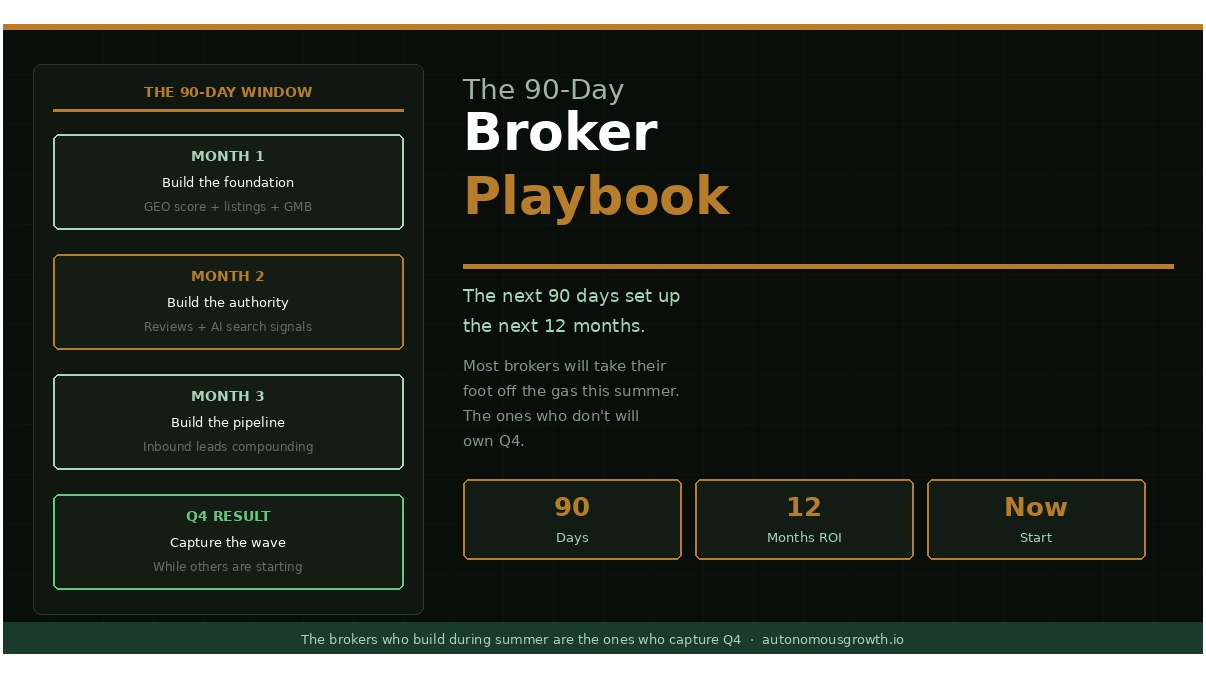
The 90-Day Playbook, Month by Month
Month 1 — Foundation: Website, Google Business Profile & Directory Listings
The first month is about establishing the fundamental digital presence that everything else builds on. Without a clean, optimized foundation, no amount of review generation or SEO effort will compound correctly — because the signals have nowhere credible to point.
In practical terms, that means a professional, mobile-optimized website built to convert visitors into inbound calls and form submissions — not just an online business card. A verified Google Business Profile, fully optimized with accurate categories, service areas, hours, and photos — the single highest-leverage asset for appearing in Google's Map Pack. And consistent directory listings across 40+ platforms with name, address, phone number, and website all matching exactly. Inconsistencies across directories are one of the most common and most damaging factors suppressing local search visibility for mortgage brokers.
A gap analysis completed before this work begins identifies exactly which of these elements are missing or broken in the current digital presence — so no effort goes toward fixing things that aren't actually the problem.
Month 2 — Authority: Local SEO, AI Search Optimization & Automated Reviews
With the foundation in place, month two shifts to building the authority signals that search engines and AI platforms use to determine trust and relevance. This is where the compounding dynamic begins.
Local SEO — targeting the specific near-me search terms that high-intent borrowers use, from "mortgage broker near me" to "VA loan specialist in[city]" — gets activated and optimized based on the competitor intelligence gathered in month one. The goal is to identify the gaps competitors have left open and move into those positions before they do.
Generative Engine Optimization (GEO) is the emerging discipline of ensuring that AI platforms like ChatGPT, Claude, and Gemini recommend a specific mortgage professional when users ask conversational questions about local brokers. Optimizing for GEO now — while most competitors haven't heard of it — creates an early-mover advantage that will be significantly harder to establish once the practice becomes mainstream.
Automated review generation also launches in month two. Every closed loan becomes an opportunity to capture a verified five-star review — consistently, without manual follow-up. Review velocity and recency are among the strongest signals in local search ranking algorithms, and an automated system means the broker never has to think about it again.
Month 3 — Pipeline: Established Visibility & Consistent Inbound Leads
By month three — September — the compounding that started in July becomes visible in the form of early inbound leads. The foundation is built. The authority signals are accumulating. The review count is growing. And the broker's name is beginning to appear in the places potential borrowers actually look: Google's Map Pack, AI-generated search recommendations, and local directory results.
The pipeline entering Q4 isn't built from a last-minute lead purchase. It's built from three months of compounded digital authority — leads that arrive because the broker's presence is established, trusted, and visible across every platform a potential borrower might use to search. By the time Q4 demand peaks, the infrastructure is already running. The broker isn't setting up — they're capturing.
What Gets Built — Even Starting From Zero
Professional Website & Verified Google Business Profile
One of the most common objections to starting this process is the assumption that something needs to already exist. The reality is that the 90-day playbook is specifically designed to work from nothing — because many of the mortgage brokers who need it most are operating with an outdated website, an unclaimed Google Business Profile, and no consistent presence across local directories.
A professional website gets built from scratch — mobile-optimized, structured for local search, and designed to convert visitors into inbound calls. A Google Business Profile gets created, verified, and optimized using competitor intelligence that identifies exactly what the top-ranking brokers in the market are doing and where they've left gaps. Business listings get built across 40+ directories with consistent, accurate information that reinforces search authority from day one.
The broker owns everything that gets built. The website, the profile, the reviews, the authority — all of it belongs to the business permanently.
Optimizing for AI Platforms Like ChatGPT, Claude & Gemini
The way borrowers find local mortgage brokers is changing faster than most brokers realize. A growing share of high-intent local searches now happen through conversational AI platforms — someone asking ChatGPT who the best mortgage broker near them is and acting on the recommendation they receive. That shift is early but accelerating.
Generative Engine Optimization (GEO) is the practice of structuring a business's digital presence so that AI platforms can read, trust, and recommend it. Most mortgage brokers have done none of this — which means the broker who starts now gains an early-mover advantage that compounds on top of traditional local SEO gains. The businesses that dominate AI search recommendations in 2026 are the ones optimizing for it today.
Done-For-You: No Agency Overhead, No Manual Work
The appeal of a done-for-you model for busy mortgage brokers is straightforward: the work gets done without requiring the broker to become a digital marketing expert, manage an agency relationship, or spend hours every week on tasks that should be automated.
An AI system monitors and adjusts around the clock — processing signals and making optimizations at a pace no human team can match. Review requests go out automatically after every closing. Listings stay consistent. Local search signals keep building. Human oversight remains in the loop throughout — catching edge cases, making judgment calls, and ensuring the strategy stays aligned with the broker's actual goals.
The result is marketing infrastructure that runs continuously in the background while the broker focuses entirely on the work that actually requires their expertise: qualifying borrowers, structuring loans, and closing transactions.
Reviews and Local SEO Are the Leads That Actually Close
There's a meaningful difference between paid leads and leads generated through organic local search authority. Paid leads — Zillow, LendingTree, purchased lists — arrive cold. They require more nurturing, more follow-up, and more persuasion before a commitment is made. Organic leads — particularly those arriving through near-me searches and AI recommendations — are different in character. These are borrowers who searched, compared options, read reviews, and chose to reach out. The trust has already begun to form before the first conversation happens.
Reviews are a central part of that trust-building process. A borrower about to make the largest financial decision of their life reads reviews before calling a mortgage broker. A broker with a consistent stream of recent, verified five-star reviews doesn't just rank better in local search. They convert at a higher rate once a potential borrower lands on their profile.
Local SEO produces leads with a built-in qualification layer. Appearing in the Google Map Pack for searches like "mortgage broker in[city]" or "VA loan specialist near me" means the searcher is already local, already in-market, and already expressing intent. That's a fundamentally more valuable lead than one generated by interrupting someone with an ad.
Get Your Free Gap Analysis Before Your Competitors Do
The 90-day window is specific by design. July, August, and September are the months when building this kind of infrastructure is possible without the distraction of peak-season production demands. Once Q4 arrives, the time and attention required to set up a website, claim and verify listings, build review velocity, and optimize for AI search simply isn't available.
The brokers who use summer strategically don't just enter Q4 prepared. They enter Q4 with a compounding advantage that their competitors — those still trying to rebuild momentum after a slow summer — can't close in time.
A gap analysis completed now shows exactly where that opportunity exists in a specific market — which competitors have weak review profiles, which search positions are uncontested, and what a realistic 12-month growth plan looks like given current conditions. It takes 5-10 minutes and costs nothing.
autonomousgrowth.io offers a free personalized gap analysis and 12-month marketing plan built specifically for US-based mortgage professionals ready to stop guessing and start compounding before Q4 arrives.
Start with one question: "How much monthly revenue do you want to add?"
? Currently available for US-based mortgage professionals and local service businesses only.


