A 5.0 tournament player just won using a $399 paddle that reviewers rated 10/10 for control—but here’s what most people miss about the price tag: the surface technology doesn’t wear out like traditional grit coatings that need replacing every few months.
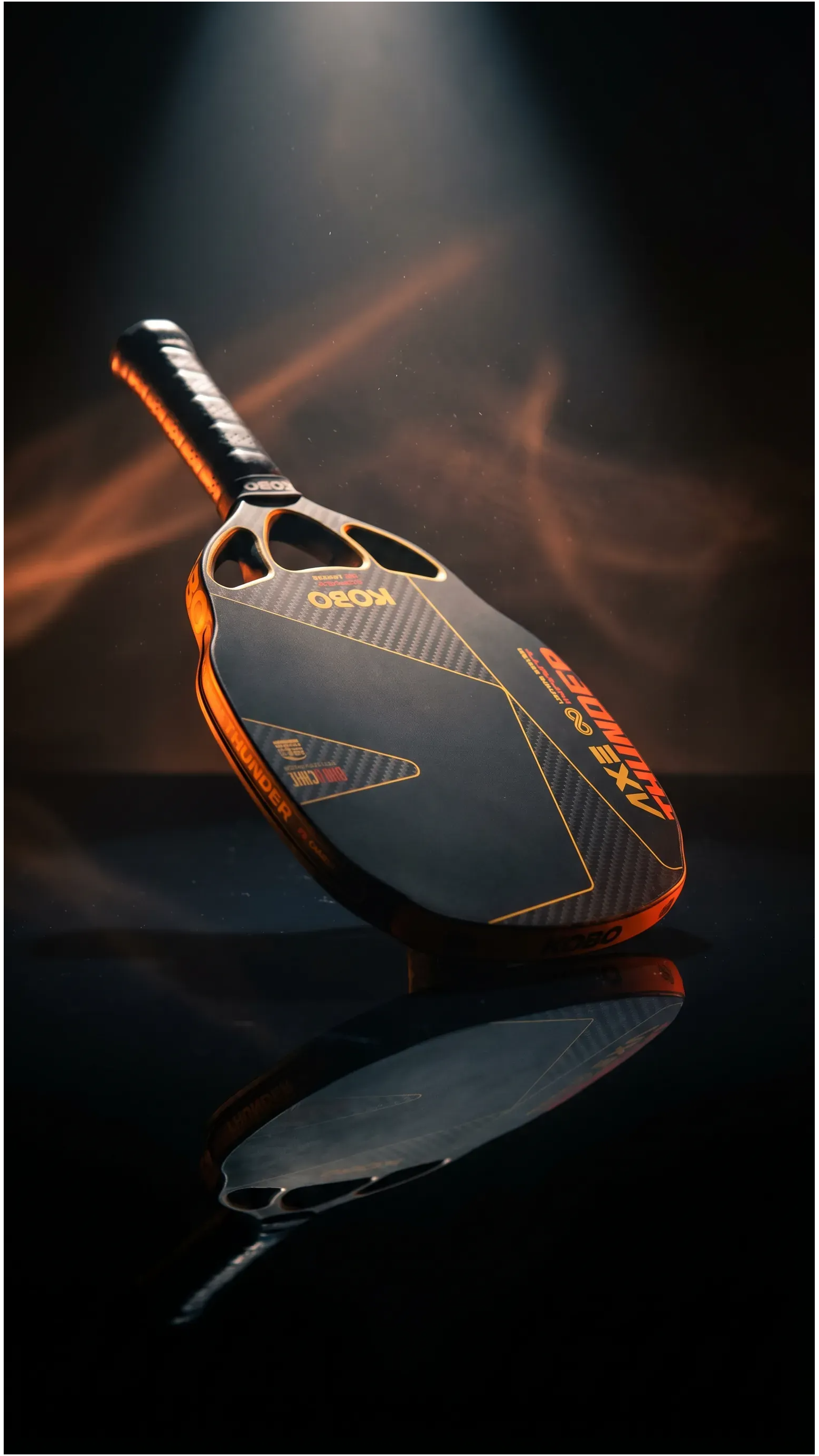
Every so often, a piece of gear shows up that splits a community right down the middle. The KOBO Thunder Axe is that paddle. Half the players who see it laugh at the price. The other half — the ones who've actually played with it — go quiet and start rethinking what they've been settling for. This breakdown looks at what the paddle actually does, what the tournament record says, and who it genuinely makes sense for.
Here's where the Thunder Axe conversation gets harder to dismiss. Taylor Gervais, a reviewer for Pickleheads, brought the KOBO Thunder Axe into a 5.0-level tournament — the highest tier of recreational competitive play — and won. That's not a marketing claim. That's a documented, independent result from a credible reviewer who went on record with one of the rarest ratings in pickleball gear coverage: 10 out of 10 for control.
Reviewer Kip clocked his serve at 50 mph straight out of the box and said the control was precise enough to "throw dimes out there on the court and just bounce the ball off top of the dimes." Verified player Randy L. put it plainly in his own words: "The topspin this paddle easily generates is second to none, period."
These aren't beginners chasing a shiny new toy. They're experienced, competitive players who are hard to impress — and they're all describing the same thing: a level of control and feel that genuinely changes how the game is played. That kind of consistency across independent sources is the starting point for understanding why this paddle costs what it costs. The full picture of the KOBO Thunder Axe starts with its construction — because the tournament results flow directly from the engineering underneath.
The Thunder Axe doesn't look like other paddles, and that's not an accident. Almost every design decision — the surface, the core, the shape — was made with a specific performance outcome in mind. Understanding the why behind each one makes the $399 price tag make a lot more sense.
Most premium pickleball paddles generate spin through a grit coating — essentially a sandpaper-like texture applied to the face. It works well at first. Then it wears smooth. After a few months of serious play, the spin you paid for quietly disappears, and suddenly a $300 paddle is performing like a $150 one.
The Thunder Axe takes a completely different approach. Its face is coated with SoftPlex™, a proprietary semi-transparent elastomer that players describe as feeling "like suede to touch." Rather than scraping the ball with grit, SoftPlex grips it — the same fundamental mechanism used in high-end table tennis rubbers. The result is spin that's not only impressive out of the box but doesn't degrade over time the way grit surfaces do, because there's no abrasive layer to wear smooth. The contact feel is notably different too: muted, pillowy, and connected — the kind of sensation that experienced players associate with precision rather than raw power.
Inside the Thunder Axe is a DuraCore center built by hand — carbon strips laid down individually, then fused into a single cohesive structure through a thermoforming process. The face, core, and perimeter become one unified piece, with no glued-on components that can rattle loose or create dead spots over time.
This unibody construction directly influences feel. Because the entire paddle is one solid structure, energy transfer on contact is more consistent across the face. The 18mm thick core — notably thicker than most competitors — plays a key role here, absorbing hard-driven shots effectively and making soft, controlled returns significantly easier to execute. Every paddle is individually serial-numbered, a reflection of the handcraft process and the limited production volumes that come with it.
Three more features define how the Thunder Axe plays in real-time exchanges. First, it's edgeless — no plastic guard around the rim. That keeps the weight centralized and eliminates one of the most common failure points on traditional paddles, though it does shrink the margin for off-center hits. Players call the clean sweet spot "dead red." Hit it flush there, and the response is exceptional. Catch the frame, and there's no guard to save the shot.
Second, the paddle comes in at right around 8 ounces, which surprises almost everyone who picks it up for the first time. Something that looks this aggressive should feel heavier than it does. Third — and visually the most distinctive feature — are the Triple Air Channels cut into the paddle's throat. These scooped-out sections reduce aerodynamic drag, keeping swing speed fast and hands quick during net firefights. The design looks unusual. In play, it makes a measurable difference.
Performance claims are easy to make. Independent tournament results are harder to fake. The Thunder Axe has both — and it's worth looking at what the reviewers who actually played competitive events with it had to say, in their own words.
Taylor Gervais at Pickleheads awarded the Thunder Axe a 10 out of 10 for control — a rating that rarely appears in serious gear reviews, where most paddles cluster between 7 and 9. After winning a 5.0 tournament with it, Gervais made a statement that goes well beyond a typical reviewer's enthusiasm: "I think this could be the future of pickleball paddles."
A 10/10 control score from someone playing at the highest recreational level isn't a marketing number — it's a competitive verdict.
Beyond the headline rating, the patterns in player feedback tell a consistent story. Verified players and reviewers describe the control as "insane,""ridiculous," and precise enough that one tester said it felt like "there's a tiny GPS hidden in the face." At the net — where pickleball games are actually won and lost in fast-hand exchanges — multiple testers noted that the Thunder Axe's combination of quick swing speed (thanks to the air channels) and muted, grippy contact feel allowed them to place the ball with a level of precision they hadn't experienced with other paddles.
What stands out across these accounts isn't any single superlative. It's the agreement — different players, different skill levels, different playing styles, all landing on the same word: control.
The KOBO Thunder Axe is USA Pickleball approved for sanctioned tournament play. USA Pickleball approval isn't a rubber stamp — it requires paddles to pass a rigorous independent evaluation by the Equipment Evaluation Committee, confirming that the paddle meets technical standards across dimensions, surface texture, deflection, and more.
For competitive players, this matters beyond the obvious reason. An approved paddle means the SoftPlex surface, the edgeless design, the 18mm core — all of it passed independent scrutiny. There's no asterisk. Players can bring the Thunder Axe into any USA Pickleball-sanctioned event without a second thought, which is exactly what Taylor Gervais did when he won his 5.0 tournament.
One of the clearest signs of a well-designed piece of gear is knowing its own limitations. The Thunder Axe has a specific player in mind — and the reviews are refreshingly honest about who falls outside that target.
The Thunder Axe was engineered for experienced, control-oriented players — typically 3.5 skill level and above — who've already developed consistency and want a paddle that raises their precision rather than compensates for loose fundamentals. At that level, the SoftPlex feel, the 18mm core's absorptive response, and the quick swing speed from the air channels all click into place in a way that makes competitive play measurably better.
That said, a few reviewers noted a genuinely surprising secondary use case. The paddle's forgiving core and controlled feel can actually help developing players build cleaner technique, since the feedback on off-center hits is honest rather than masked. So while the Thunder Axe isn't designed as a beginner's paddle, it isn't necessarily off-limits either — it just rewards players faster the more skill they bring to it.
If the baseline game plan involves hitting as hard as possible on every ball, the Thunder Axe is likely the wrong tool. Multiple reviewers flagged that out of the box, the paddle prioritizes control over raw pace — it's described as "oddly polite" by players expecting cannon-level power. Several testers addressed this by adding lead tape to the perimeter, which increased both pop and forgiveness on the edges. But that's a modification step, not a default setting.
The edgeless design compounds this. Power hitters who spray the ball around the face more than they'd like to admit will find the smaller sweet spot punishing. The Thunder Axe rewards clean, intentional ball-striking — and penalizes the kind of aggressive, loose swing that works just fine on more forgiving, edge-guarded paddles.
The sticker price is the first thing that sends half the room laughing. But the actual cost comparison depends on how the math gets run — and most skeptics are skipping a step.
A typical premium paddle in the $280-$350 range uses a grit surface that wears smooth within a few months of serious play. For a competitive player putting real sessions in, that can mean replacing a paddle two or three times a year. At those replacement rates, the annual spend on paddles runs anywhere from $560 to over $900 — and with each replacement, there's a break-in period, a readjustment phase, and a return to baseline.
The Thunder Axe's SoftPlex surface doesn't operate on that cycle. Because it grips rather than scrapes, there's no grit layer to wear smooth. The durability claim across independent reviewers is consistent: the spin performance holds. Run that against the cost of two or three dying grit paddles per year, and $399 for one paddle that maintains its surface begins to look less like a premium and more like a practical choice. The expensive paddle might actually be the cheap one.
There's a practical wrinkle worth knowing before deciding to circle back later. Because every Thunder Axe is built by hand — carbon strips laid individually, then thermoformed into a single structure and serial-numbered — KOBO can't produce them at the volume that mass-molded paddles get stamped out. They're made in limited runs. And those runs have sold out before.
This isn't manufactured scarcity. The handcraft process that justifies the price is the same reason inventory doesn't pile up in a warehouse. For players who decide this is the right paddle, assuming it'll be available whenever convenient is a gamble that previous buyers already lost.
Pull back and look at what the full picture adds up to. A hand-built, USA Pickleball-approved control paddle with a proprietary surface that doesn't wear out, an 18mm core that absorbs pace and enables precision, a swing-fast edgeless design, and a tournament record that includes a 5.0 win and a 10/10 control rating from credible, independent sources. For the player it's built for — competitive, control-oriented, tired of watching grit wear off expensive paddles — the Thunder Axe answers almost every question at once.
It's not a paddle for everyone. Power-first players who live on hard swings will find it frustrating until they adjust their game. Beginners spending $399 before they've developed consistency aren't ready for what the edgeless design demands. But for a 3.5+ player who's already hit a ceiling and suspects their gear is part of why — the Thunder Axe is a different kind of investment. Not a splurge. A reset.
The math on grit paddles that keep dying, the tournament results that keep stacking up, and the limited-run production that keeps selling out all point toward the same conclusion. Waiting doesn't make this decision easier — it just leaves fewer options on the table. See the full range of performance paddles and gear at KOBO Sports, where the focus is engineering over endorsements, and every paddle is built to compete.


