A $400 pickleball paddle just split the competitive community in half. Players at 3.5+ are winning tournaments and calling it the best control they’ve ever experienced, while skeptics point to cheaper alternatives. The engineering behind the controversy goes deeper than the price tag suggests.
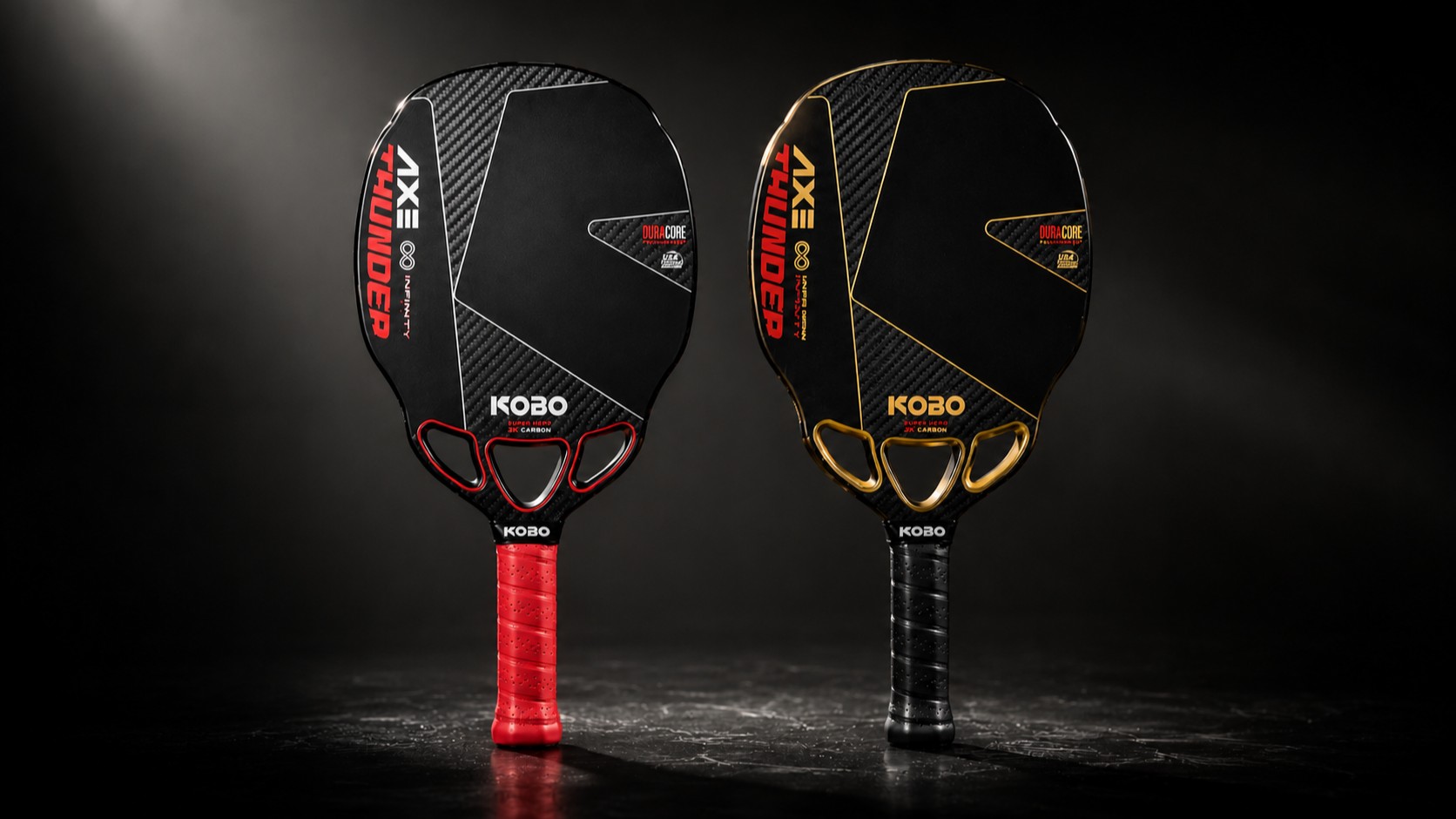
Walk onto any competitive court right now and mention a $40 pickleball paddle. Half the players will roll their eyes. The other half will lean in. That divide - sharp, loud, and genuinely unresolved - is exactly what makes the KOBO Thunder Axe one of the most talked-about pieces of gear in pickleball right now. It has no grit. No edge guard. And it plays unlike anything else at the kitchen line. So what is really going on with it?
Pickleball has grown up fast. Players who picked up a paddle three years ago are now grinding toward 4.0, drilling resets, and thinking seriously about their equipment. That maturation has triggered a real arms race in gear - and brands have responded with paddles pushing $250, $280, even $300 as the new normal for premium.
Into that market walked KOBO Sports, an Arizona-based company with a different philosophy: Engineering Over Endorsements. No pro sponsorships. No tour deals. Just product development. Their flagship paddle, the Thunder Axe, launched at $399 - above every comparable competitor - and immediately drew fire. "There are such good alternatives for much cheaper," one longtime player put it bluntly. When a JOOLA or CRBN runs $280 to $300, the math feels obvious to skeptics.
The Thunder Axe was officially approved by USA Pickleball on March 5, 2026, confirming it is fully legal for sanctioned tournament play. That single fact changed the conversation. This is not a novelty item. A full breakdown of how it performs - and who it performs for - is available at Pickleball Times, and what it reveals is more nuanced than either camp admits. The price tag is real. So is the performance data behind it.
Strip away the controversy and three engineering choices define this paddle. Each one is a deliberate departure from industry convention - and each one is responsible for both the paddle's devoted fans and its loudest critics.
Most paddles wrap a plastic edge guard around the rim to protect the frame and expand the usable hitting surface. The Thunder Axe has none. The decision is intentional - removing that guard keeps the paddle's weight distribution cleaner and eliminates a common point of failure where guards eventually separate from the frame and rattle. The result is a paddle that looks visually stripped-down compared to competitors, with distinctive scooped-out channels near the throat - described by more than one reviewer as resembling something off the wing of a fighter jet.
The face is equally unconventional. Where virtually every performance paddle on the market uses a sprayed-on grit texture to generate spin, the Thunder Axe uses none. No sandpaper surface. No rough coating. The spin comes entirely from the SoftPlex system underneath - which works on a completely different physical principle. That choice is the single biggest reason experienced players either love this paddle or cannot understand it.
SoftPlex is KOBO's proprietary surface material - a semi-transparent, rubber-like coating that reviewers consistently describe as feeling like suede to touch. Rather than abrading the ball the way grit does, it grips it. The physics are closer to a high-end table tennis rubber than anything found on a standard pickleball paddle face. When the ball contacts the surface flush, it bites and releases with a kind of controlled snap that players describe as bitey - generating topspin that reviewers say is measurably different from what grit produces.
The durability argument here is significant. Grit wears smooth. Every serious player has experienced a premium paddle that felt electric in week one and noticeably flatter by month three. Because SoftPlex works through grip rather than abrasion, the mechanism by which grit degrades simply does not apply. That is not a marketing claim - it is a different physical surface working a different way. Whether it holds up identically over the long haul depends on individual use, but the wear-failure mode that kills grit paddles is not present in the same form.
Inside the Thunder Axe is where the $399 price tag makes its clearest argument. Most paddles at even the premium tier are mass-produced: a core is cut, faces are glued on, edge guards are pressed into place. The Thunder Axe's DuraCore construction is hand-built - carbon fiber is laid down strip by strip and the entire structure is fused into a single integrated piece. No glued-on faces to delaminate. No separate core to rattle loose over time.
Every paddle is individually serial-numbered, and production runs are deliberately small because the handcraft process cannot be scaled the way injection molding can. Earlier batches sold out completely. That scarcity is not manufactured for hype - it is a direct consequence of how long it takes to build one correctly. The result, according to players who have compared this to conventional paddles, is a structural solidity you can feel the moment you pick it up. It does not sound hollow. It does not flex unevenly. It feels like a single piece of equipment, because that is exactly what it is.
Balanced coverage of the Thunder Axe has to acknowledge what the critics get right - because they do get some of it right. This paddle has real limitations, and for certain players, those limitations are disqualifying.
The absence of an edge guard narrows the forgiving zone. Players have started calling the optimal contact point dead red - hit it there and the feel is exceptional. Catch the ball off-center toward the frame and, in the blunt assessment of one reviewer, when you hit the frame it's just game over. That is not an exaggeration for effect. The edgeless design removes the slight buffer that a traditional guard provides at the rim, and off-center mishits are penalized more severely than on most paddles.
For players who are still developing shot consistency - anyone below 3.5, realistically - that lack of forgiveness will show up in their results before the control benefits do. Several testers also noted that the Thunder Axe feels relatively polite on power out of the box, prompting some to add small amounts of lead tape to the perimeter to open up the sweet spot and add pace. That is an easy modification, but it is an additional step that more forgiving paddles do not require.
This is the skeptics' strongest point, and it deserves a straight answer. Yes - players are winning tournaments, climbing ratings, and genuinely enjoying their game with paddles that cost $200 to $300. The question is not whether those paddles work. They do. The question is whether the Thunder Axe does something they do not, and for whom that difference matters enough to justify the gap.
For a 3.5 player who has maxed out the performance of their current paddle and is starting to notice that grit wear is costing them spin - or for a 4.0 player who has tried multiple premium options and still feels like the paddle is the ceiling - the gap closes considerably. For someone buying their first serious paddle, or someone whose game is not yet refined enough to exploit the control ceiling the Thunder Axe offers, the gap stays wide. The skeptics are not wrong about the number. They are arguing with the wrong buyer in mind.
Specs describe a paddle. Play tells you what it actually is. The Thunder Axe's on-court feel is consistently described in terms that do not map cleanly onto most carbon paddle experiences - which is either the product doing something genuinely new, or the product doing something that takes adjustment. In practice, it appears to be both.
The first thing players notice is the sound. Standard performance paddles crack - that sharp, hollow pop that carries across a rec center. The Thunder Axe, struck flush, makes what reviewers call a totally different sound... a nice little thud. The feel at contact is described consistently as pillowy, muted, and bitey - words associated with high-end table tennis paddles, not carbon pickleball gear.
That muted feel comes from the SoftPlex surface and the DuraCore construction working together. The ball does not bounce off a hard grit face - it briefly engages the surface, grips, and releases. Players who have used table tennis equipment at a competitive level recognize it immediately. For those coming purely from pickleball, it requires a short recalibration period. Once that adjustment happens, the control precision that becomes available is what reviewers struggle to describe without reaching for hyperbole - one tester compared the accuracy to having a tiny GPS hidden in the face.
The visual impression of the Thunder Axe is substantial - the long handle, the wide head, those aerodynamic throat channels. Players pick it up expecting weight. What they get is approximately 8 ounces of paddle that moves with a speed inconsistent with its appearance. As Taylor Gervais of Pickleheads put it: While this feels like an axe in your hand, the design makes it fly through the air.
Those fighter-jet channels in the throat are not decorative. They reduce air resistance through the swing, keeping hand speed high during fast exchanges at the net - which is where points at the 4.0+ level are increasingly won and lost. Players who have added lead tape to the perimeter, bringing it to around 8.2 oz, report that the additional mass opens up the sweet spot and adds pace without sacrificing that hand-speed advantage. It is a customizable baseline, not a fixed limitation.
Reviews and feel assessments are one kind of evidence. Tournament results are another. The Thunder Axe has accumulated enough of the latter to make the performance case difficult to dismiss.
Taylor Gervais, a reviewer for Pickleheads, won a 5.0-level tournament using the Thunder Axe and awarded it a rare 10/10 for control - a rating reserved for paddles that perform without qualification at the highest recreational tier. Gervais went further than most reviewers will: I think this could be the future of pickleball paddles. That is a statement made after tournament competition, not after a casual session in a driveway.
Kip, a reviewer for the Famous by Friday channel, clocked his serve at 50 mph straight from the box - before adding lead tape. After the modification, he described the control precision this way: throw dimes out there on the court and just bounce the ball off top of the dimes. Serve speed and placement precision are a combination that most paddles deliver one or the other of, not both. At the 4.0 and 5.0 level, that combination is what separates good paddles from great ones.
Randy Lawson, a 70-year-old coach, used the Thunder Axe to win Tournament Gold. His verdict is worth quoting in full because it cuts to why this paddle wins where it wins: This is by far the best paddle I have used yet to deliver that feel... The topspin this paddle easily generates is second to none, period.
What is notable about every one of these accounts is what the players share. None are beginners. None are easily impressed. All of them are describing the same experience from different angles - exceptional, almost counterintuitively precise control at competitive levels. For players who have plateaued with their current equipment and are quietly wondering whether their gear is part of the ceiling, these tournament results provide the most direct answer available.
The price conversation almost always stops at the sticker. Run the numbers forward and the picture changes substantially.
Every grit-based paddle - including the $280 to $300 options skeptics point to as proof the Thunder Axe is overpriced - creates spin through a rough surface that degrades with use. Serious players who drill daily and compete regularly know this timeline well: elite spin feel in the first month, noticeably reduced texture by month three, effectively a different paddle by month six. That is not a flaw in the construction - it is the nature of abrasive surfaces under repeated impact.
Replace a $300 paddle two or three times a year and the annual cost runs $600 to $900. The Thunder Axe, at $399 with a surface that works through grip rather than abrasion, offers a different cost model entirely. Whether SoftPlex maintains its grip properties indefinitely depends on individual usage and care - that is an honest caveat. But the specific degradation mode that kills grit paddles simply does not apply to a rubber-grip surface in the same way. For high-volume players, the math on the so-called expensive paddle deserves a second look before the conversation ends at the sticker price. KOBO also currently offers a discount code - ORG60 - that brings the Thunder Axe from $399 down to $339, narrowing the gap with competing options even further.
KOBO's stated philosophy - Engineering Over Endorsements - is easy to be cynical about. Every brand claims to prioritize performance. Most of them are also paying sponsorship deals to touring pros and folding that cost into the retail price. KOBO's position is that it does not. No paid partnerships. No sponsored players. The company puts it plainly: You're not paying for a logo or endorsements.
Whether that translates directly into the Thunder Axe's $399 price being lower than it would otherwise be is impossible to verify from the outside. What is verifiable: the paddle is hand-built in limited serial-numbered batches, uses a proprietary surface material not found on any comparable paddle, and carries USA Pickleball approval for tournament play. The construction is genuinely different - not a repositioned version of existing technology with a new name on it. That does not automatically validate the philosophy, but it does mean there is a real engineering story behind the claim. For buyers deciding between two paddles at similar price points, knowing that one of those prices includes a pro athlete endorsement deal and one does not is relevant information.
The honest recommendation is a narrow one, and that narrowness is actually the point. The Thunder Axe is not the right paddle for every player - and KOBO does not pretend otherwise. For beginners or players whose game is built on raw power and swinging from the baseline, the edgeless design will punish mishits before the control benefits have any chance to show up. The skeptics are correct about that player.
For a 3.5-and-climbing player who has already burned through two or three premium paddles, watched the spin wear off each one, and started to wonder whether the ceiling they have hit is a skill ceiling or an equipment ceiling - the Thunder Axe answers a different question than most paddles do. The contact is quieter, the grip-based spin does not degrade the same way grit does, and the control precision is something experienced players describe in terms reserved for the best equipment they have ever used.
The $399 price tag is real, the demands are real, and the forgiveness margin is narrower than more conventional options. But the tournament results are also real. For the right player, this is not an indulgence - it is the paddle that finally matches the level they have been working toward. Whether that player is you comes down to one question: have you already hit the ceiling on what a standard grit paddle can do for your game?
For players ready to see what KOBO's full lineup offers across different play styles and price points, KOBO Pickleball builds every paddle around a player-first engineering philosophy designed to help serious players actually improve their game.


