For years, digital dentistry has been fragmented — with simulations, design, and fabrication operating in separate worlds. SmileFy changes this by introducing the first fully integrated AI workflow that converts intraoral scans into clinical smile designs in minutes. No manual designing, no delays.
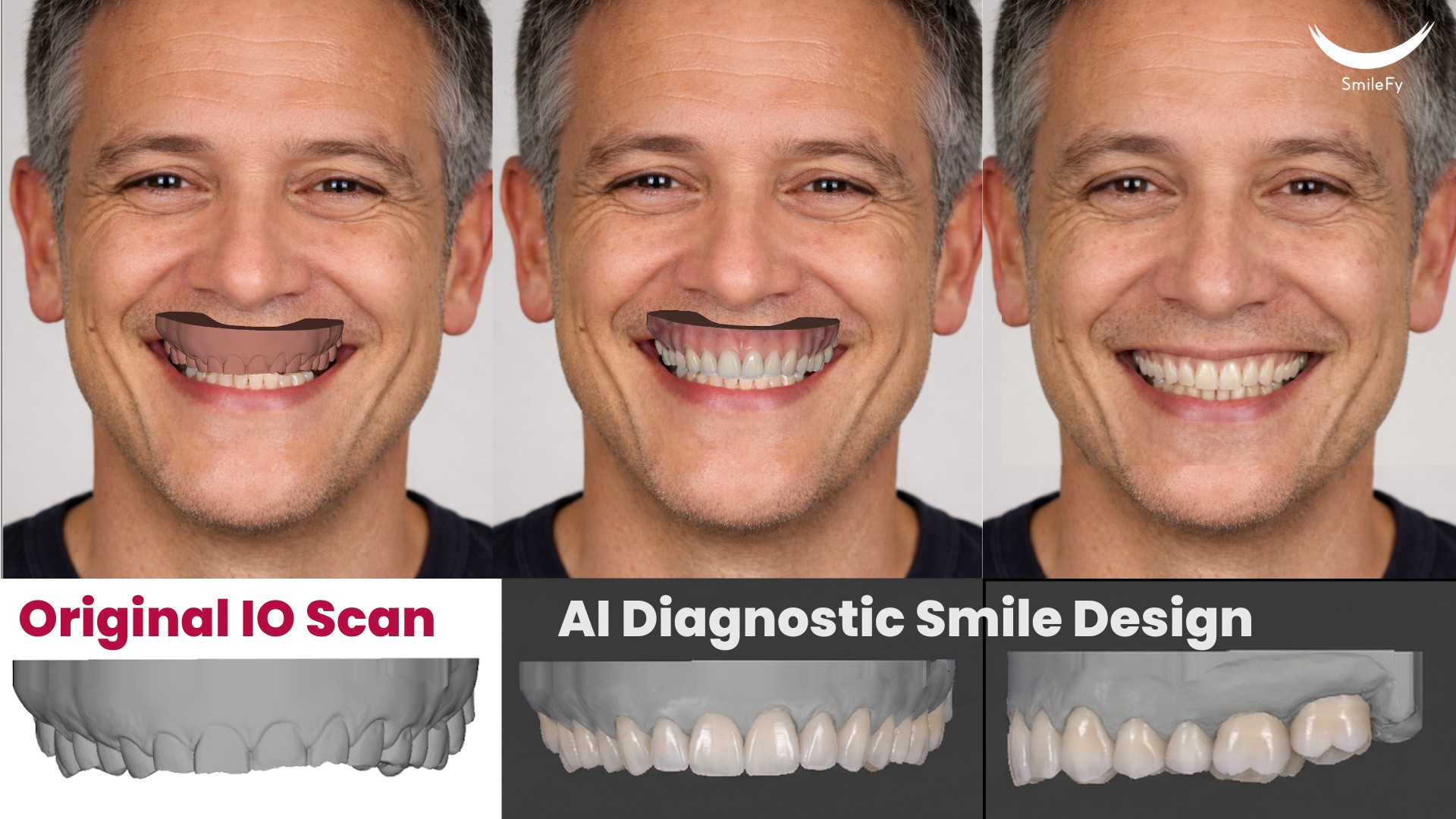
For years, the phrase “digital dentistry” has promised a seamless clinical journey: scan the patient, design the result, communicate it to the lab, and fabricate. It’s a compelling vision — and for most practices, it has remained exactly that. A vision. The scan gets taken. The design still requires a skilled technician, a separate software platform, hours of manual work, and days of back-and-forth before a clinically meaningful result lands back in the clinician’s hands.
The smile simulation the patient saw was built from a photograph. The restoration the lab fabricated was built from geometry. Nobody was quite sure how well the two would agree until the temporary went in.
That disconnect is now over.
SmileFy’s AI Diagnostic Smile Design is the first fully integrated workflow to take intraoral scan data as its primary input, run it through an AI engine trained on esthetic and restorative clinical parameters, and return — in minutes — a structured diagnostic report and a clinically grounded smile design ready to share with your dental laboratory or send directly to your 3D printer. No manual CAD. No design session booked for next week. No gap between what the patient was shown and what can actually be delivered.
This is not an incremental software update. It is a fundamental shift in where and how clinical intelligence enters the restorative workflow — and the timing could not be better aligned with where the profession is heading.
Why Now?
Intraoral scanners are already standard equipment in cosmetic and restorative practices globally. The hardware infrastructure for scan-based AI workflows is in place. What has been missing is the software intelligence layer that turns scan data into a clinical design output without manual intervention. That layer is now here.
The Problem With the Way Smile Design Has Always Worked
Ask any clinician who has invested seriously in esthetic dentistry about the friction points in their workflow, and the same answers appear. Smile design takes too long. The fort-and-back communication with the lab is time consuming. The provisional rarely fits exactly as visualised. And the whole process relies on the skill, availability, and aesthetic sensibility of whoever happens to be doing the design work that day.
The deeper structural problem is this: The simulation the patient is shown — however sophisticated, however beautifully rendered — is an approximation based on a flat photograph of their face. It tells the patient what a smile could look like. It cannot tell the clinician what that smile would require in terms of actual tooth preparation, actual gingival management, actual restorative volume.
That gap between the simulation and the clinical reality is the root cause of treatment plan revisions, lab remakes, patient disappointment, and the low conversion rates that plague esthetic consultations. The patient leaves excited about a smile they saw in a photograph. By the time the clinical reality is fully understood, three appointments have passed and the emotional momentum of that first consultation is long gone.
SmileFy was built specifically to close this gap; with AI Diagnostic Smile Design, that closure is now complete.
AI Diagnostic Smile Design: How SmileFy Does It Differently (https://smilefy.com/)
The foundational innovation in SmileFy’s AI Diagnostic Smile Design is deceptively simple: use the intraoral scan - not the photograph alone - as the analytical starting point.
An intraoral scan is a dimensionally accurate 3D record of the patient’s dentition, accurate to within microns. It contains every proportion, every angular relationship, every surface geometry that a clinical analysis of the esthetic situation requires. When the SmileFy AI, trained on esthetic and restorative parameters, is applied to that data, the outputs are not approximations, but clinical smile deisgn. SmileFy’s AI engine analyses the IO scan and automatically evaluates the full set of parameters that govern esthetic and functional outcomes, like:
The result of this analysis is a structured diagnostic report — a clinical document that describes the patient’s current esthetic situation with objective precision and defines the parameters the treatment design is constructed to address. This report visualize the treatment goal for the patients and goes to the laboratory. It goes to the specialist. It becomes the shared reference that aligns everyone involved in delivering the final result.
And then, from that same scan data, SmileFy AI generates the clinical smile design itself — a 3D design grounded in the patient’s actual anatomy, aligned with established esthetic principles including smile arc, golden proportion, tooth-to-gingival relationships, and facial symmetry. Not estimated. Not approximated. Designed from reality to deliver predictably.
The Clinical Workflow: Five Steps to a Diagnostic Smile Design
SmileFy’s AI Diagnostic workflow is engineered to integrate without friction into any existing digital practice. If you already take intraoral scans — which, if you are reading this, you almost certainly do — you are already most of the way there.
What the Science Says: The Study That Changes the Conversation
Adoption decisions for clinical technology should be driven by evidence. That evidence now exists, and it is unambiguous.
Published in Frontiers in Dental Medicine in early 2026 (https://www.frontiersin.org/journals/dental-medicine/articles/10.3389/fdmed.2026.1775373/abstract) — in the journal’s Reconstructive Dentistry section — a prospective comparative study by Nagi, Abou-Bakr, Hassanein, Ahmed, Hamza, and Aboheikal set out to answer the question directly: how does fully automated AI smile design compare with designs created by expert clinicians using gold-standard professional software?
The methodology was rigorous. Thirty-three patient cases were used to produce two smile designs each: one by the AI system, one by an expert prosthodontist using Exocad DentalCAD. All designs were evaluated by a blinded panel of 20 prosthodontists using the Dental Esthetic Screening Index (DESI) and a Visual Analog Scale (VAS). Patient-reported outcomes were captured through VAS responses and direct design preference comparisons. Time-to-completion was recorded for every case.
Finding One: Superior Esthetic Quality
AI-generated designs achieved significantly lower DESI scores compared with expert-generated designs (p < .001). In the DESI framework, lower scores represent fewer identified esthetic discrepancies — meaning the AI designs were assessed as esthetically superior by the specialist panel. VAS ratings were also higher for AI designs as evaluated by both the expert panel and patients (p < .001).
This matters because esthetic quality is ultimately what the patient is purchasing. A design tool that consistently outperforms expert manual design on validated esthetic scoring criteria is not a convenience feature. It is a clinical quality improvement.
Finding Two: Patient Preference at Nearly 70%
When patients were asked to choose between the AI design and the expert alternative, 69.7% preferred the AI outcome versus 30.3% for the expert design (p < .001). This is the finding that should command every esthetic clinician’s attention.
Patient preference is not a soft metric. It is the direct predictor of treatment acceptance, case conversion, and revenue. A design methodology that generates patient-preferred outcomes at nearly 70% has a measurable commercial impact on every esthetic consultation in which it is used. Higher preference rates mean higher acceptance rates. Higher acceptance rates mean more cases delivered, more patients transformed, and a stronger practice bottom line.
Finding Three: 51.46% Faster, With Greater Consistency
The AI workflow completed designs in a mean time of 30.82 ± 5.14 minutes. Expert clinicians using Exocad required an average of 63.48 ± 14.12 minutes — more than twice as long, and with nearly three times the variability in completion time. The AI process was 51.46% faster (p < .001).
The reduced variance deserves as much attention as the speed gain. A standard deviation of 5.14 minutes means you can schedule AI-driven smile design into your appointment book with confidence. A standard deviation of 14.12 minutes means that expert manual design is, by comparison, an unpredictable resource. In a practice where clinical time is the scarcest commodity, predictability is not a bonus — it is a prerequisite for operational efficiency.
“Fully automated AI smile designs demonstrated higher esthetic properties, patient-rated esthetic scores, and greater time efficiency compared with designs created by expert clinicians.”
— Nagi et al., Frontiers in Dental Medicine, 2026
Five Practice-Changing Benefits, Quantified
1. Speed: Recover Hours Every Week
The 51% time savings documented in the Frontiers study translate into tangible time savings for any practice and dental laboratory performing esthetic work. A design workflow that takes minutes instead of hours not only reduces the time spent on digital design but also decreases laboratory revision cycles, thanks to the improved dimensional accuracy of the designs and clear vision of treatment goals.
2. Quality: AI Consistency Versus Human Variability
The esthetic quality of a manually produced smile design varies with the skill and experience of whoever produces. AI eliminates this variable entirely. The same analytical model, applied to every case, every time, produces outputs governed by the same underlying clinical logic.
When the input is an intraoral scan rather than a photograph, the quality threshold rises even further. The AI measures tooth dimensions instead of estimating them. Proportional relationships, midline deviations, occlusal cant, and gingival asymmetries are quantified, documented, and incorporated into the design. The suggested design can then be adjusted as needed, ensuring that the final clinical decision remains fully in the hands of the clinician.
3. Laboratory Communication: End the Specification Gap
Remakes and revisions are expensive. They consume chair time, materials, and the trust patients place in the clinician. The most common root cause of laboratory remakes is not technical failure at the fabrication stage. It is inadequate treatment design specification at the preparation stage.
A technician working traditionally from an intra-oral scan and a verbal description makes interpretive decisions and assumptions. A technician working from a structured AI-generated analysis report and a dimensionally accurate clinical design makes none. The report defines the starting point. The design defines the target. The STL provides the geometry. For the first time, the laboratory communication package is as precise as the clinical record that underlies it.
SmileFy’s integrated collaboration module means this package reaches the laboratory directly from the platform — no email attachments, no version confusion, no scattered clarifications across multiple messages. The case moves forward with clear, structured communication — consistently, and for every case.
The Clinician’s Role in an AI-Augmented World
A question that surfaces in every conversation about AI in clinical dentistry deserves a direct answer: does this replace the clinician?
No, and here is why that answer matters beyond reassurance.
The clinical steps that AI cannot perform are the steps that define the quality of the outcome. The examination that identifies functional concerns the scan does not capture. The patient dialogue that contextualises the design proposal within the individual’s life, personality, and aesthetic preferences. The evaluation of the AI output against phonetic requirements, lip support needs, and occlusal function. The clinical execution of every preparation, restoration, and adjustment. These are not mechanical tasks. They are the irreducible core of clinical dentistry, and they remain entirely in the clinician’s domain.
What AI replaces is the mechanical task of manual design production — the hours spent placing, adjusting, and fine-tuning virtual teeth in a CAD environment. This is a skilled task, but it is not a clinical task. When AI performs it faster and more consistently, the clinician’s expertise is liberated for higher-value application. More time with the patient. More focus on treatment execution. More capacity for the complex cases that genuinely require clinical judgement at every stage.
The aspects of laboratory work that define true quality remain human-driven. Case planning in collaboration with the clinician. The interpretation of functional requirements beyond what data alone can convey. The refinement of morphology, texture, and characterization to achieve natural aesthetics. The craftsmanship required for complex restorations. These are not automated processes — they are the foundation of high-level laboratory work.
What AI replaces is the time-consuming, repetitive process of manual digital design construction — the hours spent building and adjusting designs. When AI performs this step faster and with greater consistency, it allows the laboratory team to shift focus toward higher-value contributions: precision finishing, customization, complex case execution, and scaling production without compromising quality.
The result is not replacement, but elevation — enabling laboratories to increase efficiency, improve consistency, and dedicate their expertise where it matters most.
SmileFy’s platform is built with this in mind. Every AI-generated design is fully editable within the software. Tooth shape, proportions, midlines, incisal edge positions, and gingival contours can all be adjusted. The AI delivers an optimised, evidence-based starting point. The clinician applies their expertise to produce the final, patient-specific result. The Frontiers study authors describe this precisely when they recommend AI as an auxiliary, time-efficient esthetic treatment planning tool for expert use.
“Dental professionals need solutions that are fast, predictable, and easy to implement. AI Diagnostic Smile Design gives clinics a tool that transforms the entire patient experience — from first consultation to final restoration.”
— Ralph Georg, Founder & CEO, SmileFy
Adoption Is Simpler Than You Think
The most common objection to new clinical technology is the one that never gets said out loud: this will require significant retraining, significant investment, and significant disruption to the workflows we have already built. For most new software categories, that concern is legitimate.
For SmileFy’s AI Diagnostic Smile Design, it is not.
The hardware requirement is an intraoral scanner you almost certainly already own and an internet connection. The AI processing runs server-side; no local computing upgrade is required and it runs on any device. SmileFy’s interface has been designed from its founding principle — to make advanced digital workflows accessible to every clinician, not just CAD experts — and the AI Diagnostic module inherits that design ethos. Weekly onboarding sessions and advanced training are included with every subscription. The learning curve that once required a multi-day hands-on course to overcome is now a guided workflow that most clinicians are comfortable with in their first session.
Smilefy provides an intelligent layer that connects scan data to clinical design without requiring hours of manual intervention and a specialist’s hand.vIt takes the most accurate record of your patient’s dentition — the intraoral scan — analyzes it against clinical parameters, and returns a comprehensive clinical report and clinical smile design with a level of speed and consistency no individual can match.
The loop is closed. The only remaining question is how long your practice will wait before stepping through it.
Request access or a live demo of SmileFy AI Diagnostic Smile Design:
www.smilefy.com


