If your tooth discolouration sits deep within the tooth structure rather than on the surface, traditional bleaching often can’t help. Some types of intrinsic stains respond differently than others, and knowing why makes all the difference.
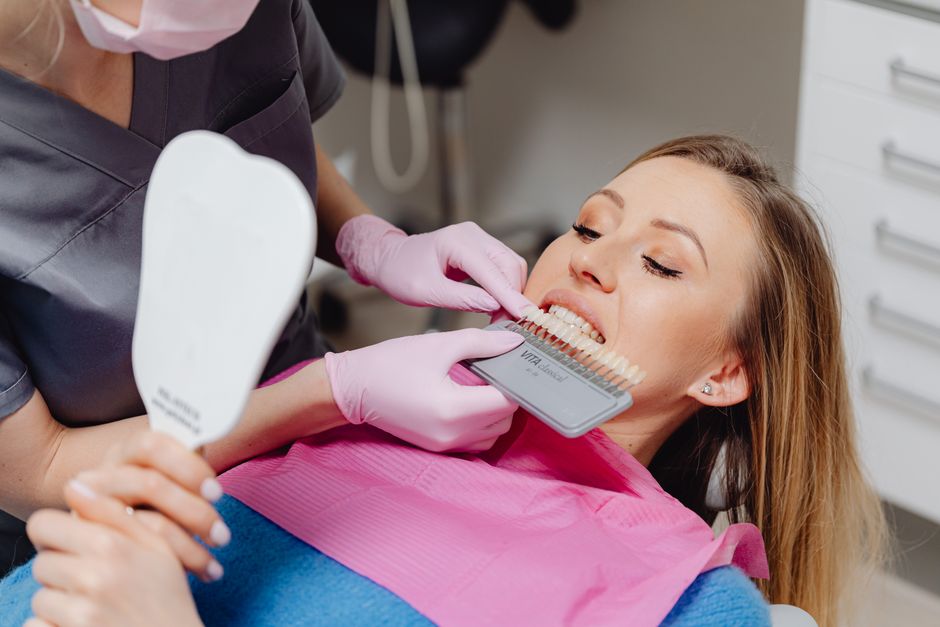
Teeth whitening is one of the most popular cosmetic dental treatments in the UK - and for good reason. For surface-level discolouration caused by coffee, red wine, or smoking, professional bleaching can produce a genuinely dramatic result. But for a significant number of people, the staining they're dealing with sits inside the tooth itself. In those cases, traditional bleaching is often insufficient to resolve the issue - and understanding why is the first step toward finding a treatment that actually works.
Tooth whitening works by using peroxide-based agents to break apart pigmented molecules on and near the tooth's surface. This approach is highly effective for extrinsic stains - the kind that build up on enamel from lifestyle habits. When discolouration originates within the tooth's deeper layers, however, surface bleaching doesn't reach far enough to make a real difference. The result is frustration: multiple whitening sessions with little to no visible improvement.
This distinction often gets overlooked in online guides and high-street whitening kits.
Intrinsic stains develop within the dentine - the dense layer beneath the enamel - or become incorporated into the tooth's structure during development. Because they exist at a deeper level than surface stains, external bleaching agents, while able to penetrate, often struggle to make a meaningful difference for moderate to severe intrinsic stains. That's not a flaw in the bleaching process; it's the wrong tool for the job.
The most frequently seen causes of intrinsic staining include:
Professional whitening - including higher-concentration in-chair treatments and custom tray-based home bleaching - can sometimes improve mild intrinsic staining, particularly age-related yellowing that involves both the enamel and dentine. These deep bleaching protocols use stronger peroxide concentrations over longer treatment periods, but they still rely on the agent diffusing through enamel into dentine. For moderate to severe intrinsic stains, this diffusion is rarely sufficient.
Not all intrinsic stains respond equally, and the colour of the discolouration is one of the clearest indicators of how well bleaching will work. Yellow-brown staining, common with mild fluorosis or age-related changes, tends to show the best response to professional whitening. Blue-grey banding - the hallmark of tetracycline staining - is widely considered the most resistant. Even prolonged bleaching protocols show limited results for tetracycline cases, which is why alternative treatments are typically recommended from the outset.
There is one scenario where bleaching can tackle an intrinsic stain: when a tooth has been root-treated (rendered non-vital) and has subsequently darkened. In this case, a dentist can place a bleaching agent directly inside the tooth's pulp chamber - a technique known as internal or walking bleach. The agent works from the inside out over several days. This is a specialist procedure and is only appropriate for non-vital teeth. It offers no benefit for the vast majority of people with intrinsic staining caused by fluorosis, tetracycline, or developmental factors.
Arnold Dental & Implant Centre, a cosmetic dental practice based in Nottingham, explains that porcelain veneers are widely regarded as one of the most effective long-term solutions for intrinsic tooth discolouration. These custom-made, ultra-thin shells are bonded to the front surface of the tooth, fully concealing the underlying stain regardless of how deep it sits or what caused it.
Porcelain is inherently stain-resistant, meaning everyday exposure to coffee, tea, and red wine won't darken them the way natural enamel can be affected over time. In terms of longevity, studies indicate that porcelain veneers can remain functional for 10 to 15 years, with some lasting up to 20 years or more when maintained with good oral hygiene. One study found that up to 95% of porcelain veneers remain functional after 10 years. High-quality porcelain also mimics the translucency of natural enamel closely, making the cosmetic result difficult to distinguish from natural teeth.
One underappreciated advantage of veneers is their versatility. Because they resurface the entire visible face of the tooth, they can simultaneously address minor chips, slight misalignments, and gaps between teeth - all in a single treatment. For patients whose intrinsic staining also comes with other cosmetic concerns, this makes veneers a particularly efficient option.
Bioclear is a minimally invasive restorative technique that uses clear anatomical matrices combined with heated, injection-moulded composite resin. The warm composite flows into and around the tooth, creating a smooth, tight seal that covers discolouration and reshapes the tooth in a single appointment - all without removing natural enamel. Its smooth surface is also notably resistant to staining from food and drink, outperforming traditional bonding in both durability and colour stability over time.
No-preparation veneers - sometimes called prepless veneers - are ultra-thin shells that require little to no reduction of the natural tooth structure before placement. Because no enamel is removed, the procedure can sometimes be reversible, which appeals to patients who want cosmetic improvement without committing to permanent alteration of their teeth. The trade-off is coverage: no-prep veneers may not fully conceal severe intrinsic staining, particularly dark tetracycline banding, without the underlying discolouration showing through the shell. For mild to moderate cases, they offer a strong balance between aesthetics and conservation of tooth structure.
Dental bonding involves applying a tooth-coloured composite resin directly to the tooth surface, then shaping and hardening it in place. It's a faster and more affordable option than veneers, making it suitable for localised discolouration - particularly when combined with a minor chip or gap. The limitation is longevity: bonding is more prone to staining and chipping over time than porcelain, so it's better viewed as a medium-term solution.
Dental crowns sit at the other end of the scale. Rather than covering the front surface alone, a crown encases the entire visible tooth. They're typically reserved for teeth that are both severely discoloured and structurally compromised - for example, a darkened tooth that has also become weakened after root canal treatment. Where the staining is purely cosmetic, a veneer is usually preferred because it preserves far more natural tooth structure.


