Most business owners think their loan was rejected because their business isn’t strong enough. But the real culprit is usually something far more specific: one debt ratio that traditional banks use to automatically filter out applications before anyone even reviews your financials.
Getting a business loan denial feels like a door slamming shut. But in most cases, that door was never fully open - not because the business was not viable, but because the application did not speak the lender's language. Understanding exactly what lenders look for, and where applications typically fall short, is the fastest way to flip that outcome. Business Funding Insider breaks down the funding landscape for small business owners facing these exact challenges.
Here is what often gets overlooked: lenders are not trying to reject applications. They are trying to minimize risk. Every denial is essentially a lender saying they do not have enough confidence that the loan will be repaid. That is a data problem - and data problems are solvable.
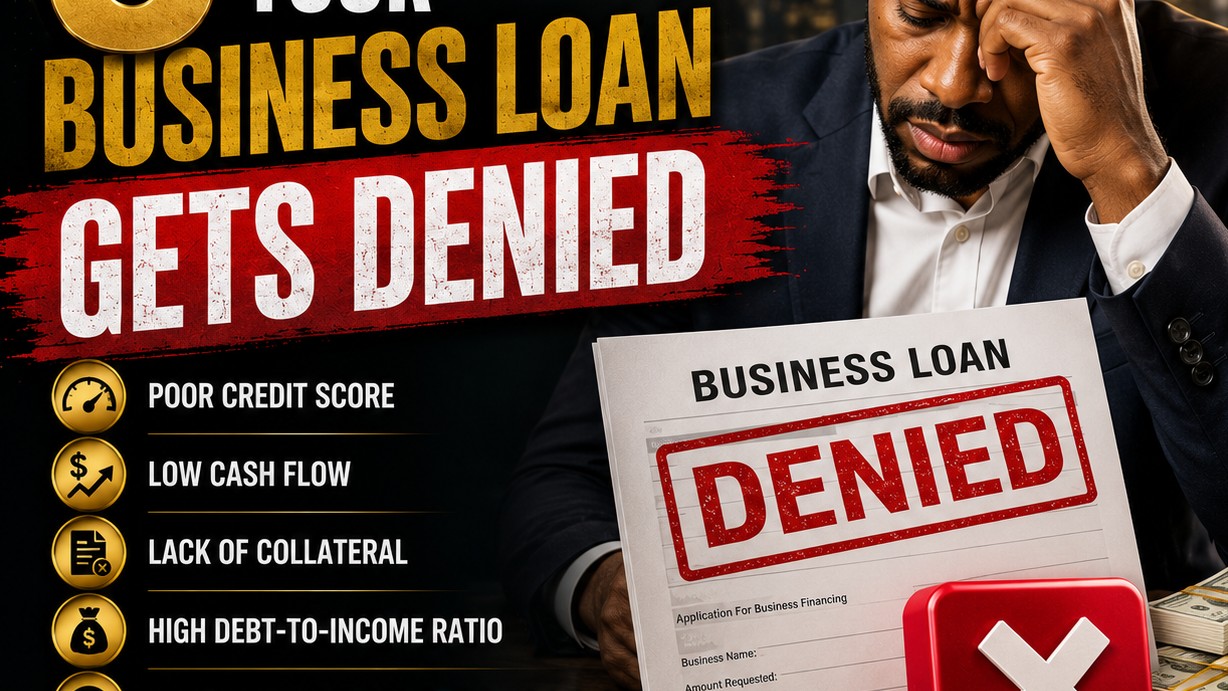
The five most common reasons for denial are credit score thresholds, cash flow documentation gaps, debt ratios that exceed acceptable limits, insufficient time in business or collateral, and incomplete applications. Each one is addressable before the next application goes out. The businesses that secure funding are not necessarily the most profitable - they are the most prepared.
Credit scores are a lender's first filter. A low score signals risk before a single financial statement gets reviewed. This applies to both personal and business credit - and many small business owners do not realize both are evaluated.
Personal credit scores (FICO) reflect the owner's financial history and responsibility. Business credit scores - from bureaus like Dun and Bradstreet, Experian Business, or Equifax Business - reflect the company's own credit track record. For newer businesses without an established credit profile, lenders lean heavily on the owner's personal score. A personal financial misstep can directly impact a business loan application, even if the business itself is performing well.
Traditional banks typically require a personal FICO score of 680 or higher. Drop below that, and the application enters high-risk territory at most conventional institutions. Online and alternative lenders may accept scores as low as 500 to 600, but this flexibility comes at a cost - higher interest rates, shorter repayment terms, or reduced loan amounts. Knowing which lender tier matches a current credit profile is a critical step before submitting any application.
If credit scores are the first filter, cash flow documentation is the main event. Lenders do not just want to know that a business is profitable - they want to see that it consistently generates enough liquid cash to cover existing obligations and a new loan payment. Profit on paper means very little if cash is not actually flowing through the business in a predictable way.
A cash flow statement tracks money moving in and out of the business across three categories: operating activities, investing activities, and financing activities. Lenders focus hardest on operating cash flow - the cash generated by the core business, not one-time asset sales or financing events. They typically want to see:
Bank statements are often requested alongside formal cash flow statements to cross-verify what is actually moving through accounts - the specific period requested varies by lender, but several months of history is a common baseline. Discrepancies between tax returns, profit-and-loss statements, and bank statements are an immediate red flag.
Missing or mismatched documents rank among the most common - and most avoidable - denial triggers. Specifically:
Even a technically profitable business can be denied if its documentation does not clearly and cleanly tell the financial story a lender needs to approve the loan.
Lenders do not just look at how much debt a business carries - they measure it against income and assets. Two debt ratios that appear in nearly every commercial lending review are the Debt Service Coverage Ratio and the Debt-to-Equity ratio.
The Debt Service Coverage Ratio (DSCR) measures whether a business generates enough net operating income to cover its total annual debt payments. The formula is straightforward: DSCR equals Net Operating Income divided by Total Annual Debt Service.
A DSCR of 1.25x is the standard benchmark at traditional banks - meaning the business earns at least 25% more than it needs to cover debt payments. SBA loans may accept a minimum of 1.15x, though this varies by program. Anything at or below 1.0x signals that the business cannot cover its existing debt, let alone new obligations - a near-automatic denial trigger.
Beyond DSCR, lenders also scrutinize the Debt-to-Equity (D/E) ratio - how much of the business is financed by debt versus owner equity. A D/E ratio below 2.0 is generally considered acceptable. Higher than that, and lenders begin to question whether the business is over-leveraged.
The Debt-to-Asset ratio compares total liabilities to total assets. Ratios exceeding 0.60 to 0.70 raise concern, indicating that more than 60 to 70% of business assets are financed by debt. When both metrics are elevated simultaneously, loan approval becomes very unlikely without significant compensating factors.
Most traditional banks and credit unions want to see at least two years of operating history before extending a standard business loan. This track record gives lenders the data needed to assess performance trends and repayment reliability. Startups, by definition, cannot offer this - which is why so many early-stage businesses are turned away from conventional lending.
The picture is not entirely bleak for newer businesses. SBA Microloans and many online lending programs carry more flexible time-in-business requirements, sometimes approving businesses with as little as six months of operation. These programs often offset the risk with smaller loan amounts, personal guarantees, or collateral requirements. Traditional lenders frequently require physical assets - real estate, equipment, or inventory - to secure a loan, and businesses that lack hard assets face a higher bar. Unsecured loan options exist but typically carry higher rates and stricter cash flow requirements.
Even when the financials are strong, a sloppy application can derail everything. Lenders interpret an incomplete or disorganized application as a sign of how the business is actually run. Missing fields, unsigned documents, or inconsistent figures across forms create doubt - and doubt leads to denial.
A weak business plan compounds the problem. Lenders want to see that an owner understands their market, has a clear revenue model, and has realistic financial projections that align with the loan's purpose. A plan that is vague on strategy or overly optimistic without supporting data signals higher risk than stated. Strong applications include complete tax returns for two to three years, a current profit-and-loss statement, a balance sheet, recent bank statements, a detailed business plan with projections, and relevant legal documents such as licenses, leases, and entity formation documents.
A denial is not the end - it is a diagnostic. Lenders are required to provide an adverse action notice explaining why an application was rejected. That notice is a roadmap. Use it.
Preparation - not luck - separates approved applicants from denied ones. For more expert guidance on small business funding, Business Funding Insider offers ongoing insights to help small business owners understand what lenders really look for - and how to show up ready.


