When disability changes your working life, understanding what you can legally earn becomes urgent. But from April 2026, new LCWRA claimants face a £47 weekly cut, and one course creator’s health crisis nearly stopped them sharing the answer disabled people desperately need.
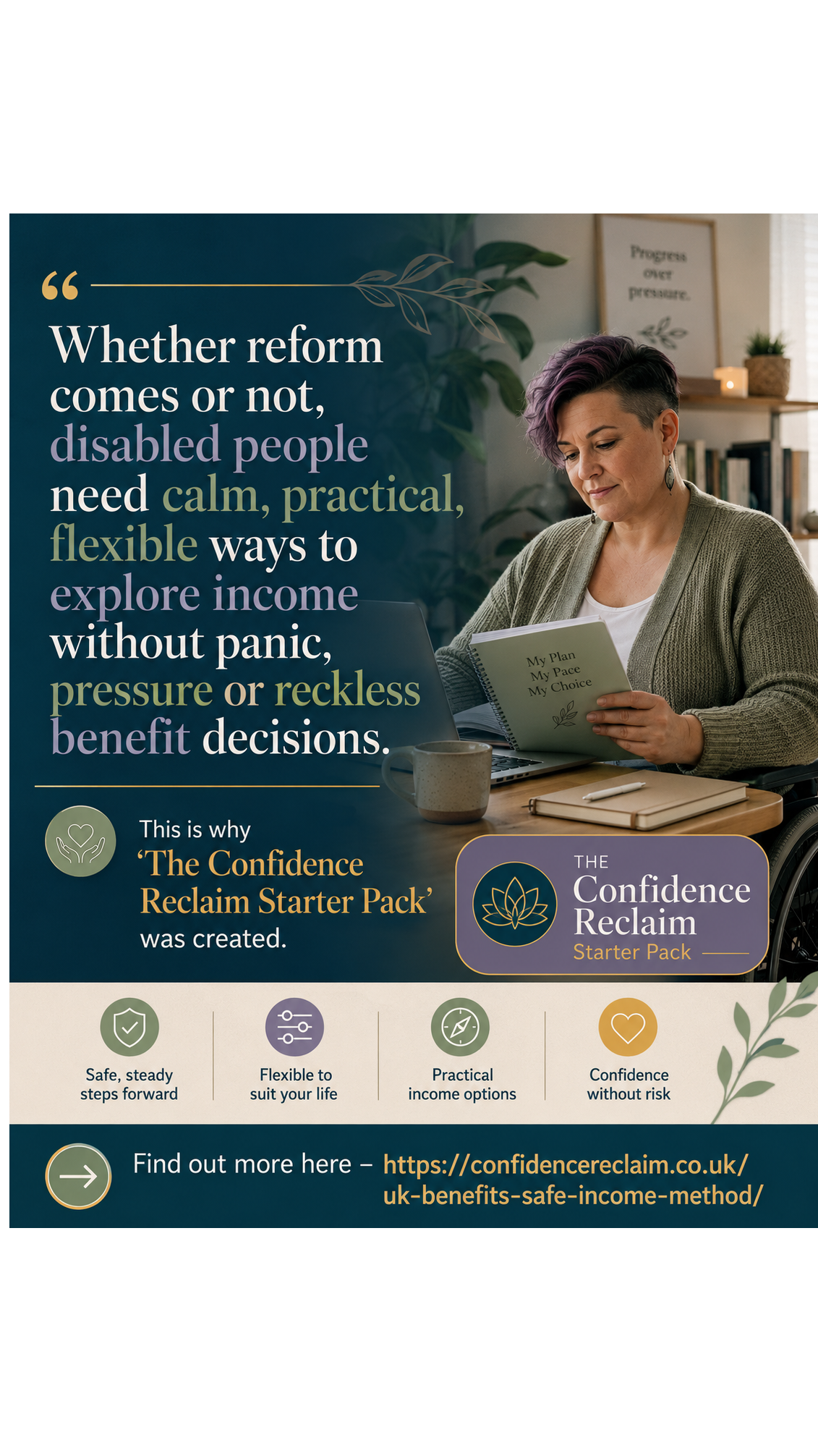
When disability changes your working life, the questions that follow can feel overwhelming. What can you legally do? What are you allowed to earn? And how do you even start when your health is unreliable? This post walks through the story behind one course built to answer exactly those questions - and the very real obstacles that nearly prevented it from being finished.
Disability does not just affect the body. It tends to affect everything at once - income, confidence, routine, identity. One day a working pattern makes sense. Then something shifts, and suddenly the landscape looks completely different.
For many disabled people in the UK, that shift arrives alongside paperwork, benefit rules, financial uncertainty, and a question that not many people say out loud: "What can I safely do now?" Not recklessly. Not in a way that risks losing vital support. Safely.
That gap - between wanting to do something and not knowing what is actually permitted - is exactly what The Confidence Reclaim Starter Pack was designed to address. The founder's story, available in full at Confidence Reclaim's About the Founder page, is not a polished entrepreneurial success story. It is an honest account of health, setbacks, and the determination to finish something that matters.
Version 1 of The Confidence Reclaim Starter Pack had been created and was close to release. Then came an unexpected deterioration in the founder's own health condition. The time and energy the project needed were simply no longer available. The course stalled.
This is not a dramatic metaphor. For anyone who lives with a fluctuating health condition, it will sound familiar. Plans get interrupted. Capacity disappears. What felt manageable last month becomes impossible this one.
While the health recovery was still ongoing, April 2026 brought a wave of changes to UK disability benefit regulations. The course that had already been drafted was suddenly out of date in significant ways. Releasing it without updates would have meant putting inaccurate guidance into the hands of people relying on it to make real decisions about their real money.
That was not acceptable. So, despite the circumstances, the research began again. Every relevant rule was checked. Every section was reviewed. It took considerably more time and effort than originally planned - but Version 2 is now complete and accurate.
From April 2026, new Universal Credit claimants assessed as having Limited Capability for Work and Work-Related Activity (LCWRA) will receive a lower health element payment - unless they meet criteria for a severe conditions category. The reduction amounts to approximately £47 per week, with the health element dropping from £97 to £50.
For people already on Universal Credit with LCWRA status before this date, the change does not apply immediately. For new claimants going through assessment from April 2026 onwards, this represents a significant reduction in financial support at a time when they are likely to be at their most vulnerable.
Proposed changes to Personal Independence Payment (PIP) assessment criteria had been widely reported, and for many disabled people the uncertainty around them was itself a source of stress. That specific overhaul has now been delayed until at least late 2026, pending a full government review.
The delay on that one element does not mean everything stayed the same. Other rule and process changes did come into effect - which is precisely why a course offering guidance on benefits and income required a full update, not just a quick patch.
The advice sounds straightforward enough: if your income has dropped, earn more. For disabled people on benefits, acting on that without first understanding the rules can trigger reductions - or worse, overpayment clawbacks - that leave someone financially worse off than when they started.
The rules differ significantly depending on which benefits someone receives. Under Universal Credit, a Work Allowance lets claimants earn a certain amount before their payment is reduced. Beyond that threshold, Universal Credit reduces by 55p for every £1 earned. The taper is gradual, but the threshold matters enormously.
For those on income-related Employment and Support Allowance (ESA), the system works differently. Permitted Work rules apply, generally allowing work of fewer than 16 hours per week with earnings below a set threshold - £203.50 per week from April 2026. Going over either limit without prior approval can jeopardise the benefit entirely.
PIP, unlike Universal Credit or ESA, is not means-tested in the same way - earning income does not directly reduce a PIP payment. Many people receive more than one benefit simultaneously, which means a change in one area can have knock-on effects elsewhere. Council Tax Reduction rules also vary by local authority. There is no single universal answer, which is exactly why a personalised starting point matters more than generic advice.
The Confidence Reclaim Starter Pack does not begin with income ideas. It begins with clarity. The first stage of the course includes a guided, easy-to-use spreadsheet that helps people ask the right questions about their own specific benefits - before any decision about earning is made.
One person's safe route is not automatically someone else's. The course is designed to help people understand their own position calmly and clearly, without needing to wade through hours of government guidance or risk acting on outdated information found online.
Once someone has a clearer picture of their benefits position, the course moves to the second stage: flexible income opportunities. The focus is on online offer promotion - a model where people can share and recommend products or services digitally, earning commission without needing to hold stock, manage customers directly, or commit to fixed hours.
If you have ever told a friend about a useful product, a helpful service, or a film worth watching, the core idea of offer promotion is already familiar. The course builds from that instinct into something more structured and purposeful.
Three things the course makes clear from the start:
The course itself takes approximately one hour to complete, with no time limit - so it can be broken into whatever segments are manageable.
Many disabled people cannot guarantee fixed hours. Fatigue, pain, anxiety, and unpredictable symptoms mean that traditional employment structures simply do not accommodate how their lives actually work. Self-employment and flexible online income offer greater autonomy over working environment and pace - which is not a luxury for disabled people, it is often a necessity.
Disabled and neurodivergent entrepreneurs make up around 25% of small business owners in the UK, yet account for only 8.6% of small business turnover. The gap is not caused by a lack of ambition. A lack of accessible, tailored guidance and systemic barriers that have not yet been dismantled are the real causes. Addressing that gap, even in a small way, is part of what makes a course like this worth finishing.
The health setback was real. The regulatory upheaval was significant. The update took far longer than expected. Version 2 of The Confidence Reclaim Starter Pack is now complete - accurate, up to date, and built for exactly the kind of uncertainty that many disabled people in the UK are currently facing.
The course does not promise to fix everything. It does not push anyone toward work they are not ready for, capable of, or safe to take on. What it offers is something simpler and more valuable: a calm, structured starting point. A way to understand where you stand before deciding what to do next.
Ambition is still allowed - even when health makes everything harder. For those who have it, there should be a pathway that is safe, legal, and built around real life, not an idealised version of it.
Visit Confidence Reclaim to find a calm, structured starting point for disabled people seeking clarity on their benefits position and flexible income options that fit around their health.


