Tech sector faces massive layoffs as AI integration hits 94,000 jobs in 2025. Most vulnerable: HR, customer support, junior developers. While Microsoft, Intel, and IBM lead this transformation, analysts predict a significant rehiring wave in 2026 as companies recognize AI’s limitations.
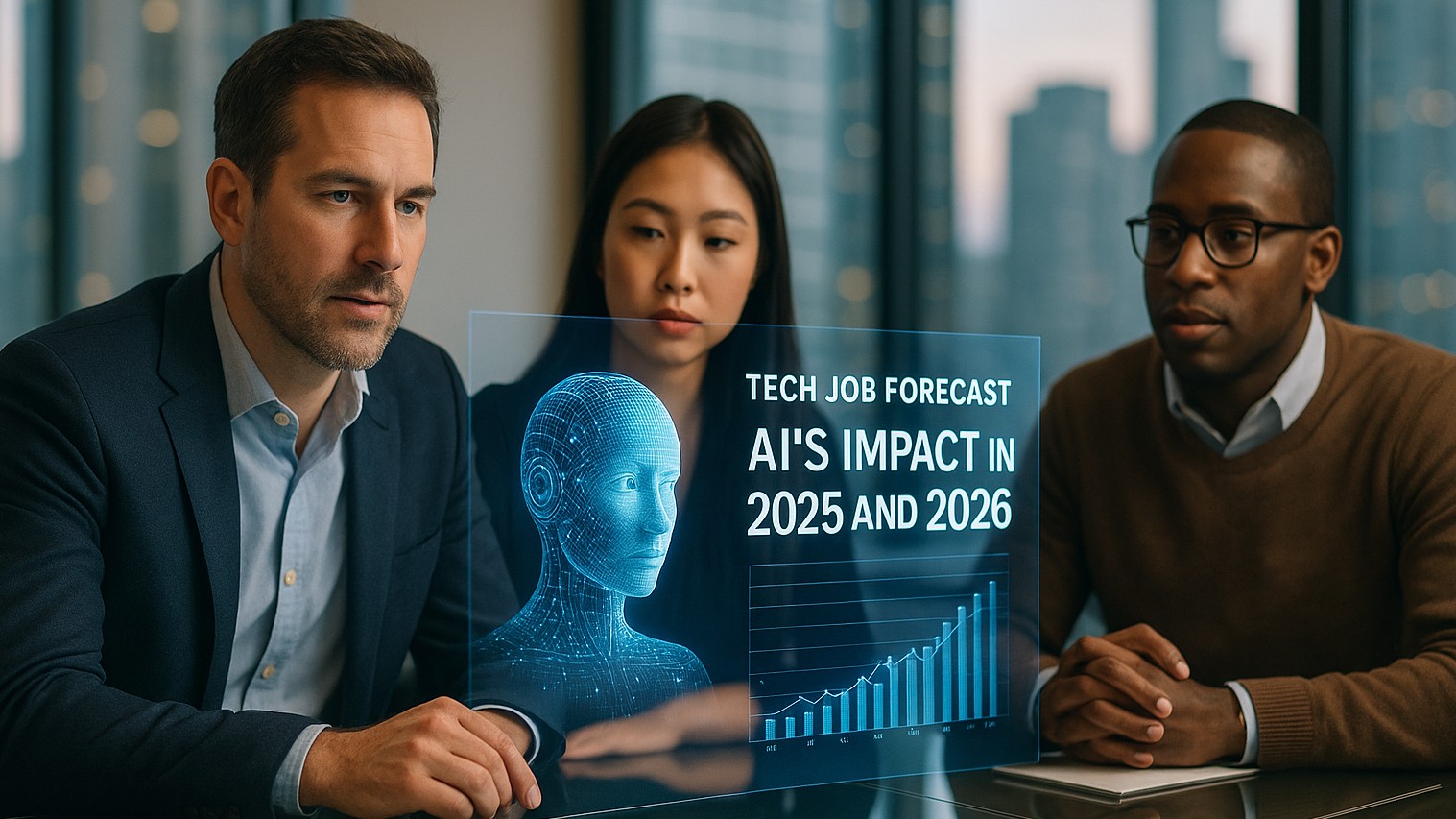
The tech industry is experiencing an unprecedented wave of layoffs directly attributed to artificial intelligence adoption. In just the first half of 2025, between 80,000 and 94,000 tech jobs have been eliminated, already matching or exceeding the full-year totals from both 2023 and 2024. This isn't just another cyclical downturn in the tech sector – it represents a fundamental transformation of how companies structure their workforces in the age of AI. If you're wondering how to navigate this shifting landscape, Career Pro Guider provides specialized guidance for professionals adapting to these changes.
Unlike previous layoff waves that were often reactions to economic uncertainties or pandemic-related adjustments, today's job cuts are explicitly strategic. Companies are openly citing AI integration as the primary driver behind their workforce restructuring decisions. This signals a permanent shift rather than a temporary measure, as organizations fundamentally change which skills they value and how work gets done.
Junior developers and those handling repetitive coding tasks are facing significant disruption. Microsoft reports that AI tools like GitHub Copilot are now writing 20-30% of their code base, dramatically improving developer productivity while reducing headcount needs. This efficiency has led to 40% of Microsoft's recent layoffs affecting development teams, as fewer programmers can now accomplish the same workload.
HR departments are increasingly automated through AI chatbots and screening tools. IBM made headlines when it replaced approximately 8,000 HR positions with an internal AI chatbot named AskHR. Basic functions like candidate sourcing, interview scheduling, and internal policy inquiries are now handled through automated systems, eliminating many traditional HR roles.
AI-powered customer service solutions are rapidly replacing human agents for routine inquiries. Companies like Chegg have cut substantial portions of their customer support teams as users increasingly interact with AI assistants. Industry experts predict that by 2027, up to 25% of all customer service operations could be led entirely by AI systems, with potential cost savings of up to 80%.
Creative roles are increasingly affected by AI tools that can generate written content, graphics, and basic designs. Marketing departments have seen substantial cuts as AI systems now handle routine content production. Over 80% of marketing leaders report using AI for content creation, considering the output "good enough" for many purposes. Companies like Canva have eliminated technical writing positions as generative AI takes over documentation tasks.
Middle management positions are being streamlined as AI tools handle performance tracking, scheduling, and basic team coordination. Microsoft has publicly stated its goal of creating "flatter team structures with more engineers and fewer middle managers," a sentiment echoed across the industry. This shift eliminates layers of organizational hierarchy previously needed for information flow and decision-making.
Microsoft stands at the forefront of AI-driven workforce transformation. The company has cut over 15,000 jobs in 2025 alone, spanning roles across gaming, cloud services, legal, and product management. CEO Satya Nadella has been transparent about the company's "clear focus to define the AI wave," redirecting investments from legacy functions to AI development.
Microsoft's GitHub Copilot tool exemplifies this transition, now writing between 20-30% of all code across Microsoft's projects. This dramatically increases developer productivity while reducing the number of programmers needed. The company reports that a single developer with AI assistance can now accomplish work that previously required multiple team members.
Intel's workforce transformation has been equally dramatic, with over 21,000 positions affected as the company pivots toward AI chip manufacturing. CEO Lip-Bu Tan announced an ambitious goal to reduce the overall workforce by 20%, while simultaneously investing heavily in AI-focused semiconductor production.
The chipmaker is shutting down portions of its automotive chip business and other non-AI-centric divisions, consolidating operations to fund its strategic shift toward AI infrastructure. This represents not just cost-cutting but a fundamental realignment of Intel's core business toward AI technologies.
IBM made waves when it laid off approximately 8,000 employees, primarily from its HR department, directly replacing them with an AI chatbot system called AskHR. This move exemplifies how even complex administrative functions are becoming candidates for AI automation.
The company has been clear that it's not merely reducing headcount but strategically reallocating resources. IBM is actively hiring software engineers and data analysts to support its AI initiatives, demonstrating a clear shift in the types of skills it values in the new AI-driven economy.
Amazon Web Services has eliminated hundreds of roles in customer success and specialist teams while prioritizing AI tools and cloud automation. CEO Andy Jassy explicitly stated that as they roll out more generative AI, "the company will need fewer people doing some jobs that are being done today."
Google has made cuts across its platforms, devices, smart TV, and advertising teams, redirecting those budgets toward AI projects like Bard and Gemini. Meta has laid off approximately 3,700 employees while investing heavily in AI infrastructure, with CEO Mark Zuckerberg noting that AI could "effectively be a sort of mid-level engineer."
Despite the rush to replace human workers, significant limitations of AI are becoming apparent. The most notable example is Klarna, which replaced 700 employees with AI systems, only to experience such severe customer service failures that the company had to hurriedly rehire staff. This phenomenon has become known as "The Klarna Effect" - the realization that AI systems, while impressive, cannot fully replicate human interaction quality.
The Klarna case demonstrates that AI still struggles with nuanced communication, empathy, and handling complex or unusual customer scenarios. While AI can manage straightforward transactions, it often fails when situations require judgment, creativity, or emotional intelligence.
AI systems continue to exhibit significant limitations in understanding context, especially in dynamic or ambiguous situations. They lack the ability to apply real-world knowledge that hasn't been explicitly programmed or learned from data. Creative tasks requiring true innovation rather than pattern recognition remain challenging for AI systems.
Human judgment and ethical reasoning are particularly difficult to automate. In scenarios requiring complex ethical decisions or stakeholder management, AI tools often fail to consider important factors that humans naturally incorporate into their thinking. These limitations suggest that complete automation of many roles remains premature, despite impressive advances in AI capabilities.
Analysts are increasingly predicting a significant "rehiring wave" beginning in 2026, as companies recognize the limitations of over-automation. Several economic indicators point to this coming workforce correction:
These factors suggest that many companies may have overestimated AI's capabilities while underestimating the value of human skills, leading to a pendulum swing back toward strategic rehiring in key areas.
Certain industries appear particularly likely to lead this rehiring trend:
While routine and truly repetitive tasks will remain automated, positions requiring judgment, creativity, and interpersonal skills are prime candidates for the rehiring wave.
As companies recognize the limitations of pure automation, a hybrid workforce model is gaining traction. This approach seeks to combine AI efficiency with irreplaceable human capabilities. Effective hybrid systems typically feature:
Companies at the forefront of this trend are finding that humans and AI working in tandem can achieve outcomes superior to either working alone. This represents a shift from viewing AI as a replacement for workers to seeing it as a powerful tool that augments human capabilities.
As the job market adapts to AI integration, certain skills are proving particularly valuable for working alongside, rather than competing with, AI systems:
Professionals who develop these complementary skills are positioning themselves for success in the emerging hybrid workforce, where the question is less about "human or AI" and more about "how humans and AI collaborate most effectively."
Even as AI eliminates some traditional positions, it's simultaneously creating entirely new job categories with explosive growth rates. AI Engineer positions have grown by 143.2%, Prompt Engineer roles have increased by 135.8%, and AI Content Creator jobs have expanded by 134.5%. Additional high-growth positions include AI Solutions Architect (+109.3%) and AI Product Manager (+89.7%).
Global reports project a net positive hiring effect from AI adoption, with projections of +21% in 2025 and +23% by 2026 for the tech sector overall. While this doesn't mean every displaced worker will find a new role, it does indicate that AI is creating opportunities alongside the disruption.
Despite the growing demand for AI expertise, only 15-20% of the current tech workforce is trained in AI technologies. This creates a significant talent gap, with companies struggling to find qualified candidates for AI-specific roles. This shortage is particularly acute in specialized areas like machine learning engineering, large language model fine-tuning, and AI ethics.
The gap between supply and demand is driving companies to invest heavily in retraining existing employees, creating internal AI academies, and developing partnerships with educational institutions to build talent pipelines. Organizations that cannot secure AI talent are finding themselves at a competitive disadvantage, unable to fully leverage AI capabilities.
The talent shortage has predictably led to dramatic compensation increases for AI specialists. Workers with AI expertise saw average wage increases of 56% in 2024, compared to just 3-4% for the broader tech sector. Some entry-level AI roles now command up to four times the standard salary for comparable non-AI positions.
This wage inflation reflects both the critical importance of AI expertise to business strategy and the significant scarcity of qualified talent. Companies are engaging in bidding wars for top AI professionals, with compensation packages including not just high salaries but also significant equity, flexibility, and professional development opportunities.
The rapid transformation of the tech job market requires proactive responses from both individuals and organizations.
For tech workers, the path forward includes:
For companies, strategic imperatives include:
The companies that will emerge as leaders in 2026 and beyond won't be those that simply replaced humans with AI, but rather those that thoughtfully integrated AI capabilities with irreplaceable human skills, creating sustainable competitive advantages through this powerful combination.
TFH Transformations LLC offers personalized career guidance to help professionals navigate the evolving AI landscape and develop the skills needed for future success.


