Most Tampa Bay homeowners don’t realize they have just 24-48 hours after a hurricane to prevent mold from taking over their home—and in Florida’s 80%+ humidity, the wrong response can turn minor storm damage into a $50,000 remediation nightmare.
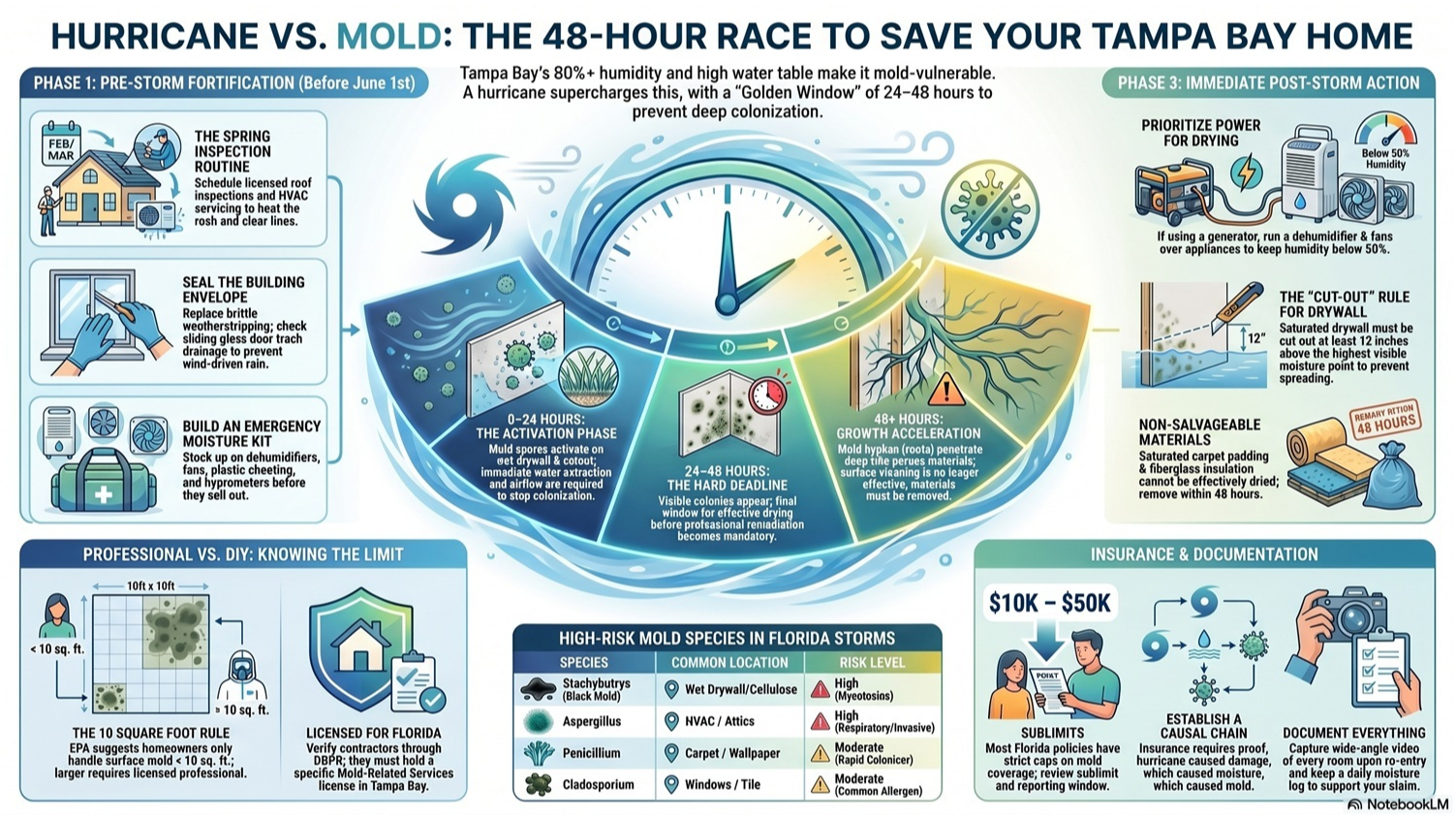
Hurricane season 2026 is underway, and Tampa Bay homeowners face a unique challenge that extends far beyond wind damage and power outages. The combination of Florida's intense storms and the region's naturally high humidity creates conditions where mold can establish itself within hours of water intrusion, turning what might be manageable storm damage into a costly remediation project that threatens both property value and family health.
Mold doesn't wait for insurance adjusters or cleanup crews. In Tampa Bay's post-storm environment, where outdoor humidity regularly exceeds 80% and temperatures stay above 80°F, mold spores that are already present in virtually every indoor environment can begin colonizing wet surfaces within 24 to 48 hours. This isn't an estimate—it's basic mycology backed by decades of research on fungal growth patterns in humid climates.
The moment a hurricane breaches your home's building envelope, moisture-saturated air pours into walls, attics, and flooring with nowhere to escape. Power outages compound the problem by disabling air conditioning systems that normally control indoor humidity. What starts as roof damage or a broken window quickly becomes a race against time to extract water and restore dry conditions before mold takes hold. TampaBayMold.net provides detailed guidance specifically designed for Tampa Bay's challenging post-storm conditions, where standard drying techniques from drier climates simply don't work effectively.
The difference between acting within this critical window and waiting even a few extra days can mean the difference between a drying job costing hundreds of dollars and a full remediation project costing tens of thousands. Once mold establishes colonies in porous materials like drywall paper or carpet backing, surface cleaning becomes ineffective, and affected materials must be removed and replaced entirely.
The most effective mold prevention happens months before any storm is named. Pre-storm preparation gives Tampa Bay homeowners the greatest advantage against water intrusion and mold growth by identifying and sealing vulnerabilities while contractors are available and supply stores are stocked. Waiting until a hurricane watch is issued means competing with thousands of other homeowners for the same limited resources.
Licensed roofing contractors in Tampa Bay get booked weeks in advance once a named storm enters the Gulf of Mexico. Schedule roof inspections in February or March, focusing on damaged shingles, compromised flashing around chimneys and vents, and deteriorating sealant around skylights. These seemingly minor repair points become major flood channels under hurricane-force winds and rain.
Windows and exterior doors deserve equal attention during pre-season inspections. Check every seal, caulk line, and piece of weatherstripping, paying particular attention to older aluminum-frame windows common in 1960s and 70s Tampa Bay construction. These frames can flex under wind pressure and allow water infiltration even without breaking. Sliding glass doors require special attention to track drainage systems that can become clogged with debris, causing water to pool and seep under thresholds.
Air conditioning systems serve as the primary weapon against indoor humidity in Florida, making them critical infrastructure that must be properly maintained before storm season. Have a licensed HVAC technician clean evaporator coils, treat drain pans with antimicrobial tablets, and flush condensate drain lines. A clogged condensate line can overflow and introduce moisture directly into ceiling or wall cavities, creating mold problems that mimic storm damage during post-hurricane inspections.
HVAC systems are often among the first to fail during hurricanes, either from power loss or physical damage. Ensuring they're in optimal condition before storm season begins maximizes the chances they'll continue operating effectively during and after storm events, when humidity control becomes most critical.
Hardware stores throughout Tampa Bay sell out of dehumidifiers, fans, and plastic sheeting within hours of a hurricane watch being issued. Building an emergency moisture control kit before June 1st ensures access to critical equipment when it's needed most. The kit should include at minimum: a portable dehumidifier rated for the largest room (50-pint capacity minimum), heavy-duty box fans or air movers, 6-mil polyethylene plastic sheeting for emergency roof tarping, a digital hygrometer to monitor humidity levels, contractor-grade garbage bags for wet material removal, N95 respirators and nitrile gloves, and a moisture meter for checking walls and flooring after water intrusion.
Store this equipment in an easily accessible location, not buried in storage areas that might become inaccessible after storm damage. Having the right tools immediately available can make the difference between successful emergency drying and watching mold establish itself while waiting for supplies.
Not all areas of a home carry equal mold risk. Bathrooms, attics, and crawl spaces are the three locations where mold establishes itself most aggressively after storms because they already have elevated baseline moisture levels before hurricanes arrive. In bathrooms, verify that exhaust fans are ducted to the exterior rather than venting into attics, which creates direct mold pathways and violates building codes in many older Tampa Bay homes.
Attics should have functioning ridge and soffit ventilation to allow moisture escape, and any existing water staining on rafters or decking should be investigated and repaired before storm season. Crawl spaces in Tampa Bay homes face particular vulnerability given the region's high water table and flood surge risk. A proper vapor barrier—6-mil polyethylene sheeting covering the entire crawl space floor and sealed at seams—is required for preventing ground moisture intrusion.
Tampa Bay doesn't just sit in a hurricane zone—it sits in one of the most mold-vulnerable corridors in the entire country, where storm damage and suffocating humidity combine into a serious threat that begins the moment a hurricane makes landfall. The region's geography amplifies mold risk in ways that go beyond simple rainfall totals, creating conditions that separate Tampa Bay from other storm-prone areas in the Carolinas or Texas.
Tampa Bay averages around 46-49 inches of rainfall annually, and relative humidity in summer months routinely exceeds 80%. During hurricane season, which runs from June 1 through November 30 with peak activity between mid-August and mid-October, outdoor humidity levels regularly reach 85-95%. When storms breach building envelopes, this moisture-saturated air pours into structural cavities with nowhere to escape, creating perfect incubators for mold growth.
The region's low-lying coastal location increases storm surge exposure, meaning flooding events often inundate homes from the ground up rather than just through roof penetrations. When flood water enters from below, it saturates subfloor materials, insulation, and wall cavities at the base—areas that are extremely difficult to dry thoroughly and that provide ideal growing conditions for dangerous mold species like Stachybotrys chartarum (black mold).
Housing age in many Tampa Bay neighborhoods compounds the mold problem significantly. Homes built before the 1980s often lack vapor barriers in crawl spaces and use older insulation materials that absorb and hold moisture like sponges. In neighborhoods like Seminole Heights and St. Pete, these older homes face mold risk even in moderate storm seasons, let alone direct hurricane strikes.
Combined with the region's naturally high water table, older construction creates multiple vulnerabilities that modern homes are specifically designed to prevent. Older aluminum-frame windows, inadequate attic ventilation, and outdated moisture management systems all contribute to increased mold risk when storm conditions test a home's defenses.
Once a hurricane passes and re-entry is safe, the clock starts running immediately. Mold doesn't wait for cleanup crews or insurance adjusters to arrive. In Tampa Bay's post-storm heat and humidity, the difference between a manageable drying job and a full remediation project often comes down to actions taken in the first 24-48 hours after re-entry.
Standing water must be extracted first using wet/dry vacuums or submersible pumps for deeper flooding. Once bulk water is removed, deploy every available air mover and dehumidifier immediately. Position air movers to create circular airflow patterns across wet flooring and walls rather than pointing them directly at single surfaces, which can actually slow overall drying.
Run dehumidifiers continuously, emptying collection tanks frequently or routing drain hoses to exterior drainage points. Keep windows and doors closed while dehumidifiers operate—pulling air in from Tampa Bay's post-storm humidity will undermine equipment effectiveness and extend drying time significantly. If power is available, prioritize dehumidification over other conveniences; a 2,000-watt generator can run a 50-pint dehumidifier and box fan simultaneously.
Some materials simply cannot be dried quickly enough to prevent mold establishment, and attempting to save them creates far more expensive problems down the line. Carpet and carpet padding that have been saturated by flood water—particularly water that may carry sewage or debris—should be removed within 24 hours. There is no effective way to dry carpet padding fast enough to prevent mold, and flood-contaminated carpet cannot be sanitized to safe standards.
Drywall that shows water absorption at its base, indicated by waterline staining along lower walls, must be cut out to at least 12 inches above the highest visible moisture point. Wet drywall paper provides one of the most efficient growth substrates for dangerous mold species. Similarly, fiberglass batt insulation that has been wetted loses thermal value permanently and retains moisture against wall cavities for weeks—it must be removed and replaced entirely.
Thorough documentation protects insurance claims and provides baseline information for remediation contractors. Start with wide-angle video of every affected room immediately after re-entry, then follow with close-up photos of specific damage points including waterlines on walls, damaged roof structures, compromised window frames, and any visible mold growth. Include hygrometer readings in each affected room to establish humidity conditions at the time of inspection.
Keep all receipts for emergency mitigation expenses including dehumidifier rentals, contractor invoices, and material disposal costs. If emergency mitigation companies begin drying, ensure they provide written moisture logs showing daily readings in affected materials—this documentation establishes timeline and severity in formats that both insurance adjusters and remediation contractors use regularly.
These terms get used interchangeably, but they describe fundamentally different processes with very different outcomes. Understanding the distinction is critical for Tampa Bay homeowners deciding how to respond after hurricane water intrusion, because choosing the wrong approach can turn a manageable situation into a home-condemning disaster.
Mold removal refers to physically cleaning visible mold from surfaces—wiping with bleach, scrubbing tile grout, or spraying commercial products on walls. This approach addresses only what's visible on surfaces. When mold grows on drywall, it doesn't just sit on the surface—root-like structures called hyphae penetrate into paper facing and gypsum cores. Surface cleaning with bleach kills surface colonies temporarily but leaves hyphae intact within materials.
In Tampa Bay's humidity, colonies re-establish from these embedded structures within days or weeks. Worse, cleaning processes disturb mold and release thousands of spores into the air, potentially spreading contamination to previously clean areas. Bleach also adds moisture to already compromised materials, actually feeding the problem it's meant to solve.
Mold remediation is a structured, multi-step protocol that addresses contamination, moisture sources, air quality, and affected structural materials. Licensed contractors in Florida must hold Department of Business and Professional Regulation (DBPR) Mold-Related Services licenses and follow structured protocols that go far beyond surface cleaning.
Professional remediation begins with containment setup, sealing affected areas with 6-mil polyethylene sheeting and establishing negative air pressure using HEPA-filtered air scrubbers to prevent spore migration. Contaminated porous materials like drywall, insulation, and carpet are removed and bagged for disposal before any surface treatment begins. Air sampling before and after remediation confirms that spore counts have returned to acceptable levels, and moisture sources must be identified and corrected before reconstruction begins.
Florida homeowners insurance policies vary significantly in how they treat mold damage, and the relationship between hurricane events and mold growth is the critical link that must be established in claims. Mold directly caused by covered perils—meaning hurricane-driven water intrusion—is generally covered under policies' mold remediation sublimits, which typically range from $10,000 to $50,000 depending on the specific policy.
Standard homeowners insurance in Florida covers mold remediation when it results directly from sudden and accidental covered events, including hurricane wind damage and storm surge. Coverage typically includes professional remediation costs, air testing, temporary containment, and disposal of contaminated materials. What it generally doesn't cover is mold resulting from long-term neglect, pre-existing leaks, or maintenance failures unrelated to storm events.
Some Tampa Bay homeowners carry endorsements that increase mold coverage sublimits beyond standard policy amounts. Review policy mold language before storm season, not after claims are filed. Knowing sublimits and coverage conditions in advance allows informed decisions about remediation scope and contractor selection without the pressure of active claims driving choices.
Insurance carriers look for clear, documented causal chains: hurricanes caused structural damage, that damage allowed water entry, and that water caused mold growth. Any gaps in this chain—particularly delays in reporting or evidence of pre-existing mold—give carriers grounds to reduce or deny mold portions of claims. Contact insurance carriers within 24 hours of discovering damage, as most policies have strict reporting windows.
Photograph and video document every room showing water intrusion, damaged materials, and visible mold before cleanup begins. Keep all receipts for emergency mitigation expenses. Do not sign contractor authorization forms that include assignment of insurance benefits without consulting public adjusters or attorneys first, as these can complicate claim processes significantly.
Surviving one hurricane season without mold disaster is a victory, but it's not a permanent solution. Tampa Bay's climate means conditions that drive mold growth—heat, humidity, and frequent rainfall—are present every month of the year. Long-term mold prevention requires building consistent habits and maintaining moisture control systems so each new storm season starts from a position of strength rather than accumulated neglect.
The EPA recommends keeping indoor relative humidity between 30% and 50% to prevent mold growth. In Tampa Bay, maintaining below 50% is the practical target during summer months and post-storm periods. Most central air conditioning systems in properly sized and maintained homes can hold indoor humidity in the 50-55% range during normal operation. During rainy season or anytime AC is offline, standalone dehumidifiers running continuously become necessary to maintain safe levels.
Mold problems caught at 10 square feet cost a fraction of what they cost at 100 square feet. Monthly inspections don't need to be formal or time-consuming—they just need to be consistent and cover areas where mold establishes first in Tampa Bay homes. Spend 15 minutes each month checking attics for water staining on rafters or insulation, bathrooms for cracked caulk lines around tubs and toilets, areas under sinks for slow drips, exterior walls after heavy rain for water running toward foundations, window frames for soft drywall indicating moisture intrusion, and HVAC drain pans to confirm they're dry between service visits.
Pay particular attention after significant rain events, not just named storms. Slow-moving thunderstorms can deposit three inches of rain in an hour and overwhelm gutters, downspouts, or window seals that seemed functional in dry conditions. Crawl spaces deserve dedicated monthly checks during hurricane season—bring flashlights and moisture meters to look for standing water, pipe condensation, vapor barrier damage, or musty odors that indicate active mold metabolism even when visual growth isn't obvious.
Everything in this guide points to the same conclusion: homeowners who come through hurricane season without mold disasters are those who prepared before storms, responded within the critical 48 hour window, and maintained their homes consistently between seasons. None of these actions require extraordinary resources—they require knowledge and follow-through applied systematically over time.
The preparation timeline starts in early spring, not when storms are named. Post-storm response begins the moment re-entry is safe, not when insurance adjusters schedule visits. Any mold growth covering more than 10 square feet, involving porous materials, or in areas wet for more than 48 hours warrants calls to licensed remediation professionals, not trips to hardware stores for bleach and surface cleaners.
Schedule roof and window inspections before June 1 every year, build emergency moisture kits before storm season peaks, document pre-storm home conditions with photos and video for insurance baselines, know policy mold sublimits and reporting windows before needing them, begin drying and water extraction within 24 hours of re-entry after any storm event, remove saturated carpet, drywall, and insulation within 48 hours, run dehumidifiers continuously during power restoration periods, and conduct monthly inspections of attics, crawl spaces, bathrooms, and exterior drainage systems.
For Tampa Bay homeowners seeking guidance on hurricane mold prevention and professional remediation services, TampaBayMold.net focuses on protecting homes from the unique mold challenges that define this region's storm season reality.


