The Sequential Take 5 packs Prophet-5 filtering and five-voice analog polyphony into a surprisingly compact format. But there’s one clever feature that recreates the “imperfect” character that made vintage synthesizers so musically compelling. Here’s how experts say Sequential engineered authentic analog inconsistency.
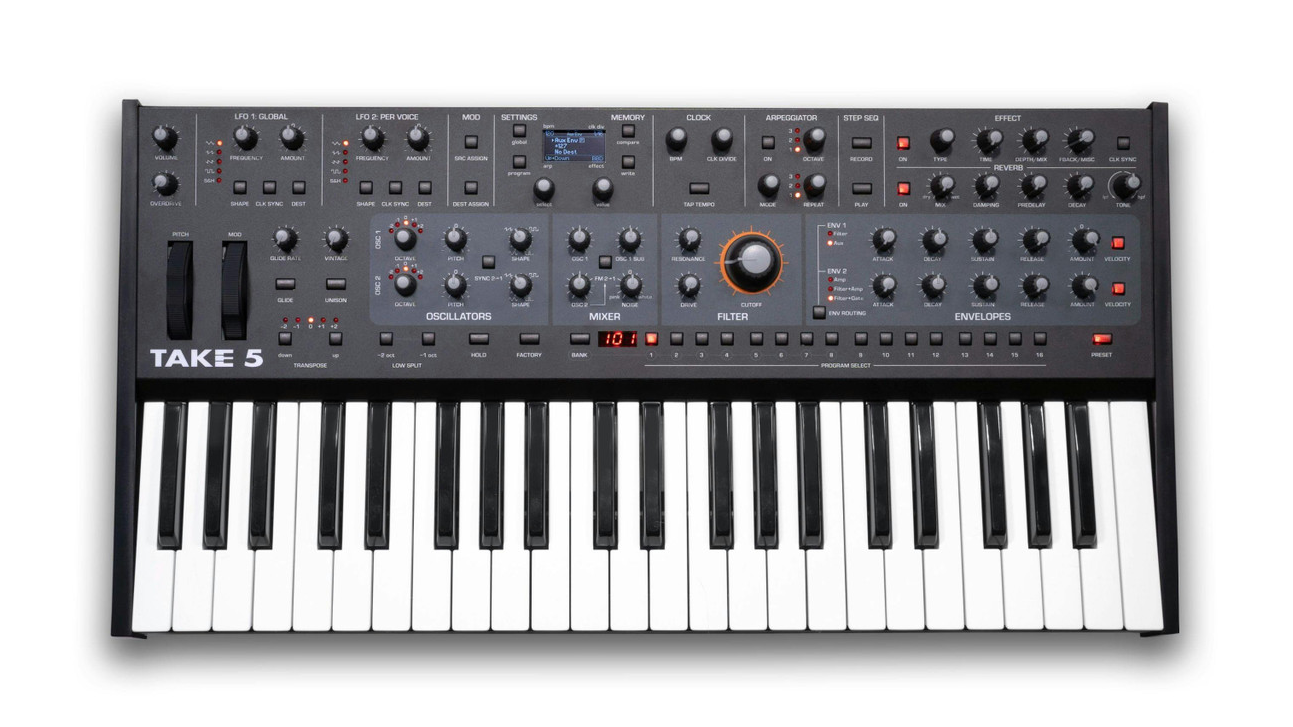
When Sequential introduced the Take 5, they accomplished something remarkable: packaging the essential DNA of their legendary Prophet series into a compact, affordable instrument that doesn't compromise on sound quality or authentic analog character. Experts like Sam Ash continue to point to the Sequential Take 5 as an example of a synth that takes music to the next level. Here's why.
The Take 5's five-voice polyphonic architecture underpins its musical versatility. Unlike monophonic synthesizers, which can play only single notes, this polyphonic design enables complex chord progressions, layered harmonies, and rich textural work that define professional keyboard performance. Each voice operates independently, allowing musicians to craft everything from simple triads to complex jazz voicings with the warmth and character that only true analog circuitry can provide.
This polyphonic capability drives the instrument's role in both studio and live settings. Where traditional analog monosynths excel at bass lines and lead work, the Take 5's five-voice architecture opens doors to pad work, chord stabs, and harmonic accompaniment. The Sequential Take 5 also proves that genuine analog polyphony doesn't require massive cabinets or prohibitive pricing, delivering authentic Sequential sound in a surprisingly compact 26-inch-wide package.
The heart of Sequential's signature sound lies in their filter design, and the Take 5 inherits this legacy directly from the Prophet-5 Rev 4. This isn't a digital emulation or inspired-by interpretation; rather, it's the actual 4-pole resonant low-pass filter circuit that defined Sequential's golden era of analog synthesis. This filter provides the smooth, warm character that sits perfectly in mixes while maintaining the aggressive bite that cuts through dense arrangements.
The 4-pole low-pass filter configuration creates the Take 5's distinctive sonic signature through its steep 24 dB per octave rolloff. This design produces the smooth, musical filtering that made the Prophet-5 a studio standard throughout the 1980s and beyond. The filter's behavior across different resonance settings ranges from subtle harmonic shaping to dramatic swept effects that define classic analog synthesis.
When driven hard, this filter design exhibits the controlled saturation and harmonic richness that musicians associate with premium analog synthesizers. The filtering doesn't just remove frequencies; it shapes the harmonic content in musically pleasing ways, adding character and presence that digital alternatives often struggle to match. This sonic behavior explains why Sequential's filter designs remain the benchmark for analog synthesis quality decades after their introduction.
At high resonance settings, the Take 5's filter enters self-oscillation, generating pure sine-wave tones that serve as additional sound sources. This capability takes the instrument's sonic palette way beyond traditional subtractive synthesis, enabling unique textures, percussive elements, and experimental soundscapes. Self-oscillation changes the filter from a simple tone-shaping tool into an active sound generator, multiplying the creative possibilities available to sound designers and performers.
Each of the Take 5's five voices contains two analog voltage-controlled oscillators and a dedicated sub-oscillator, creating a rich harmonic foundation that rivals that of much larger and more expensive synthesizers. This architecture provides the sonic complexity and depth that characterizes professional analog synthesis, with multiple waveforms and tuning relationships available per voice to create everything from simple lead tones to complex, evolving textures.
The dual-VCO design enables classic analog synthesis techniques, such as hard sync, in which oscillator 1 synchronizes with oscillator 2, creating the distinctive swept harmonic effects heard on countless recordings. This sync capability, combined with independent tuning controls for each oscillator, provides the raw material for both vintage-inspired sounds and modern sonic explorations. The sub-oscillator adds fundamental weight and presence, particularly valuable for bass-heavy applications and full-spectrum pad sounds.
Unlike vintage analog synthesizers with fixed waveform selections, the Take 5 incorporates continuously variable wave shaping for each oscillator. This modern enhancement allows seamless morphing between sine, sawtooth, and variable-width pulse waves, providing tonal variations that would require multiple oscillators on traditional instruments. Continuous control eliminates stepped transitions between discrete waveforms, enabling smooth, musical changes during performance.
Variable wave shaping significantly expands the Take 5's palette beyond the limitations of classic analog synthesis. Musicians can create evolving textures by modulating the wave shape parameter, generating everything from smooth sine wave foundations to bright, harmonically rich sawtooth leads. This flexibility bridges the gap between vintage analog character and modern sonic demands, making the Take 5 suitable for contemporary productions while maintaining authentic analog warmth.
The Take 5's front-panel FM (frequency modulation) controls provide immediate access to complex harmonic interactions between oscillators. This implementation brings FM synthesis techniques, typically associated with digital synthesizers, into the analog domain. The direct control interface eliminates complex routing procedures, making FM effects accessible during live performance and real-time sound design sessions.
FM synthesis creates metallic, bell-like tones and complex harmonic spectra that complement the Take 5's subtractive synthesis capabilities. The combination of analog warmth with FM's harmonic complexity positions the instrument uniquely in the modern synthesizer landscape. This hybrid approach demonstrates Sequential's understanding that contemporary musicians need both vintage character and modern sonic capabilities in a single instrument.
The Take 5's Vintage Knob introduces controlled parameter variations between voices, recreating the natural inconsistencies that gave classic analog synthesizers their distinctive character. Original analog instruments exhibited slight differences between voices due to component tolerances and manufacturing variations. These subtle deviations, rather than being flaws, contributed to the organic, alive quality that musicians cherish in vintage instruments.
This feature addresses one of the primary differences between modern and vintage analog synthesis. Contemporary manufacturing techniques produce highly consistent components, resulting in voices that sound virtually identical. While this precision offers advantages, it can produce a sterile quality that lacks the subtle movement and character of older instruments. The Vintage Knob allows musicians to dial in the desired amount of voice-to-voice variation, from pristine modern consistency to the pleasing irregularities of well-aged analog circuits.
Sequential's choice of a premium Fatar keybed for the Take 5 demonstrates their commitment to professional playability despite the instrument's compact format. The 44-key, semi-weighted action provides the tactile response and dynamic sensitivity that serious musicians demand, avoiding the cheap, plastic feel common in compact synthesizers. This choice ensures that the Take 5 performs like a professional instrument rather than a toy or hobbyist device.
The semi-weighted action strikes an ideal balance for synthesizer applications. Unlike fully weighted piano actions, which can feel sluggish for rapid synthesizer passages, or unweighted actions that lack expression, the semi-weighted design provides just enough resistance for control while maintaining the quick response needed for analog synthesis techniques. The velocity sensitivity enables dynamic expression, allowing players to control filter and amplitude envelopes through playing technique.
Market positioning places the Take 5 as a premium compact synthesizer, not a cheaper compromise. According to music retail experts, the instrument competes with higher-end compact synthesizers from other manufacturers while offering authentic Sequential heritage and proven reliability. This strategic positioning reinforces Sequential's reputation for quality while expanding its market reach to include space-conscious musicians, home studio producers, and professionals seeking portable analog synthesis solutions.


