Are your sales reps wasting hours chasing dead leads and disconnected phone numbers? Research reveals that pursuing bad contact data consumes 27% of sales teams’ time, but there’s a game-changing solution that increases conversion rates by 2-3x.
Sales teams across industries face the same frustrating challenge: spending precious hours chasing down leads that no longer work. Email addresses bounce, phone numbers disconnect, and decision-makers change roles faster than static databases can keep up. This reality costs businesses more than just time—it erodes team morale and directly impacts revenue growth.
Research shows that pursuing bad leads consumes up to 27% of a sales team's productive hours. Sales representatives spend their mornings calling disconnected numbers, crafting emails that bounce back immediately, and researching contacts who left their companies months ago. This wasted effort translates into missed quotas, frustrated team members, and disappointed leadership.
The problem compounds when teams rely on purchased lead lists or aging CRM data. Commercial email lists lose an average of 28% of their contacts annually, creating a cascade of inefficiency that ripples through entire sales organizations. What starts as a promising list of 1,000 prospects quickly becomes 720 valid contacts—assuming the remaining data is even accurate.
Traditional lead generation methods create a vicious cycle where sales teams spend more time validating data than actually selling. This approach transforms top performers into data janitors, cleaning up information instead of building relationships with potential customers.
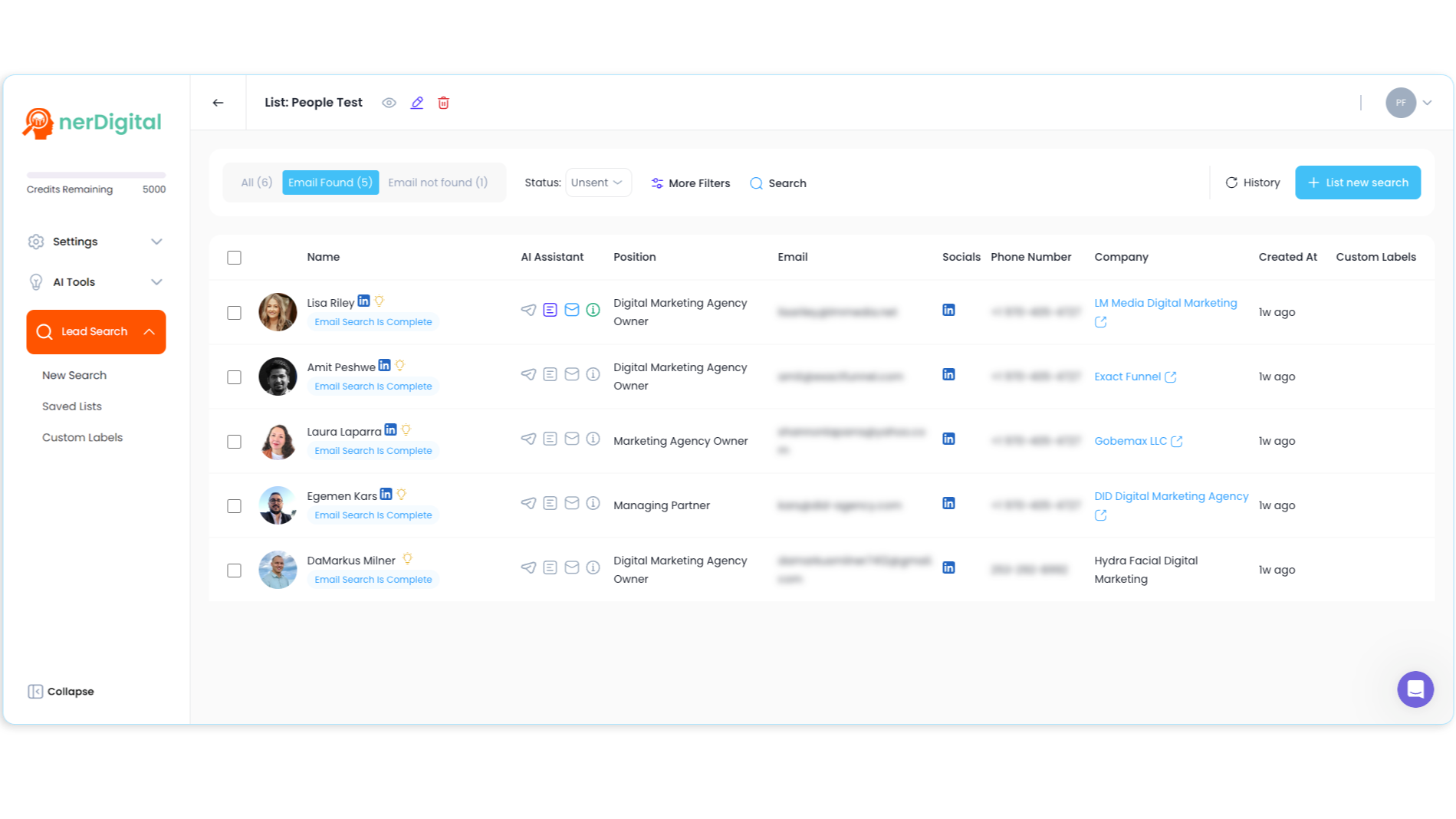
Real-time data sourcing operates fundamentally differently than traditional database models. Instead of relying on pre-compiled lists that age from the moment of purchase, nerDigital AI's platform pulls fresh contact information at the moment of search. This approach ensures that email addresses, phone numbers, and job titles reflect current reality rather than historical snapshots.
The system cross-references multiple live data sources to verify contact accuracy before presenting results. When a sales professional searches for decision-makers at a target company, the platform scans current employee directories, recent press releases, and social media updates to confirm that contacts still hold their listed positions and remain reachable through provided channels.
This verification process eliminates the guesswork that plagues static databases. Sales teams receive confidence that their outreach efforts will reach actual people rather than digital dead ends.
Static database providers face an impossible mathematical challenge. They sell the same contact lists to hundreds or thousands of customers, creating market saturation before prospects ever hear from most purchasers. Decision-makers receive dozens of identical pitches from companies using the same "exclusive" lead lists.
These databases also suffer from inherent staleness. Contact information becomes outdated the moment employees change roles, companies restructure, or email systems migrate. Traditional providers update their databases quarterly or annually—far too slowly for today's business environment.
The recycling problem extends beyond oversaturation. When multiple companies target the same prospects using identical contact lists, response rates plummet across the board. Prospects become conditioned to ignore outreach because they've received the same message from multiple vendors.
Contacting prospects within five minutes makes sales teams 21 times more likely to qualify leads compared to waiting 30 minutes or longer. This statistic highlights why real-time data sourcing provides such a significant competitive advantage over traditional methods.
Static databases cannot support rapid response strategies because they lack the freshness and accuracy required for immediate outreach. Sales representatives using outdated contact information waste time validating details before making contact, destroying the speed advantage that drives qualification success.
Real-time platforms enable instant action. When market intelligence identifies a prospect showing buying intent, sales teams can reach out immediately with confidence that their contact information is current and accurate.
Modern AI platforms learn business-specific parameters to improve targeting accuracy over time. Sales teams train the system by providing examples of successful customer profiles, including industry verticals, company sizes, and decision-maker characteristics that historically convert well.
The AI analyzes these patterns to understand which departments, job titles, and company attributes align with optimal prospects. This training creates a feedback loop where the platform becomes more precise with each search, reducing time spent evaluating unqualified leads.
Machine learning algorithms identify subtle correlations that humans might miss. For example, the system might discover that prospects from specific geographic regions or with certain educational backgrounds show higher engagement rates, automatically prioritizing these characteristics in future searches.
AI-driven personalization transforms generic outreach into targeted communications that resonate with specific prospects. The system analyzes publicly available information about target contacts and their companies to craft relevant messaging that addresses likely pain points and interests.
This personalization extends beyond simple name insertion. Advanced platforms generate subject lines, opening paragraphs, and value propositions tailored to each prospect's industry, role, and recent company developments. The result is outreach that feels researched and relevant rather than mass-produced.
Personalized messages consistently outperform generic templates, creating higher open rates, response rates, and meeting acceptance rates. Sales teams using AI personalization report significant improvements in prospect engagement across all communication channels.
People search functionality targets specific individuals based on job titles, responsibilities, and seniority levels. Sales teams input criteria like "Chief Technology Officer" or "VP of Marketing" along with company size and industry filters to identify decision-makers with purchasing authority.
Advanced people search algorithms understand job title variations and organizational hierarchies. The system recognizes that "Chief Revenue Officer," "VP of Sales," and "Head of Revenue" might represent equivalent decision-making authority in different companies.
This search method proves most effective for complex B2B sales where multiple stakeholders influence purchasing decisions. Sales teams can map entire buying committees before beginning outreach campaigns.
Company search enables account-based prospecting by identifying organizations that match specific business criteria. Sales teams filter by revenue range, employee count, industry classification, and growth indicators to build target account lists.
The system provides detailed company profiles including recent funding events, leadership changes, technology stack information, and expansion announcements. This intelligence helps sales teams understand which accounts show buying signals and time their outreach accordingly.
Account-based approaches typically generate higher-value opportunities because they focus on companies with demonstrated need and budget capacity. Company search makes this targeting scalable and systematic.
Domain search functionality reveals employee contacts across specific company websites, enabling competitive intelligence and market research. Sales teams can analyze competitor customer bases, identify potential switching opportunities, and understand market dynamics.
This approach proves valuable when targeting accounts currently using competitive solutions. Sales teams can identify decision-makers at companies using competitor products and craft messaging that addresses known limitations or switching benefits.
Domain search also supports partnership development and market expansion strategies by revealing potential integration partners, reseller candidates, and strategic alliance opportunities.
Commercial email lists lose approximately 28% of their contacts each year on average, creating a rapidly depreciating asset that frustrates sales teams and wastes marketing budgets. This decay rate has accelerated as professionals change jobs more frequently and companies reorganize to adapt to market conditions.
Traditional lead generation companies acknowledge this decay but continue selling the same aging databases to multiple customers. They justify the practice by offering "fresh" data that still contains months-old information by the time it reaches end users.
Data enrichment provides an alternative approach by updating existing contact lists with current information. Instead of purchasing entirely new databases, sales teams can refresh their existing CRM data with verified contact details and updated job titles.
Live data enrichment operates continuously rather than providing one-time updates. When contact information changes—such as job titles, phone numbers, or email addresses—the system automatically flags outdated records and provides current details.
This approach treats data as a living resource that requires ongoing maintenance rather than a static asset that degrades over time. Sales teams benefit from contact lists that improve in accuracy rather than deteriorating with age.
One-time database purchases create immediate obsolescence problems. By the time sales teams implement new contact lists into their workflows, portions of the data have already become outdated. Live enrichment solves this timing problem by providing updates as changes occur in real-time.
Modern lead generation platforms integrate directly with existing CRM systems, eliminating the manual data entry that slows down sales processes. These integrations automatically populate contact records, activity histories, and prospect intelligence without requiring sales teams to switch between multiple applications.
Integration capabilities extend beyond simple data transfer. Advanced platforms synchronize lead scoring, engagement tracking, and follow-up scheduling with CRM workflows, creating a unified environment where all prospect information remains current and accessible.
This connectivity prevents the data silos that traditionally separate lead generation from sales execution. Sales representatives access enriched prospect profiles, AI-generated talking points, and real-time contact updates directly within their familiar CRM interface.
Companies using AI for lead generation report up to 50% more leads compared to traditional database methods. These improvements stem from better targeting accuracy, fresher contact information, and intelligent lead scoring algorithms.
AI platforms analyze vast datasets to identify prospects most likely to convert based on behavioral patterns, company characteristics, and timing indicators. This analysis eliminates much of the guesswork that reduces traditional lead generation effectiveness.
The qualification improvement comes from AI's ability to process multiple data points simultaneously. While human sales teams might evaluate prospects based on company size and industry, AI algorithms can incorporate dozens of variables including recent hiring trends, technology adoption patterns, and competitive changes.
These performance gains compound over time as AI systems learn from successful conversions and failed outreach attempts. The platforms become more precise in identifying high-value prospects while filtering out contacts unlikely to engage positively.
For sales and marketing professionals ready to modernize their lead generation approach, nerDigital AI offers real-time data sourcing and AI-powered prospecting tools that transform outdated contact lists into fresh, actionable opportunities.


