Franklin homeowners don’t realize that sealing an older home with spray foam can trap moisture and cause damage if done wrong. The difference between saving money and creating a costly disaster often comes down to understanding one critical factor about how pre-1980s homes were designed.
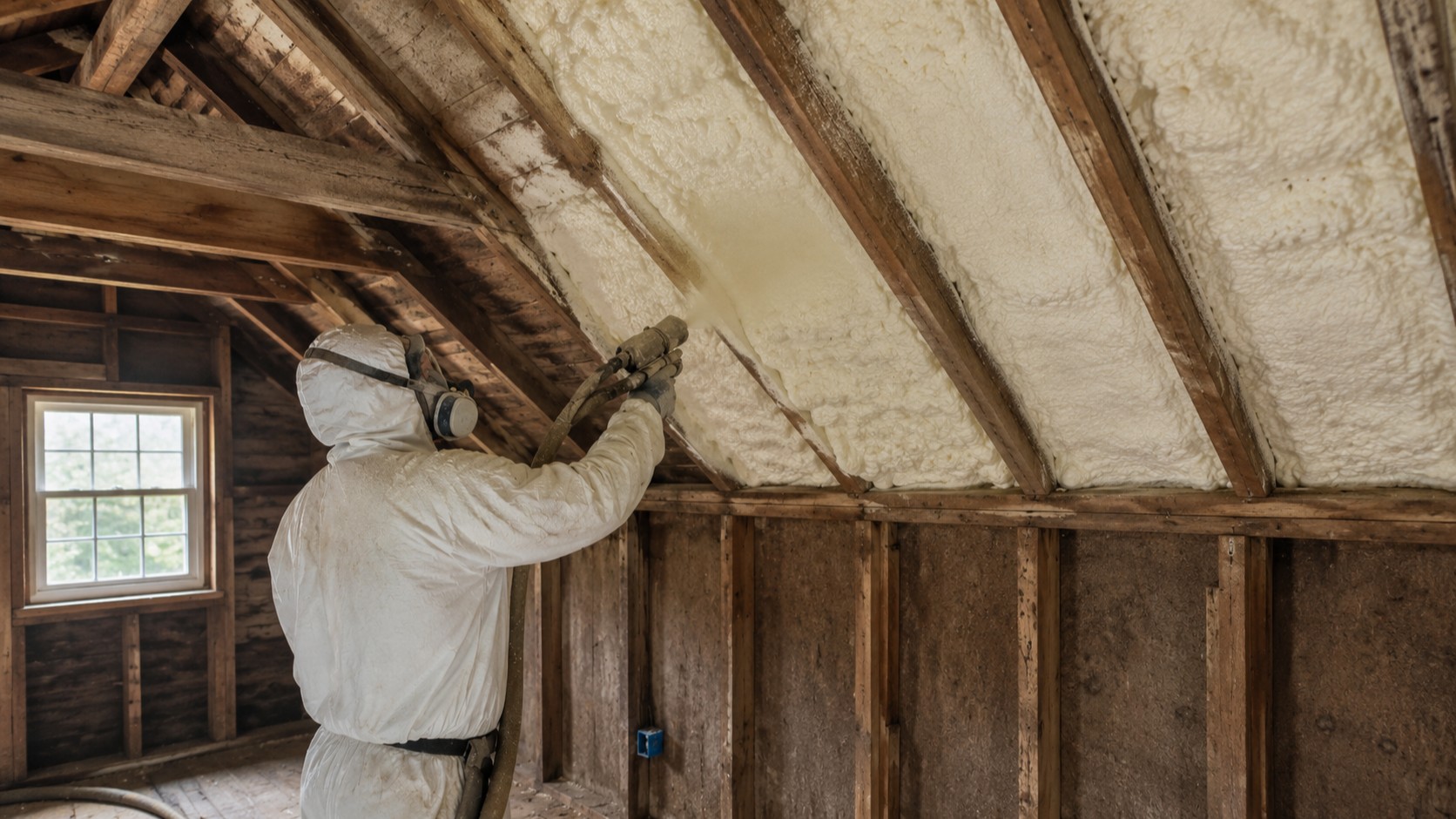
Franklin's older neighborhoods have real character — wide lots, mature trees, solid bones. But many of those homes were built in an era when energy efficiency wasn't part of the vocabulary. Retrofitting them with modern insulation isn't as simple as spraying foam and calling it a day. There are hidden risks that even well-meaning homeowners don't see coming, and the decisions made during an insulation upgrade can either solve decades-old comfort problems or create brand new ones.
It's easy to assume that an older home's energy problems are obvious — maybe a drafty hallway or a bedroom that never quite heats up. But the real losses are often invisible. Heat escapes through dozens of small pathways: gaps around old electrical boxes, spaces between floor joists, aged weatherstripping that's long past useful, and walls that were simply never insulated to begin with.
In many Franklin homes built before the 1980s, wall cavities were left partially or completely empty. Attics received minimal blown-in insulation that has since settled and degraded. Crawl spaces were largely ignored. Over decades, that adds up to energy bills that are consistently higher than they should be — and comfort levels that never quite meet expectations no matter how the thermostat gets adjusted.
The compounding factor is that older homes weren't built with a tight envelope in mind. They were built with gaps. Understanding why those gaps exist — and what happens when you seal them — is the first step toward a retrofit that actually works.
Pre-1980s construction philosophy was fundamentally different from today's. Builders relied on natural airflow moving through the structure to carry moisture out and keep the framing dry. Gaps weren't defects — they were features. The house was designed to breathe.
Modern insulation, especially spray foam, works by doing the opposite: sealing the building envelope tight. That's excellent for energy efficiency, but it creates a direct conflict with the way older homes were engineered to function. When that natural airflow is suddenly blocked, moisture that used to drift harmlessly out of the structure has nowhere to go. The result can be condensation, trapped humidity, and over time, real damage to the framing and finishes.
This doesn't mean older homes can't be insulated with spray foam — it means the approach has to account for the home's original design logic, not simply overwrite it.
There's another layer of difficulty that's purely physical. Older homes weren't built with CAD software and laser measurements. Framing bays are inconsistent. Walls that look straight often aren't. There are hidden chases, odd-shaped voids behind plaster, and materials like horsehair plaster or brick nogging that interact differently with spray foam than modern drywall does.
Aged wood presents a particular challenge. It's often more porous, more irregular, and more prone to absorbing moisture than newer dimensional lumber. Spray foam needs a clean, stable surface to adhere and cure properly. In an older home, achieving that consistent contact across every surface requires a level of attention and preparation that a straightforward new-construction job simply doesn't demand.
BST Spray Foam of Franklin has worked extensively with older homes across the Franklin area. The team at bstsprayfoamfranklin.com points to surface preparation and void assessment as the steps most often skipped by contractors — and the ones most likely to cause problems down the line.
Spray foam's defining strength — its airtight seal — is also its biggest risk factor in older structures. When a home that has relied on passive airflow for moisture management suddenly has that airflow cut off, the moisture doesn't disappear. It finds new places to collect.
In walls and ceilings, moisture can begin accumulating inside the building envelope itself, between the foam and the exterior sheathing. If that sheathing is old, already slightly degraded, or has minor gaps that allow occasional exterior moisture intrusion, the situation can escalate quickly. The foam seals it in. The wood stays wet. And wood that stays wet long enough rots.
Mold is the most immediate concern. Mold growth inside wall cavities can go undetected for months or years — long enough to compromise both air quality and structural integrity before it becomes visible. By the time a homeowner notices a smell or sees discoloration on a wall surface, the problem behind that wall is often much further along than the surface signs suggest.
This is why a proper retrofit strategy for an older home includes more than just choosing the right foam. It requires a vapor barrier plan, a ventilation strategy that compensates for the lost passive airflow, and a thorough inspection of existing moisture conditions before any foam is applied. Spraying over an area that already has moisture present doesn't fix the problem — it seals it in and accelerates it.
The attic is where retrofit decisions carry the heaviest consequences in older homes. Timber roof structures — common in pre-1980s Franklin homes — depend on a specific moisture balance to remain stable. Old-growth wood is durable, but it isn't invincible. When spray foam is applied directly to rafters and roof decking without accounting for that moisture balance, the results can be severe.
Condensation forms where warm interior air meets the cooler underside of the roof deck. In a traditionally ventilated attic, that moisture moves out through ridge vents and soffit vents. In a sealed attic created by spray foam, it has nowhere to go. Building science experts and heritage preservation organizations have flagged this issue specifically in the context of older homes — inappropriate attic insulation can accelerate decay in structural timbers, sometimes causing failures that aren't visible until significant damage has already occurred.
The solution isn't to avoid spray foam in attics altogether — it's to use the right type of foam (open-cell versus closed-cell carries very different moisture dynamics), in the right configuration, with the right ventilation design to support it.
Crawl spaces in older Franklin homes are frequently the most neglected part of the structure — and often the most problematic. Deteriorating insulation, ground moisture, inadequate vapor barriers, and years of accumulated humidity create conditions that affect not just the crawl space itself, but the air quality throughout the entire home.
Research on crawl space dynamics consistently shows that air from below the floor moves upward into living spaces through a process called the stack effect. That means mold spores, musty odors, and high humidity originating in the crawl space end up circulating through bedrooms and living areas. Homeowners often attribute these air quality issues to HVAC problems — when the real source is underfoot.
Properly retrofitting a crawl space typically involves a combination of a reinforced vapor barrier across the ground, spray foam applied to the foundation walls, and improved drainage management. Done correctly, it transforms one of the home's biggest liabilities into a controlled, dry, conditioned space that measurably improves both energy efficiency and indoor air quality.
Tennessee's building code is based on an amended version of the 2018 International Energy Conservation Code (IECC) — but the insulation tables it references come from 2009. For attics in Climate Zone 4, which covers Franklin, the code requirement is R-38 for attics and R-13 for wood-frame walls.
Meeting code is the minimum. And in this case, the minimum was calculated using data that's now seventeen years old. Energy modeling has advanced considerably since then, and ENERGY STAR's own recommendations push well beyond what Tennessee's current code mandates. For homeowners investing in a retrofit, building to code compliance is a floor — not a goal.
Franklin sits in Climate Zone 4A — the "A" designation indicating a mixed-humid climate. That humidity factor changes the performance math significantly. High summer humidity combined with mild winters creates a longer shoulder season where the building envelope is working to manage moisture as much as temperature. In that environment, higher R-values do more than just save energy — they reduce the frequency and intensity of condensation events inside the building envelope.
ENERGY STAR's guidance for Zone 4A recommends attic insulation at R-49 or above. That's a meaningful step up from the R-38 required by code, and in an older home where the envelope has more opportunities for thermal bridging and air infiltration, the performance gap between R-38 and R-49 is even more pronounced than it would be in a tight new build. Any retrofit plan worth following should start with the climate reality, not just the code minimum.
Despite the challenges outlined above, spray foam remains one of the most capable insulation options for older homes — precisely because of the characteristics that make it tricky to use. Its ability to expand and conform to irregular surfaces means it can reach voids and gaps that batt insulation simply cannot. An older home's inconsistent framing, aged plaster walls, and accumulated gaps around penetrations are all surfaces where spray foam outperforms every alternative.
Closed-cell spray foam delivers R-values in the range of R-6 to R-7 per inch, which means it achieves high performance targets in thinner applications — important in older homes where wall cavities are often narrower than modern framing standards. Open-cell foam, with its softer structure and lower R-value per inch, has different use cases but brings superior sound attenuation and is better suited to certain moisture management strategies where some vapor permeability is desirable.
The gap between a good spray foam retrofit and a damaging one comes down almost entirely to installer knowledge. Foam chemistry, cure time, substrate preparation, temperature and humidity conditions at installation, and the interaction between foam type and the specific building assembly — these are variables that experienced contractors manage actively, and that less experienced ones often overlook entirely.
Missed areas, gaps between foam and framing, and foam applied over moisture-compromised substrates are the most common failure points. Each of these is preventable with proper technique and pre-installation assessment. The foam itself is consistent and reliable — it's the judgment calls around it that separate installations that perform as intended from ones that create problems.
Before any insulation work begins on an older home, a thorough retrofit assessment is the most valuable investment a homeowner can make. A proper assessment goes beyond measuring R-values — it identifies existing moisture conditions, maps air leakage pathways, evaluates the current state of attic timbers and crawl space materials, and determines what type of foam or combination of insulation strategies will perform best given the specific building's age, construction style, and current condition.
Skipping this step and moving directly to installation is one of the most common and costly mistakes in older home retrofits. Problems that could be identified and addressed before the foam goes in become significantly more expensive — and more damaging — to fix after the fact. An assessment isn't a delay; it's the step that makes everything that follows worth doing.
Older Franklin homes have real potential for dramatic comfort and efficiency improvements. The right retrofit, executed with the right knowledge, can reduce energy bills, eliminate drafts, improve air quality, and add lasting value to a home. Getting there requires more than just a good product — it requires someone who understands what they're working with before the first bead of foam is ever applied.
For homeowners in Franklin and surrounding communities ready to take that first step, BST Spray Foam of Franklin offers retrofit assessments and expert spray foam insulation services tailored to Tennessee's climate and the unique demands of older home construction.


