Choosing between a $7,733 MAXX-D and a $16,998 Diamond C dump trailer isn’t about budget – it’s about whether your daily loads actually need 23,000-lb capacity or if you’re overpaying for engineering you’ll never use. The GVWR math changes everything.
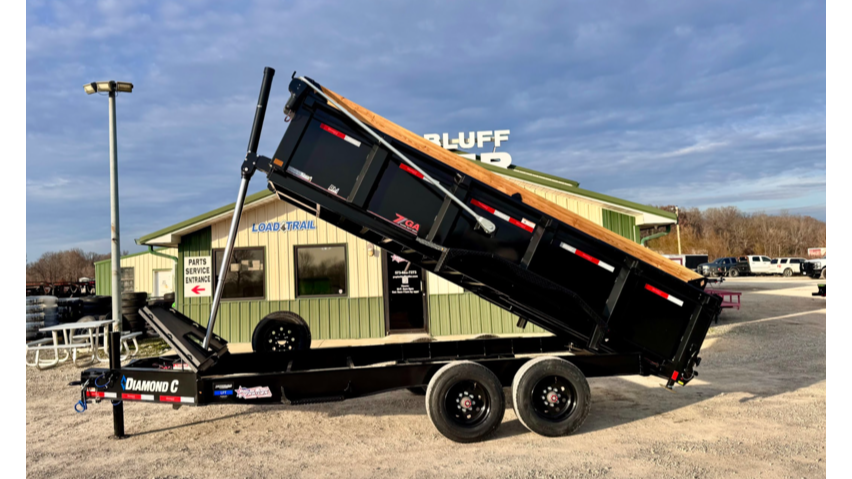
Picking between MAXX-D and Diamond C isn't just a brand preference. It's a decision that follows every job your trailer goes out on. Get it wrong, and the trailer either underperforms under load or costs more than the work justifies. Get it right, and that trailer becomes one of the most reliable tools in the fleet.
Here's how to make the choice easier.
Most contractors start the comparison where they probably shouldn't: the price tag. A few thousand dollars difference looks significant on paper, but when that cheaper trailer can't handle the GVWR of a full commercial load, or when the lift system slows down the crew twice a week, the savings disappear fast. The real question is: does the spec sheet match the daily haul?
MAXX-D and Diamond C represent two very different philosophies. MAXX-D builds trailers that are ready to work the moment they leave the lot — tarp kits, ramps, and a reliable hydraulic system are all standard. Diamond C takes a heavier, more engineered approach, targeting commercial operators who need higher capacity and the ability to configure the trailer around specific job demands.
Neither brand is universally better. But one of them is almost certainly the better fit for a specific type of contractor.
MAXX-D has built its reputation on delivering work-ready dump trailers without asking contractors to add a feature list before the trailer is useful. The lineup covers medium-duty daily haulers all the way up to heavy commercial-grade units. Frame construction varies by model - many feature full I-beam frames, while compact entry-level models like the D6X use tube frames - and practical features are consistent across every tier.
Entry price for a MAXX-D dump trailer starts at $7,733 for the compact D6X, with the DKB8314 priced at $8,998, and the range climbs to $16,488 and beyond for the high-capacity DTX8316. That spread gives contractors meaningful options without forcing a jump to a completely different brand when job requirements grow.
Four models give a clear picture of the MAXX-D dump trailer lineup and where each one fits in a working fleet:
Every one of these ships ready to haul. That's not incidental; it's a deliberate design choice that defines the MAXX-D brand.
Many MAXX-D models run full I-beam frames, with the I-beam profile excelling at handling vertical loads - exactly the kind of stress a loaded dump trailer puts on its frame during transit and while the bed is raised. The result is even weight distribution and reduced stress concentration at welds and joints, which directly affects how long the trailer stays tight and reliable under daily use. Compact entry-level models use tube frames suited to their lower-capacity applications.
The lift system choice is where MAXX-D gives contractors a genuine decision to make:
Neither lift type is inherently superior; the better choice depends on what's being hauled and how often a full, clean dump matters on the job.
One of the most practically valuable aspects of MAXX-D dump trailers is what's already included when the trailer rolls off the lot. Contractors don't have to budget for add-ons before the first haul:
These aren't upgrade items - they're standard equipment. For a contractor comparing true out-the-door cost, that distinction matters when pricing out the Diamond C alternative.
Diamond C targets the upper end of the commercial hauling market. The brand's engineering philosophy centers on higher GVWRs, reinforced frame construction, and the flexibility to configure a trailer around the specific demands of a job or industry. The LPT series entry price sits at $16,998 for the 2025 LPT208, and the lineup extends well into the mid-$20,000s for extreme commercial capacity.
For contractors regularly moving at or near the top of what a medium-duty trailer can handle, or for fleet operators who need specific configurations that standard builds don't offer, Diamond C fills a role that MAXX-D isn't designed to fill.
Three models represent the core of Diamond C's dump trailer offering at the commercial level:
Diamond C's frame construction stands apart from a standard I-beam build. The brand uses an Engineered Beam Technology approach - combining I-beam profiles with engineered channel frame construction and strategically placed crossmembers at high-stress zones. The 12" center crossmembers on the LPT208 and LPT210 frames are a direct response to the stress concentrations that appear under commercial-grade loads, especially during repeated dump cycles over the life of the trailer.
The engineered crossmember placement contributes to overall frame rigidity - resistance to the forces that a heavy, shifting load introduces during transit and dumping. The I-beam handles vertical compression; the reinforced crossmember layout absorbs the additional stress that high-weight commercial cycling generates over time.
On the lift side, Diamond C's LPT dump trailer series uses telescopic hydraulics. This keeps the engineering focused; all optimization effort goes into making the telescopic system perform at its best under high-weight conditions. Buyers who prefer the stability of a scissor lift under certain load types will need to look at MAXX-D's DJX series instead.
Both brands build serious trailers. The differences between them are real, but they're targeted.
Each brand wins in specific areas that matter more or less depending on the job. Here's where each one pulls ahead.
Diamond C wins on raw capacity. The GVWR gap between these two brands is meaningful at the commercial level:
For contractors regularly hauling at or near maximum payload — demolition debris, crushed aggregate, heavy fill - the 5,500-lb GVWR advantage on Diamond C's top model is not a minor spec difference. It's the difference between one trip and two. GVWR also carries regulatory weight: overloading a trailer creates liability exposure, fines, and accelerated mechanical wear. Running a properly rated trailer for the load is both a safety and a cost issue.
Diamond C wins on frame engineering for extreme loads. The Engineered Beam Technology construction, combined with 12" center crossmembers in high-stress zones, is a more complex and load-targeted build than a standard I-beam approach. For trailers regularly running at 20,000+ lbs, that engineering depth matters - reinforced stress points reduce the fatigue cracking and joint wear that show up over years of heavy commercial cycling.
MAXX-D's I-beam frames aren't a compromise. I-beam profiles are well-proven for vertical load handling, and for the GVWR range MAXX-D targets (up to 17,500 lbs), the construction is appropriate and durable. Reinforced frame construction and premium suspension systems generally deliver lower maintenance costs and reduced downtime over time; exactly the profile Diamond C's LPT series is engineered to deliver at the heavy commercial level.
MAXX-D wins on immediate job-site readiness. Diamond C wins on configurability. These aren't competing values — they reflect different buyer needs.
For most daily contractor use, MAXX-D's standard-equipped approach removes friction and gets the trailer earning its keep faster. For specialized commercial operations where an off-the-shelf trailer creates regular compromises, Diamond C's configurability pays for itself over time.


