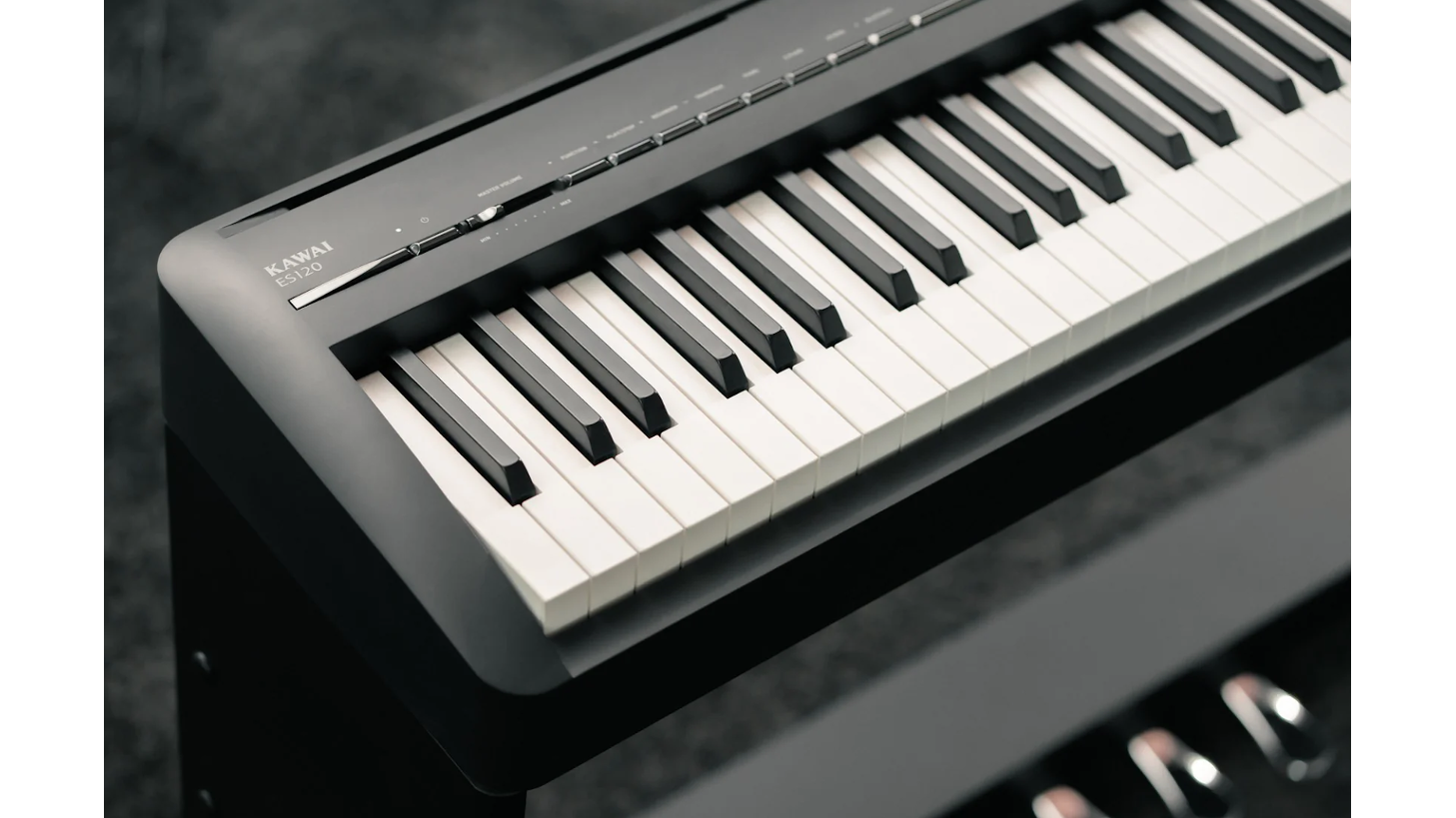
Selecting a first digital piano often comes down to priorities. The Kawai ES120 emphasizes portability and acoustic realism, while the Roland FP-30X offers versatility and advanced features — even their six-pound weight difference shapes the choice.
The global digital piano market is projected to grow to US$ 1.83 billion by 2033 (Spherical Insights). Analysts attribute this steady rise to younger generations discovering music through social media, the expansion of online music education, and the use of digital instruments in therapy and home recording.
Features like weighted keys, touch sensitivity, and built-in learning modes have become essential for beginners, while portability and affordability continue to drive consumer interest. This demand has pushed manufacturers to refine entry-level models that deliver both authentic sound and practical convenience.
Two instruments consistently rise to the top of beginner recommendations: the Kawai ES120 and Roland FP-30X. Both deliver quality weighted actions and convincing sound engines, yet each represents a different design philosophy.
The Kawai ES120 emphasizes simplicity and acoustic authenticity, weighing just 26.5 pounds and drawing on samples from the Shigeru Kawai SK-EX grand piano. Roland's FP-30X, by contrast, adds advanced features such as USB audio recording, broad sound libraries, and deep customization tools in a slightly heavier 32.6-pound frame.
Industry specialists at Sam Ash note that the choice often comes down to whether a player values focused simplicity or versatile functionality.
The Kawai ES120 leans into warmth and authenticity, powered by its Harmonic Imaging (HI) sound engine. Its flagship tone comes from samples of the Shigeru Kawai SK-EX concert grand, celebrated for its organic resonance and layered harmonic detail. With 25 curated voices, the ES120 keeps the palette focused — piano, electric piano, organ, and strings — ensuring quality over quantity. A 192-note polyphony allows complex classical passages and sustained pedal work without dropped notes, giving beginners room to grow without technical limitations.
Roland's FP-30X aims for breadth. Its SuperNATURAL sound engine combines high-resolution sampling with behavior modeling, producing tones that shift dynamically with playing technique. The sound profile is brighter, with pronounced upper frequencies that project well in recordings and ensemble settings. With 56 voices and 256-note polyphony, this model provides a wider creative range, from synths and electric pianos to organs with rotary speaker effects.
The Kawai ES120 uses the Responsive Hammer Compact (RHC) action to deliver a lighter and quicker touch that beginners often find approachable for long practice sessions. The updated version includes improved cushioning to reduce mechanical noise and extend durability. Its graded hammer system mirrors the heavier feel of bass keys and the lighter response of treble keys, closely resembling the behavior of an acoustic piano. While the keys feature smooth plastic surfaces rather than textured coatings, the action provides solid feedback for developing technique and remains especially appealing to players transitioning from upright pianos.
The FP-30X features the PHA-4 Standard action, regarded as one of the most refined weighted key actions in its class. Triple-sensor detection captures subtle nuances and supports fast note repetition, while the escapement mechanism recreates the gentle "let-off" feel of an acoustic grand. The ivory- and ebony-textured key surfaces provide grip, helping prevent slipping during demanding passages. With its heavier resistance and robust construction, the PHA-4 action aligns closely with acoustic performance standards, offering beginners a strong foundation and advanced players precise control.
Both instruments include educational tools, but their approaches differ. The Kawai ES120 offers built-in lesson modes with exercises drawn from standard method books, giving beginners structured material to build foundational skills. Roland's FP-30X leans on app integration, with the Piano Partner 2 app delivering rhythm tracks, sound editing, and practice features. Both models support Bluetooth MIDI and audio, enabling wireless use with learning platforms such as Flowkey or Simply Piano, while also streaming music through their onboard speakers.
Recording is another area of divergence. The ES120 includes basic MIDI recording, useful for practice review but limited without external equipment for audio capture. The FP-30X includes a built-in USB audio interface, allowing direct recording into digital audio workstations — a professional-grade feature attractive to beginners interested in composition or home studio projects. Both models also double as Bluetooth speakers for casual playback and backing track support.
The ES120's 25 voices reflect Kawai's focus on quality and restraint, covering acoustic and electric pianos, organs, and strings without overwhelming choice. The FP-30X expands the palette with 56 voices, including vintage e-pianos, jazz organs, orchestral strings, and modern synth patches. The broader library encourages exploration across genres, appealing to learners who want flexibility as they progress.
Sam Ash notes that this branching often mirrors player intent: the ES120's simplicity supports structured growth, while the FP-30X's features appeal to those drawn to recording, customization, and genre-hopping.
Portability is a key distinction between the two models. At 26.5 pounds, the Kawai ES120 is light enough for students carrying it between lessons or musicians moving between practice spaces and small venues. Its compact frame makes transport straightforward without sacrificing playability.
Roland's FP-30X weighs in at 32.6 pounds — still within portable range but noticeably heavier. That added weight translates into greater stability and a more solid feel on stage, minimizing movement during energetic performances. For players who rarely move their instrument, the extra heft becomes an advantage rather than a drawback.
Built-in speakers shape both practice sessions and small-scale performances. The ES120's 20-watt dual speakers emphasize warmth, with tone ports boosting bass response and delivering a rounded, acoustic-like sound. This setup suits personal practice and intimate settings.
The FP-30X edges ahead with 22 watts of output and a broader frequency range. It maintains clarity at higher volumes, handling dynamic shifts without distortion. For learners planning to play in ensembles or perform in small venues, the stronger projection can be a deciding factor.
The Kawai ES120 stands out for its acoustic focus, offering a warm tone and straightforward design that favor traditional piano study. Its lighter weight and built-in lesson materials support students who want to develop core skills without distraction. With an emphasis on touch and tonal authenticity, it provides a natural stepping stone for those planning to transition to acoustic instruments.
The Roland FP-30X appeals to beginners who value versatility and long-term growth. Its expanded feature set — ranging from a larger voice library to advanced connectivity and recording options — suits learners exploring multiple genres or planning to integrate their piano into a broader creative setup.
According to Sam Ash specialists, both models represent strong value in their category, though finding the best fit depends on whether the priority is focused acoustic realism or expansive digital capability.


