Choosing between a $300 golf mat and a $1,500 premium option seems straightforward until you factor in joint protection, long-term replacement costs, and how each system’s technology actually affects your swing development.
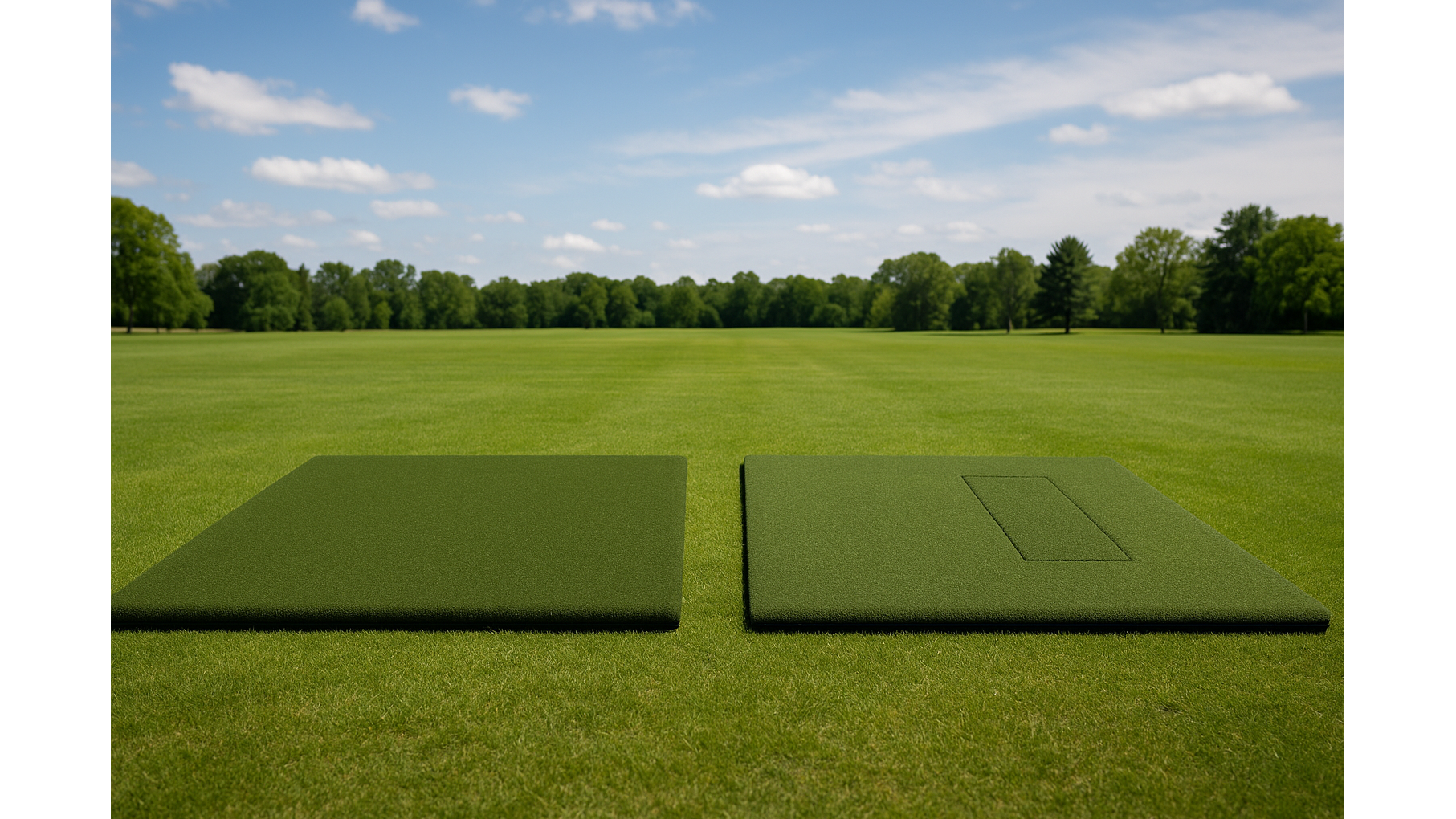
Choosing the right golf mat can transform practice sessions from joint-punishing ordeals into productive training that actually improves course performance. When comparing two industry leaders—FiberBuilt's premium bristle technology against Carl's Place HotShot's modular design—the decision ultimately comes down to balancing performance expectations with budget realities.
The fundamental difference between these mat systems becomes apparent the moment club meets surface. FiberBuilt mats deliver what many teaching professionals consider the gold standard in realistic turf interaction. Their patented fiber technology creates a hitting surface that genuinely allows clubhead penetration through the hitting zone, mimicking the divot action experienced on well-maintained fairways.
Carl's Place HotShot mats take a different approach entirely. Instead of engineering one ultra-premium surface, they've created a modular system where golfers can choose between Foam Flex and Gel Touch hitting strips. Golf Simulator Depot offers these customizable HotShot systems that allow users to tailor their hitting experience based on personal preferences and joint comfort needs.
The performance gap isn't as dramatic as price differences might suggest. Both systems effectively eliminate the "mat bounce" problem that plagues budget options, where clubs skip off hard surfaces and artificially improve mishit results. However, FiberBuilt's consistency across the entire hitting area provides more uniform feedback, while HotShot's replaceable strips may offer slightly different characteristics as they wear and age.
FiberBuilt's core innovation centers on vertically oriented polymer fibers that behave remarkably like real grass. Unlike traditional artificial turf mats that use compressed foam or rubber underlayment, these dense fiber beds allow clubheads to penetrate slightly and continue downward through impact. Each fiber strand is embedded into a heavy-duty base that prevents extraction over time, even after thousands of aggressive strikes.
This bristle construction maintains consistent performance characteristics across temperature variations—crucial for garage practice spaces during winter months. The fiber technology has been tested to withstand over 300,000 hits without significant performance degradation, with professional teaching facilities like GolfTec relying on FiberBuilt mats for daily instruction.
The HotShot system revolutionizes mat maintenance through its replaceable hitting strip design. The base mat features a rectangular channel where golfers insert their choice of hitting surface—either the softer Foam Flex option or the firmer Gel Hitting strip. When the hitting area wears beyond acceptable limits, users simply replace the strip rather than purchasing an entirely new mat.
This modular approach addresses one of the biggest problems with traditional mats: the wear pattern that develops in the sweet spot after extended use. HotShot Hitting inserts are designed to handle significant use before requiring replacement, with costs ranging from $80-280 per strip. The surrounding commercial-grade turf base is designed to last through multiple strip changes.
The tactile differences between these systems become most apparent during iron and wedge practice. FiberBuilt's fiber technology creates authentic divot action where fat shots feel appropriately punishing without the jarring impact that damages joints. Pure strikes reward golfers with that satisfying sensation of compressing the ball cleanly, similar to premium fairway conditions.
HotShot's dual strip options cater to different preferences. The Foam Flex provides a softer, more forgiving experience that many recreational golfers find comfortable for extended sessions. The Gel Touch strip delivers firmer feedback that better players often prefer for precise strike location awareness, though some users report it's slightly more forgiving on fat shots compared to FiberBuilt's uncompromising feedback.
FiberBuilt mats represent a "buy once, use for years" philosophy. Their Grass Series mats are guaranteed for up to 300,000 shots from the same divot area, translating to roughly 5-7 years of regular use for most golfers. The integrated design eliminates weak points or seams that might fail prematurely, but also means the entire mat must be replaced once the hitting area eventually wears beyond acceptable limits.
The HotShot system approaches durability through planned component replacement. While individual strips may need changing every 1-2 years for moderate users, this targeted replacement strategy often proves more economical long-term. The base mat itself uses commercial-grade materials designed to survive multiple strip changes, potentially extending total system life beyond integrated mats that require complete replacement.
A practical comparison reveals interesting economics. A serious golfer hitting 200 balls daily might wear through three HotShot strips over five years at approximately $300 in replacement costs (as a hypothetical example). That same usage pattern could require one complete FiberBuilt mat replacement, essentially doubling the initial investment. However, occasional golfers might find either system lasts the full five years without replacement, making FiberBuilt's premium performance potentially worthwhile.
The math shifts dramatically based on usage patterns. High-volume users often find HotShot's modular design more economical, while occasional practitioners may prefer investing in FiberBuilt's premium, maintenance-free experience. Consider your realistic practice frequency when calculating long-term value rather than wishful thinking about future dedication.
FiberBuilt mats are engineered to significantly reduce shock transfer compared to traditional artificial turf mats, making them a preferred choice for teaching professionals who hit hundreds of demonstration shots daily. The fiber construction allows gradual clubhead deceleration rather than abrupt stopping, dramatically reducing forces transmitted through hands, wrists, and arms.
Carl's Place HotShot mats feature foam divot strips designed to minimize strain on wrists and elbows, allowing for longer, more comfortable practice sessions. The Foam Flex option provides superior shock absorption among HotShot's choices, creating an ultra-soft landing that some users find preferable to FiberBuilt's firmer consistency. One Reddit user noted that after switching to a Carl's Place mat, back pain issues were resolved, suggesting potential comfort benefits.
The difference in joint stress becomes most noticeable during extended practice sessions. FiberBuilt's consistent shock absorption maintains uniform comfort throughout hundreds of swings, preventing the unpredictable feedback that increases injury risk. The fiber technology particularly benefits players with aggressive swings who take substantial divots, as the surface accommodates steep attack angles without harsh rebound.
HotShot's customizable comfort levels allow golfers to match their physical needs with appropriate strip selection. Players with existing joint issues often prefer the Foam Flex option's extreme softness, while healthy golfers might choose the Gel Touch strip for feedback. This adaptability represents a significant advantage for households with multiple users having different comfort requirements.
FiberBuilt positions itself firmly in the premium segment, with popular Studio series mats ranging from $600 for compact models to $1,500+ for larger configurations. Their commercial-grade options used in teaching facilities can exceed $2,000 depending on size and features. This significant investment reflects proprietary technology and professional-grade positioning.
Carl's Place HotShot systems offer substantially more affordable entry points, with complete systems typically ranging from $300-600 depending on size and included accessories. This price advantage becomes even more pronounced with larger configurations, where FiberBuilt's premium pricing scales up considerably. For budget-conscious golfers building complete simulator setups, this difference alone may drive purchasing decisions.
Beyond initial purchase price, total ownership costs reveal important distinctions. FiberBuilt's all-or-nothing replacement approach means eventual replacement equals the full original purchase price, though this typically occurs after years of heavy use. The lack of ongoing maintenance requirements appeals to golfers who prefer set-and-forget solutions.
HotShot's component replacement strategy creates different cost dynamics. Strip replacements at $80-280 each occur more frequently but cost significantly less than complete mat replacement. This approach particularly benefits high-volume users who would otherwise cycle through multiple complete mats over several years of dedicated practice.
FiberBuilt offers several product lines to accommodate different space constraints. Their flagship Player Preferred Studio mats come in 4'x7' and 4'x9' configurations that provide ample stance room while maintaining reasonable footprints for home use. Compact options like the Practice Station (3'x5') deliver professional-grade performance in space-constrained environments. Additional sizes include 4'x4', 4'x6', 4'x8', 4'x10', 5'x5', and 6'x6' configurations across their various product lines.
All FiberBuilt models maintain consistent 1.5-inch thickness with weight increasing proportionally. A 4'x7' model weighs approximately 50-60 pounds, providing excellent stability but making frequent repositioning challenging. Most users treat FiberBuilt mats as semi-permanent installations rather than equipment for regular storage.
Carl's Place offers HotShot systems in standardized configurations including popular 4'x5' and 5'x5' models that balance adequate stance room with compact footprints. Extended options reach 6'x10' for golfers with generous space allocations, with additional sizes including 4'x7', 4'x9', 5'x7', and 5'x8' configurations. The hitting strip size remains consistent across all models.
The lighter construction (30-40 pounds for comparable sizes) makes HotShot systems more portable and suitable for multi-purpose spaces. The modular design also simplifies storage, as components can be separated when not in use. This flexibility particularly benefits golfers sharing practice space with other activities.
The choice between these systems ultimately reflects priorities and practice patterns. FiberBuilt mats represent the gold standard for serious golfers who demand authentic feedback and practice extensively. Their professional-grade performance, consistent shock absorption, and proven durability justify premium pricing for dedicated practitioners building permanent setups with other high-end components.
HotShot systems emerge as the superior value proposition for most recreational golfers. The modular design delivers 90% of premium performance at roughly half the cost, while offering practical advantages in maintenance economics and space flexibility. For typical golf enthusiasts balancing quality needs with budget constraints, HotShot represents optimal performance-to-price ratio.
Consider FiberBuilt if you're a serious competitor, practice daily, have joint concerns requiring consistent shock absorption, or are building a permanent facility with premium components throughout. Choose HotShot if you're budget-conscious, practice moderately, need portability, or want the flexibility of customizable hitting surfaces and lower long-term maintenance costs.
Both manufacturers have earned loyal followings by solving real problems that budget mats create—joint punishment, unrealistic feedback, and poor durability. Either choice represents a significant upgrade that will improve practice quality and protect long-term joint health compared to cheaper alternatives that can actually harm improvement efforts.
For guidance on building your complete home golf simulator setup with quality components that work together seamlessly, Golf Simulator Depot offers expert advice and premium equipment to transform any space into a professional-grade practice facility.
Having tested both mat systems extensively and engaged with hundreds of users across various skill levels, certain questions consistently arise when golfers are deciding between these options. Below I've addressed the most common concerns to help you make an informed decision based on your specific needs and practice environment. While individual preferences always play a role in equipment selection, these answers reflect the consensus experience of the broader golfing community.
Both FiberBuilt and HotShot mats accommodate real wooden tees, though with different implementations. FiberBuilt's fiber technology allows wooden tees to be inserted directly into the hitting surface anywhere across the mat, similar to natural turf. The fibers part to accept the tee and hold it securely at your preferred height. This natural tee insertion represents a significant advantage for driver practice where precise tee height can substantially impact performance and feedback.
The HotShot system handles tees differently depending on which hitting strip you're using. The Foam Flex strip allows direct tee insertion similar to FiberBuilt, though some users report slightly less stability with longer tees. The Gel Touch strip doesn't accommodate direct tee insertion due to its density, but Carl's Place provides specific tee holders that insert into pre-cut holes in the strip. These holders work well but limit tee positioning to these fixed locations rather than allowing placement anywhere on the surface.
Neither FiberBuilt nor HotShot mats cause significant club damage when used properly. Both manufacturers have specifically engineered their surfaces to minimize the abrasive effects common with budget mats that can wear down club grooves and damage finishes. FiberBuilt's fiber technology creates virtually no abrasion since the fibers yield to the clubhead rather than scraping against it. The most aggressive wedge practice produces minimal club wear comparable to playing from tight fairway lies.
Both mat systems can be used outdoors, but with important considerations. FiberBuilt mats are fully weatherproof and UV-resistant, making them suitable for permanent outdoor installation in all but the most extreme climates. The heavy-duty rubber base provides excellent drainage and stability, while the fiber technology maintains consistent performance characteristics even when wet. Many driving ranges and outdoor teaching facilities use FiberBuilt mats year-round with excellent longevity.
The HotShot system is weather-resistant but generally recommended for temporary outdoor use rather than permanent installation. The modular design creates seams between components that can potentially collect debris or allow water penetration with extended outdoor exposure. For occasional outdoor practice sessions or seasonal use, the HotShot performs admirably, but for permanent outdoor installation, FiberBuilt's integrated design offers superior weatherproofing and longevity.
Country Club Elite mats take yet another approach to creating realistic turf interaction, using a dense, firm material that allows clubs to take divots by actually cutting into the surface material. This creates authentic feedback and divot action but typically delivers more significant shock to the hands and wrists than either FiberBuilt or HotShot mats. Many golfers find Country Club Elite mats provide excellent performance but can be physically demanding during extended practice sessions, potentially limiting practice volume for players with joint sensitivity.
When comparing performance characteristics, FiberBuilt provides the most balanced combination of authentic feedback and joint protection, making it ideal for high-volume practice. The HotShot system, particularly with the Foam Flex strip, offers superior shock absorption at a lower price point but with slightly less realistic turf interaction than either FiberBuilt or Country Club Elite. Country Club Elite excels in feedback authenticity but requires careful management of practice volume to avoid potential joint strain.


