Analyst Tom Sayja believes Elon Musk’s “Manifested AI” marks a turning point where intelligence moves from software to the physical world—fueling demand for energy, metals, and data systems that could drive the next trillion-dollar technology cycle.
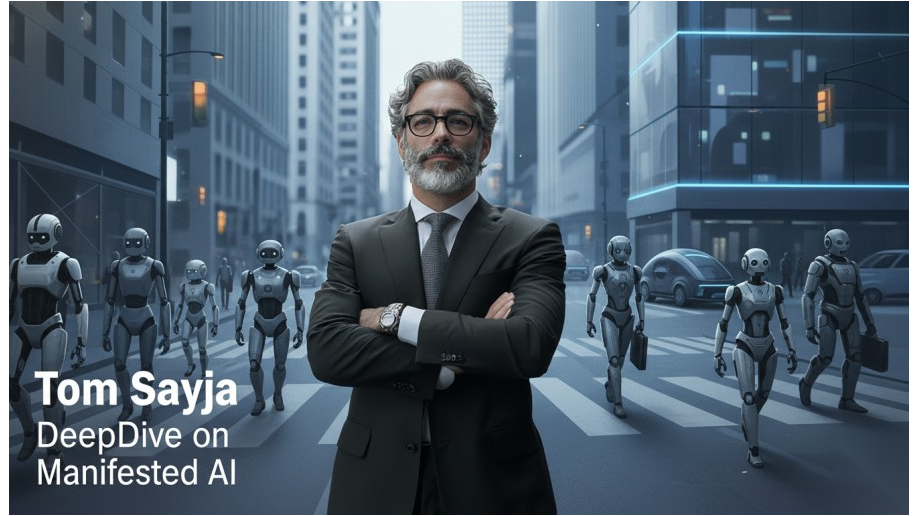
Artificial intelligence has outgrown its digital shell.
It now lives in engines, satellites, robots, and the invisible networks that bind them together.
This transformation—what Elon Musk calls Manifested AI—isn’t about smarter chatbots. It’s about systems that act in the real world: machines that see, move, decide, and reshape physical economies.
Independent analyst Tom Sayja, publisher of The DeepDive Letter, has spent months tracing how Musk’s ecosystem is driving this change. He argues that Manifested AI marks the start of a new investment cycle: one measured not in downloads or users, but in power grids, data links, and tons of refined metal.
AI began as math—code trained on data. But Manifested AI moves from cognition to construction.
Sayja calls it “the moment when intelligence stops being abstract and starts consuming resources.”
He explains the distinction in his analysis of Manifested AI Stock - Jeff Brown. The report argues that the next generation of value creation won’t come from the apps riding on AI, but from the companies building its physical backbone—semiconductors, power systems, robotics, and connectivity.
“AI is no longer weightless,” Sayja writes. “Every unit of intelligence now has a footprint in electrons, materials, and machines.”
This shift changes how economies grow. Software once scaled infinitely; Manifested AI scales only as fast as factories and supply chains allow. That’s why Musk’s projects—from xAI to Starlink—are effectively industrial ventures disguised as technology plays.
Observers often treat Musk’s companies as separate experiments. Sayja sees a single architecture forming beneath them.
Sayja notes that each layer feeds the next, creating a self-reinforcing cycle of intelligence and infrastructure.
He explored this dynamic in Project Colossus - Elon Musk xAI, describing it as “a planetary feedback loop where data, power, and movement teach one another how to think.”
This loop is what distinguishes Manifested AI from previous tech eras. It’s vertically integrated, geographically distributed, and constantly learning. Every Tesla on the road becomes both a sensor and a contributor. Every Starlink node extends the nervous system of that learning.
When Musk says AI will “manifest,” he means exactly that: the intelligence is leaving the lab and entering the grid.
If AI now acts in the real world, it needs matter to do it.
That’s where Sayja’s concept of AI Metals comes in.
He traces the idea in 100-Trillion AI Metal Stock, arguing that rare-earth elements, copper, nickel, lithium, and advanced alloys form the new critical infrastructure of cognition. “Every model runs on mined reality,” he writes. “Without the materials, there is no machine learning—only theory.”
Semiconductors already consume nearly 10 % of the world’s silver output. Data centers rival nations in power demand. Each new AI accelerator built for autonomy or energy management increases the strain on mineral and grid supply lines.
In Sayja’s view, that strain is precisely where opportunity hides.
Historically, every digital boom has produced an industrial echo: railroads after telegraphs, power plants after electrification, and now materials supply chains after artificial intelligence.
He frames the pattern simply:
“Software creates demand; hardware translates it; materials sustain it.”
Beyond metals, Manifested AI requires unprecedented power density.
In his piece on Quantum Keystone - Helium-3, Sayja examines experimental energy sources such as helium-3 fusion and quantum materials. These may one day supply AI infrastructure with cleaner, denser energy than fossil or solar grids can deliver.
The logic is straightforward: AI inference consumes electricity at a rate proportional to data scale. If intelligence doubles, energy demand more than doubles. Helium-3, superconductors, and solid-state innovations could eventually bend that curve.
Sayja doesn’t treat these technologies as near-term investments. Instead, he uses them to illustrate how AI forces the physical sciences to accelerate. “The intelligence economy,” he writes, “pulls the future forward in watts, not just lines of code.”
Space is the next frontier of Manifested AI.
Musk’s Starlink network already blankets most of the planet, providing low-latency connectivity to rural regions, oceanic routes, and developing economies. Sayja points to Elon Musk’s Trillion-Dollar Starlink IPO as an example of how AI infrastructure and orbital infrastructure now overlap.
He notes that every satellite in orbit doubles as a relay node for AI systems on Earth. As edge computing expands, data will no longer travel back to central clouds—it will be processed locally, transmitted briefly, and re-learned globally through Starlink’s network.
That dynamic, Sayja argues, transforms Musk’s space ventures from communication plays into intelligence logistics. “Starlink isn’t selling internet,” he writes. “It’s selling cognition bandwidth.”
Sayja categorizes Manifested AI as the fifth great market cycle of the modern era.
Each cycle begins with abstraction—new ideas—and ends with embodiment—new infrastructure.
He estimates that each of these transformations unfolded over roughly 20 years, with the early adopters capturing the structural gains while speculators chased derivatives. The first decade builds; the second monetizes.
Manifested AI, he suggests, is currently in its first-decade phase: the building.
That means the real opportunities lie in materials, manufacturing, and connectivity—the same places most investors overlook because they appear “old economy.”
In The DeepDive Letter, Sayja teaches a simple framework: Mechanism → Cost → Constraint → Cycle.
Applying that lens, Manifested AI’s mechanism is distributed intelligence; its cost is energy; its constraint is physical scale; and its cycle is the re-industrialization of technology itself.
By viewing Musk’s ecosystem through this model, Sayja concludes that the next trillion-dollar gains will stem not from AI software valuations, but from the companies solving these physical constraints—energy storage, chip yields, quantum materials, and global connectivity.
Not all analysts agree on the timeline. Technology strategist Derek Goudy believes the infrastructure phase could take longer than markets expect. “Manifested AI will happen,” he says, “but physics and regulation move slower than capital.”
Goudy warns that power availability, environmental limits, and data-governance frameworks will dictate the real pace of deployment. He calls it “the constraint cycle inside the hype cycle.”
Sayja doesn’t dispute the friction. He frames it as a normal phase transition: enthusiasm outruns capacity, then capacity catches up. In his view, that adjustment period is what separates speculative manias from structural wealth creation.
“Every system hits resistance,” he says. “The ones that endure are built around it.”
Governments now face an unfamiliar problem: intelligence has become infrastructure.
Nations are competing not just for chip fabs but for entire AI supply chains—minerals, ports, energy, and launch capacity.
Sayja notes that energy policy and tech policy are converging. Data centers are drawing up power agreements once reserved for heavy industry. Grid planners model AI inference demand alongside manufacturing loads. “The same math that built steel mills is now building model farms,” he observes.
Meanwhile, Musk’s enterprises blur the line between private and public utility. SpaceX launches communication satellites that support both consumers and governments. Starlink connects remote military units as easily as rural schools. xAI’s models train on public data while powering private systems.
That hybrid role, Sayja argues, is the hallmark of every new industrial backbone—just as railroads and telegraphs began as ventures and became public necessities.
For individuals and institutions alike, the Manifested AI era calls for a change in lens.
Investing in the “next AI stock” may be less effective than positioning around the inputs—materials, manufacturing, logistics, and power density.
Sayja advises readers to study how previous cycles matured. The winners weren’t always the first innovators but the enablers: steel and energy in the age of rail, copper and utilities in the age of electricity, bandwidth and semiconductors in the age of the internet.
The takeaway is pragmatic. Diversification within physical enablers of AI may prove more resilient than concentration in a few high-multiple software names. The infrastructure phase rewards patience, not momentum.
“Manifested AI isn’t a headline,” Sayja writes. “It’s a buildout measured in kilowatts and kilometers.”
Beyond markets, Manifested AI suggests a deeper shift in how humanity defines intelligence. Once a metaphor for software progress, AI is now embedded in transportation, energy, and communication—the core layers of civilization.
Sayja sees that as both a responsibility and an opportunity. “We’re industrializing cognition,” he says. “That demands the same ethical discipline we applied to power or medicine.”
He argues that the challenge is not to slow AI but to ground it—to make it measurable, accountable, and physically sustainable. In other words, to ensure that the manifestation serves people, not the other way around.
The evidence is mounting that Musk’s “Manifested AI” vision is more than branding. It is a structural blueprint for the next stage of technological capitalism. From rare-earth mining to orbital connectivity, each layer of his ecosystem contributes to a unified architecture of real-world intelligence.
Tom Sayja summarizes it in one line from his latest research:
“The next cycle won’t look like the last. Intelligence has become an industry, and the world itself is the factory.”
The trillion-dollar question isn’t if this cycle unfolds—it’s how fast the world can build to meet it.
About Tom Sayja Media
Tom Sayja Media publishes The DeepDive Letter and Podcast, offering independent, evidence-based analysis on markets, money, and real assets. Its mission is to translate complexity into clarity and help readers think in cycles, not headlines.
Disclosure: For informational purposes only. Not financial advice.


