Most Orlando homeowners think they have a few days to deal with water damage before mold becomes a problem. The reality is far more urgent—and the timeline more alarming than you’d expect, especially in Florida’s humidity.
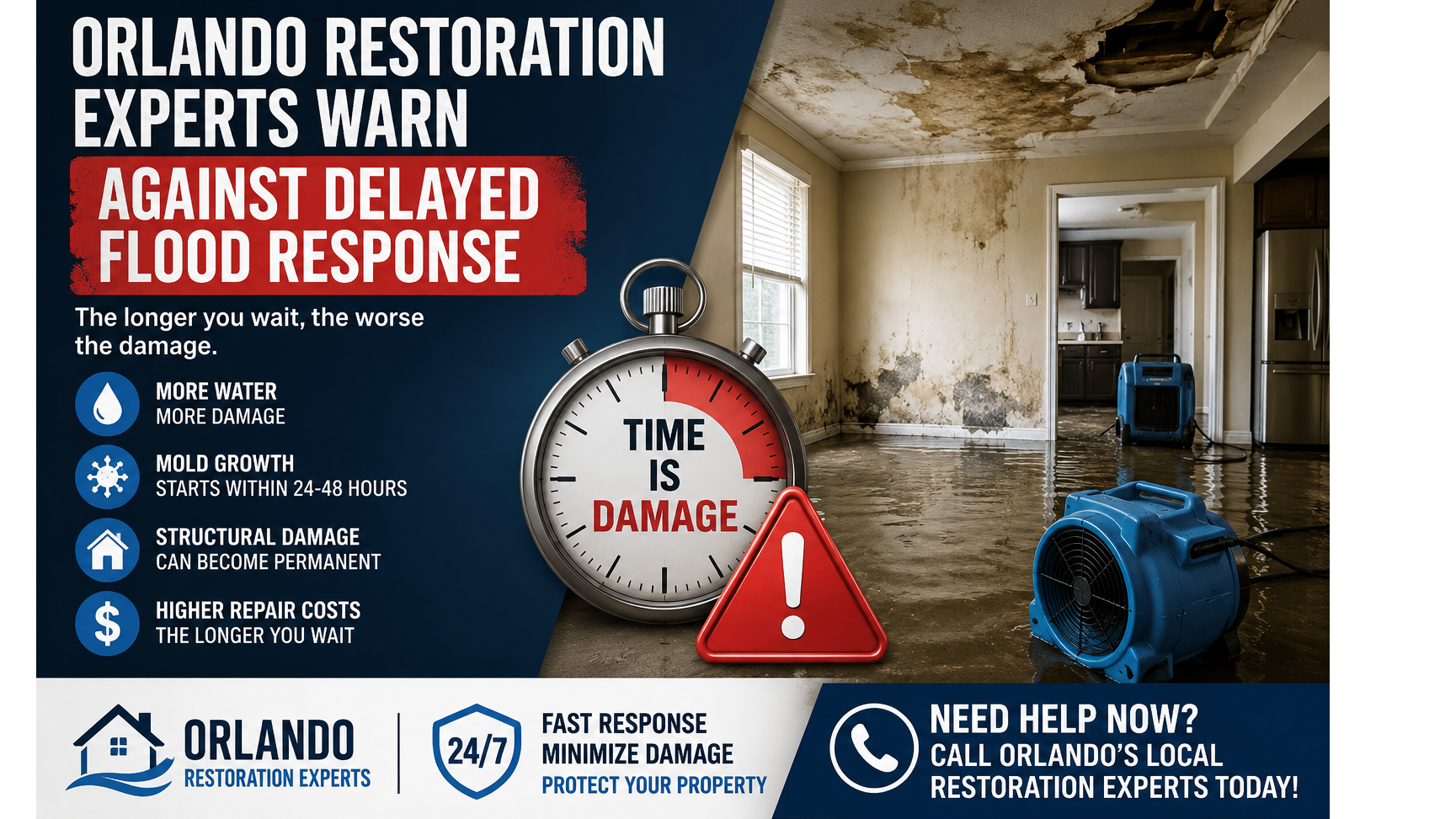
A burst pipe, a leaking roof, a flash flood — water damage rarely announces itself politely. What happens in the hours and days that follow, however, can determine whether a property owner deals with a manageable cleanup or a full-scale mold crisis. For Orlando residents and business owners, the stakes are especially high. The city's warm, humid climate doesn't just make life comfortable — it makes mold extremely comfortable too. Understanding the precise timeline of mold growth after water damage isn't just interesting science; it's essential knowledge for protecting any property in Central Florida.
There's a common and costly misconception that mold takes several days to become a problem after water damage. In reality, the clock starts much sooner. Mold spores — microscopic particles that float invisibly through virtually every indoor environment — begin germinating within 24 hours of coming into contact with moisture. The U.S. Environmental Protection Agency (EPA) advises that if a property cannot be thoroughly dried within 24 to 48 hours following a flood, mold growth should simply be assumed.
That's not a worst-case warning — that's the baseline expectation. The IICRC (Institute of Inspection, Cleaning and Restoration Certification), the leading standards body in the restoration industry, formally establishes that mold growth generally begins within 24 to 48 hours of water damage occurring. This is the professional benchmark that drives restoration urgency, and it's the standard that Workman Restoration Orlando operates by when responding to water emergencies across Central Florida.
The takeaway here is straightforward but critical: waiting to see if mold appears is already waiting too long. By the time visible patches show up, the growth process has been underway for at least a full day — often longer. Acting within that first 24-hour window isn't an overreaction. It's the only window that reliably prevents a mold problem from taking hold.
Mold doesn't need a dramatic flood to thrive — it needs moisture, an organic surface, and warmth. Humidity levels consistently above 60% are enough to sustain and accelerate mold growth on their own. Below that threshold, mold struggles to get started. Above it, the process moves quickly, especially when combined with wet building materials from a water intrusion event. This 60% mark isn't an arbitrary number; it represents the point at which ambient moisture in the air becomes sufficient for spores to germinate and colonies to establish themselves even on surfaces that appear dry to the touch.
Orlando sits firmly in a subtropical climate zone, and the humidity data reflects that. Outdoor relative humidity in the Greater Orlando area routinely exceeds 70% — particularly during the summer rainy season, which also happens to be when water damage events from storms and flooding are most common. That overlap is significant. A property that experiences water intrusion in July or August isn't just dealing with wet materials; it's dealing with wet materials surrounded by air that's already primed to support rapid mold colonization.
This is the environmental reality that separates an Orlando water damage event from one in, say, Phoenix or Denver. In drier climates, building materials may air out naturally over a few days without a major mold risk. In Orlando, that approach invites disaster. The humidity in the surrounding air slows the natural evaporation process while simultaneously feeding the mold growth cycle — a double problem that demands professional-grade dehumidification and extraction, not open windows and box fans.
Within hours of water intrusion, mold spores already present in the environment — on surfaces, in dust, in the air — begin responding to the moisture, with germination typically starting within 24 hours. They don't need to travel far or arrive from outside. By the time a water damage event is discovered and assessed, germination may already be underway. During this initial phase, there are no visible signs. The threat is entirely invisible, which is precisely why the first 24 hours represent the most critical window for intervention. Extraction and drying equipment deployed in this window can prevent germination from progressing to active growth.
Between the 24- and 48-hour marks, the IICRC's established threshold for active mold growth is typically reached, as germinating spores transition into active colonies. Those colonies begin producing hyphae — the thread-like structures that anchor mold into porous materials. At this stage, mold isn't just present; it's establishing itself inside building materials. Drywall paper, wood framing, and carpet backing are all prime targets during this phase. The colony isn't yet visible, but it is actively digesting the material it's growing on. Professional moisture mapping and targeted drying during this window can still halt the process, but the response needs to be thorough — surface drying alone won't address moisture already absorbed into structural materials.
Under favorable growth conditions, visible mold patches can begin to appear on some materials within 48 to 72 hours following a water intrusion event. Certain materials, particularly drywall with paper facing and natural-fiber carpeting, are especially susceptible within this window. The appearance of visible growth is often treated as the starting point for concern, but it actually signals that the problem is already days old and potentially widespread. At the 48-72 hour mark, remediation shifts from prevention into active mold removal — a more involved and costly process.
After 72 hours without effective intervention, mold growth moves beyond surface materials and into the hidden architecture of a building. Wall cavities, subfloor assemblies, ceiling voids, and HVAC ductwork all become potential colonization zones. This is the phase where a localized water damage event becomes a whole-property mold problem. HVAC systems are a particular concern: once mold establishes itself in ductwork, the system actively distributes spores throughout the entire property every time it runs. By the time visible signs appear on walls or ceilings, it has likely already been growing for days in areas that require invasive inspection to access and address.
Mold is, at its core, a decomposer. It breaks down organic material to extract nutrients, and modern buildings are full of it. The most vulnerable materials in any water-damaged property include:
The common thread across all of these materials is porosity. Porous surfaces absorb and retain moisture, giving mold the sustained wet environment it needs to grow deep into a material rather than just on its surface. That depth is what makes complete drying — and professional moisture verification — so necessary after any water intrusion event.
The financial case for immediate response is straightforward: mold doesn't pause its damage while a property owner weighs their options. Structural damage costs can escalate significantly within 30 to 60 days, potentially increasing by a substantial margin, as hidden mold spreads and weakens load-bearing materials like wood framing and floor assemblies. What begins as a manageable extraction and drying project can evolve into full-scale structural repairs — sagging floors, cracked or bowing drywall, compromised framing — if the mold is allowed to work undisturbed. Every day of delay narrows the gap between a restoration job and a renovation project.
The health consequences of prolonged mold exposure extend well beyond sneezing and watery eyes, though respiratory irritation is typically the first symptom people notice. Chronic exposure to mold — particularly to mycotoxin-producing species — has been linked to serious and lasting health conditions. A documented case involving a family in a water-damaged home revealed chronic sinusitis and neurological deficits, with mycotoxins detected in both the home environment and the occupants' biological samples. The progression from mild allergic symptoms to chronic respiratory illness to neurological effects isn't theoretical; it's a documented clinical trajectory. Vulnerable populations — children, the elderly, and those with compromised immune systems — face elevated risk even at lower exposure levels.
Insurance policies covering water damage and mold remediation are rarely unconditional. Insurance companies may deny claims outright when professional remediation is delayed, citing negligence or applying gradual-damage exclusions to what was originally a sudden-event claim. In practical terms, this means that waiting — even by a few days — can shift the financial burden of an extensive remediation project entirely onto the property owner. Documenting damage quickly and engaging professional services promptly creates a defensible paper trail that supports rather than undermines the claims process.
The single most effective action after a water intrusion event is the rapid removal of standing water. Every hour that water sits on flooring, against walls, or beneath cabinetry extends and deepens moisture penetration into porous materials. Professional-grade extraction equipment removes far more water, far faster, than any consumer-grade wet vacuum or towel-and-mop approach. Beyond speed, professional extraction is thorough — reaching into floor cavities, beneath baseboards, and into tight spaces where standing water accumulates out of sight. Getting water out in the first hours after damage occurs is what compresses the mold timeline back in the property owner's favor.
Visible water removal is only part of the equation. Moisture that has already been absorbed into wall assemblies, subfloor materials, and insulation is invisible to the naked eye but fully accessible to mold. Thermal imaging and moisture mapping technology — tools used by professional restoration teams — identify pockets of trapped moisture behind finished surfaces without requiring destructive exploratory demolition. This step determines where drying equipment needs to be focused and confirms when materials have reached safe moisture levels. Without it, a property can appear dry while harboring the conditions for active mold growth within its walls.
When moisture is addressed early and completely, mold remediation often remains a preventive measure rather than a reactive one. But when growth has already begun — or when a property is assessed beyond the 24-48 hour window — certified remediation protocols become necessary. This means containment of affected areas to prevent cross-contamination, HEPA-filtered air scrubbing to capture airborne spores, physical removal of colonized materials, and application of antimicrobial treatments to surfaces. Certification in mold remediation isn't just a credential — it reflects training in protocols specifically designed to eliminate mold thoroughly while protecting the health of both occupants and technicians throughout the process.
The science is unambiguous: mold doesn't wait, and neither should a response to water damage. Every hour between a water intrusion event and professional intervention is an hour that mold's biology is working against the property. The 24-hour germination window, the 48-hour active growth threshold, the 72-hour spread into walls and HVAC systems — these aren't abstract benchmarks. They're the actual sequence of events unfolding inside a water-damaged Orlando property right now if action hasn't been taken.
Orlando's climate removes any buffer that property owners in drier regions might have. There is no waiting to see how things dry out, no 48-hour grace period to assess before calling for help. The combination of subtropical humidity, warm temperatures, and organic building materials creates conditions where mold can move from invisible spore to spreading colony before a busy week is over.
The approach that consistently stops mold before it becomes a crisis is also the simplest to describe: get water out fast, verify dryness with equipment, and engage certified professionals who understand both the biology of mold and the specific environmental pressures of Central Florida. That sequence — when executed within the first 24 hours — is what separates a contained water damage event from a months-long remediation ordeal.
For anyone in the Orlando area dealing with water damage right now, or wanting to understand what a proper rapid-response plan looks like, Workman Restoration Orlando provides 24/7 emergency water damage restoration and certified mold remediation services built around exactly these principles.


