Your utility bills might be costing you 40% more than they should—and it’s not your HVAC system’s fault. In Tennessee’s humid climate, the real culprit is something most homeowners never think to check, but the fix could cut your energy costs in half.
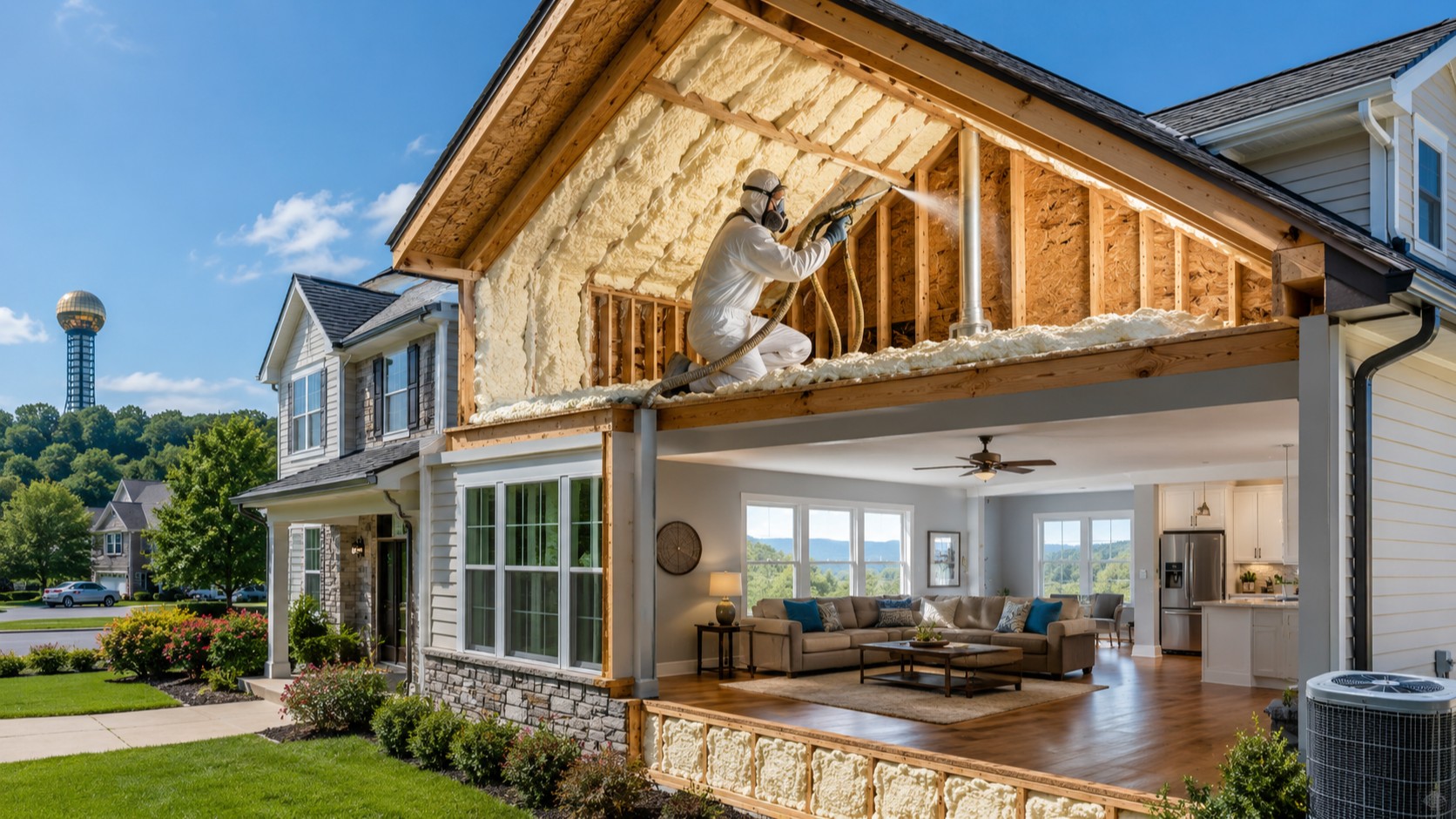
Energy bills in Knoxville don't stay quiet for long. Between sweltering July heat and January cold snaps, HVAC systems run hard — and if a home isn't properly sealed, most of that conditioned air quietly bleeds out through walls, attics, and crawl spaces. Spray foam insulation changes that equation in a measurable way. BST Spray Foam Knoxville works with homeowners and businesses across the area to tackle exactly this problem, offering a local perspective on why the Tennessee climate makes this upgrade particularly worthwhile.
The short answer: yes, spray foam insulation can cut utility bills significantly — and the numbers are well-documented. Industry data consistently points to energy savings of 30% to 50% for homes that make the switch from traditional insulation to spray foam. That's not a marketing claim; it reflects the material's unique ability to function as both an insulator and an air sealant simultaneously.
For comparison, EPA's Energy Star program — which uses conservative, government-backed estimates — acknowledges that properly sealing air leaks and adding insulation can save homeowners roughly 11% to 15% on heating and cooling costs. Spray foam, going further than basic air sealing, routinely exceeds that benchmark.
The reason the savings are so dramatic comes down to physics. Most homes lose energy not just through poorly insulated surfaces, but through hundreds of small gaps and cracks where conditioned air escapes and outdoor air infiltrates. Spray foam expands on contact to fill those gaps completely — something fiberglass batts and blown-in cellulose fundamentally cannot do.
Most homeowners think about insulation in terms of R-value — how well a material resists heat transfer. But there's a second, equally important factor that often gets overlooked: air infiltration. Building science research has found that up to 40% of a building's total energy loss comes not from conduction through walls and ceilings, but from uncontrolled air movement through gaps, seams, and penetrations.
Consider this: every electrical outlet on an exterior wall, every gap around a pipe, every unsealed attic hatch is a pathway for conditioned air to escape and outdoor air to enter. In summer, that means humid outdoor air seeping in while the AC fights to keep up. In winter, cold drafts sneak through while the furnace runs overtime. The result is a home that never quite reaches the comfort it should — and an energy bill that reflects the constant struggle.
Traditional insulation materials — fiberglass batts, cellulose, mineral wool — are designed to slow heat transfer. They do that reasonably well. What they don't do is stop air movement. A perfectly installed fiberglass batt still allows air to flow around it, through it, and past it if the cavity isn't separately air-sealed.
Spray foam expands to fill irregular spaces and adheres directly to surrounding surfaces, creating a continuous air barrier and thermal layer in one application. There are no gaps left behind. No seams. No spots where wind-driven air can bypass the insulation entirely. That's the core reason spray foam outperforms traditional options in real-world energy savings — it addresses both mechanisms of energy loss at once.
Closed-cell spray foam is the denser, more rigid of the two types. It's composed of tightly packed cells filled with a gas that further slows heat transfer, giving it an R-value of R-5.6 to R-8.0 per inch — among the highest of any insulation material available. That means even a relatively thin application can achieve the same thermal resistance as a much thicker layer of fiberglass.
Beyond R-value, closed-cell foam's rigid structure adds measurable compressive strength to walls and roof decking. It also acts as a vapor retarder, which becomes critically important in humid climates. For exterior walls, rim joists, and crawl spaces where moisture is a concern, closed-cell is typically the recommended choice.
Open-cell spray foam is softer, lighter, and more flexible. Its R-value of R-3.5 to R-3.8 per inch is lower than closed-cell, but it still outperforms standard fiberglass batts in real-world conditions because of its air-sealing capability. Open-cell foam is also notably better at soundproofing due to its porous, sponge-like structure.
It's the preferred choice for interior applications — attic cavities, interior walls, and areas where moisture vapor management is less of a priority. The lower material cost compared to closed-cell also makes it an attractive option for larger coverage areas where budget matters.
Knoxville sits in a mixed-humid climate zone — a designation that creates a demanding environment for any building envelope. Summers bring heat indices that can push past 100°F with oppressive humidity, even when actual air temperatures typically peak in the low-to-mid 90s°F. Winters are variable, with temperature swings that can drop into the teens. An insulation system that performs well in only one season is barely doing half its job.
Spray foam handles both extremes effectively. In summer, the airtight barrier keeps humid outdoor air from infiltrating conditioned spaces, reducing both the cooling load and indoor humidity. In winter, the same barrier holds heated air inside, cutting heating demand. The result is year-round energy efficiency — not just seasonal improvement.
Crawl spaces are one of the most problematic areas in East Tennessee homes. The region's humidity, combined with the soil moisture common in lower elevations near the Tennessee River watershed, creates conditions where moisture intrusion is almost guaranteed without proper treatment. Uninsulated or poorly insulated crawl spaces allow damp air to rise into living spaces, contributing to musty odors, wood rot, and worsening indoor air quality.
Spray foam applied to crawl space walls and floors creates an encapsulated environment that dramatically reduces moisture infiltration — one of the most impactful upgrades available to Knoxville homeowners dealing with ongoing humidity issues.
Closed-cell spray foam doesn't just slow moisture — it blocks it. The material's low permeability means water vapor has significant difficulty passing through it, effectively functioning as both insulation and a vapor retarder in a single layer. In a climate like Tennessee's, where mold can take hold quickly in poorly ventilated spaces, this dual function is a meaningful structural and health benefit.
Mold remediation is expensive. Structural damage from long-term moisture exposure is expensive. Closed-cell foam in moisture-prone areas is a preventative investment that often pays for itself before energy savings are even factored in.
One of the least-discussed benefits of spray foam insulation is what it does to HVAC demand. When a building envelope leaks, HVAC equipment has to work continuously to compensate — running longer cycles, fighting against constant heat gain or loss, and wearing out faster than it should.
A properly insulated and air-sealed home dramatically reduces that burden. Research into HVAC system impact has shown that the reduced thermal load from spray foam can allow HVAC unit sizing to be reduced by as much as 35%. For homeowners planning a system replacement or building new construction, that means a smaller, less expensive unit can do the job — and do it while consuming less energy. It also means less wear, longer equipment lifespan, and fewer repair calls.
Even in existing homes where the current HVAC system stays in place, the reduced workload translates directly to lower runtime — which shows up on the monthly utility bill.
Spray foam costs more upfront than fiberglass batts or blown-in cellulose. That's a straightforward fact. But the financial analysis shifts significantly when viewed over time. Financial and ROI research consistently puts the payback period for spray foam insulation at 3 to 5 years, after which the energy savings continue for the life of the home — often 20 to 30+ years.
Homeowners who have made the switch consistently report lower energy bills even after moving into larger homes, specifically attributing the savings to spray foam insulation. While every home is different, the pattern holds — the upfront investment is recovered, and the savings continue to compound over time.
The Inflation Reduction Act changed the financial picture for insulation upgrades in a meaningful way. Homeowners who install qualifying insulation and air sealing materials can now claim a federal tax credit of 30% of the cost of qualified energy efficiency improvements, up to $1,200 per year across all eligible improvements. That's real money back — not a deduction, but a direct credit against taxes owed.
This incentive effectively reduces the net cost of a spray foam project from day one, accelerating the payback timeline and making the total investment considerably more manageable for most households.
Beyond federal incentives, Knoxville residents have access to locally-focused programs. The KUB Home Uplift program, administered through Knoxville Utilities Board, provides weatherization assistance and energy efficiency upgrades to qualifying households — potentially including insulation improvements. The City of Knoxville has also participated in the Knoxville Smarter Cities Partnership, which has driven additional resources toward residential energy efficiency.
These local programs are worth researching before starting any insulation project. Combined with the federal tax credit, they can meaningfully reduce the out-of-pocket cost of an upgrade that will pay dividends for decades.
The attic is often the single greatest source of energy loss in a Knoxville home. Heat rises, and without proper insulation, it escapes freely through the roof in winter — and radiant heat pours down from a sun-baked roof deck in summer. Spray foam applied to attic rafters or the attic floor creates a continuous thermal and air barrier that dramatically cuts that exchange. In humid Tennessee summers, it also helps prevent moisture-laden outdoor air from condensing inside the attic structure.
As discussed, crawl spaces in Knoxville are a persistent challenge. BST Spray Foam addresses this with encapsulation-style applications that seal crawl space walls and rim joists, turning a damp, drafty void into a conditioned or semi-conditioned buffer zone. Floors above treated crawl spaces stay warmer in winter, HVAC ducts running through the space perform more efficiently, and moisture-related damage becomes far less likely.
Exterior walls are the primary thermal boundary of any building. Whether it's a new construction project or a retrofit on an older Knoxville home, spray foam in wall cavities delivers superior performance compared to standard batts — filling the cavity completely and leaving no thermal bridging gaps. This is particularly impactful for homes with older construction where settling and irregular framing have left conventional insulation performing well below its rated value.
Open-cell spray foam's porous structure makes it highly effective at absorbing and dampening sound transmission. For homeowners dealing with road noise, noisy neighbors, or simply wanting to reduce sound transfer between rooms and floors, spray foam offers a dual benefit — improved thermal performance and noticeably quieter living spaces. One installation that solves two separate comfort problems simultaneously.
High utility bills aren't inevitable. In most Knoxville homes, the gap between what energy should cost and what it actually costs comes down to an unsealed building envelope — and that's a solvable problem. The data is consistent: spray foam insulation reduces energy bills, improves comfort, protects against moisture damage, and pays for itself within a few years. With federal tax credits and local programs available to help offset upfront costs, there's rarely been a better time to act.
For homeowners and businesses in Knoxville, Maryville, Oak Ridge, Sevierville, and surrounding areas, BST Spray Foam Knoxville offers free estimates and walks through the full insulation process — from initial assessment to completed installation — with a team that understands the local climate and what it demands from a building envelope.


