That concrete driveway might save you money today, but New Jersey’s brutal freeze-thaw cycles could force a costly replacement in just 20 years. One material flexes with ground movement and lasts 50+ years—here’s why it might actually cost you less.
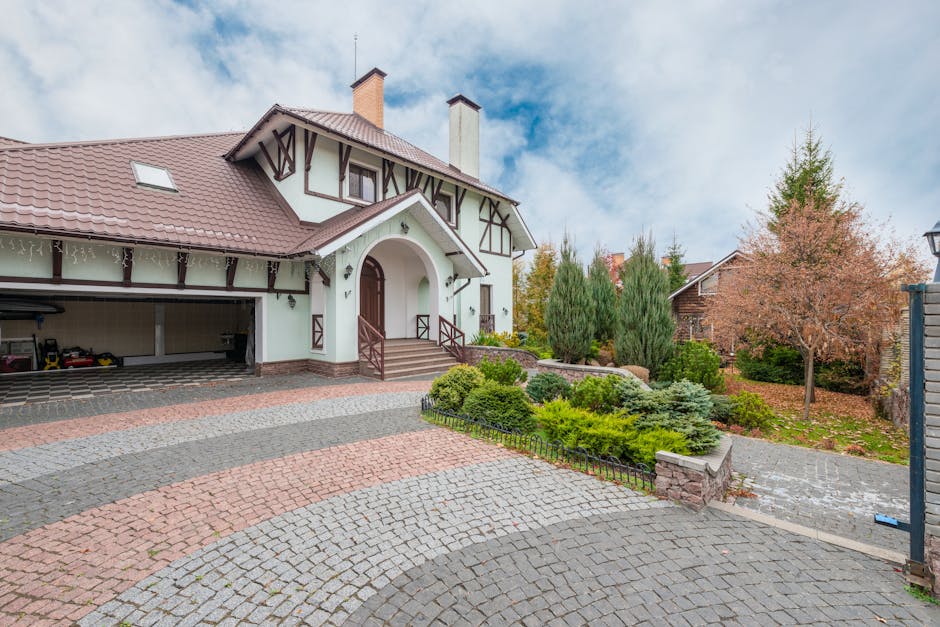
Picking a driveway material sounds straightforward — until the first New Jersey winter shows up. What looks like a simple concrete-vs.-pavers budget decision is actually a long-term financial calculation, one where the cheaper option up front can quietly become the more expensive one over time.
A standard poured concrete driveway in New Jersey typically runs $7-$12 per square foot for installation. That covers excavation, a basic gravel base, the pour itself, and finishing. For a 600 sq ft driveway, that's roughly $4,200-$7,200 — a number that's hard to argue with on the surface.
The gap closes quickly, though, when homeowners opt for decorative upgrades. Stamped concrete — designed to mimic the look of pavers, slate, or stone — adds significant labor and material costs, often pushing the total well past the entry-level range. At that point, the budget advantage of concrete starts to erode, without delivering the same long-term durability that real pavers offer.
A paver driveway in New Jersey typically starts at $12 per square foot and can exceed $20/sq ft for premium materials, complex patterns, or custom borders. The higher cost reflects a labor-intensive installation process that concrete simply doesn't require.
Here's what the price includes:
Pattern complexity also drives cost. A basic running bond is more efficient to install than a herringbone or basketweave pattern, which requires more cuts and more precision. The material itself — concrete pavers, clay brick, or natural stone — also significantly affects the per-square-foot price.
When a concrete slab cracks in New Jersey, it's rarely dramatic at first. A hairline crack forms, water gets in, the freeze-thaw cycle widens it, and within a few seasons, that small crack has become a structural problem. The rigid, monolithic nature of concrete means there's no way for the slab to absorb or distribute ground movement — the stress has to go somewhere, and it goes into the material itself.
Paver driveways are engineered around this problem. Because each unit is independent and interlocking, the surface behaves more like a flexible system than a single rigid plane. When the ground shifts, individual pavers shift with it — slightly, invisibly — and the surface stays intact. That flexibility is the reason well-installed paver driveways in New Jersey can last 50 years or more without cracking.
The real financial pain with concrete comes at repair time. Once a concrete slab cracks significantly, patching it invisibly is nearly impossible. Color matching cured concrete is notoriously difficult — the patch always looks like a patch. In cases of widespread cracking, the only real fix is a full tear-out and repour, which means paying for a new driveway on top of the original one.
With pavers, the repair process is completely different. A damaged, stained, or sunken paver can be pulled out individually and replaced with a matching unit — often undetectably. Because the surface is made of discrete pieces, repairs don't require disturbing the surrounding area. That same characteristic extends to utility work: since individual pavers can be lifted and reset, any crew needing access to a line running beneath the driveway can do so without saw cutting, patching, or leaving visible evidence behind.
Concrete driveways aren't maintenance-free. To protect against moisture intrusion, staining, and freeze-thaw damage, concrete should be sealed every 2-3 years. Professional sealing typically runs $0.95-$1.45 per square foot depending on the product used and surface condition. On a 600 sq ft driveway, that's a recurring cost of approximately $570-$870 every few years — indefinitely, or until the slab needs replacement.
Cracks also require periodic filler application to prevent water infiltration from widening them. These aren't large expenses individually, but they accumulate. Over the 20-30 year lifespan of a concrete driveway, routine maintenance costs add meaningfully to the total cost of ownership.
Paver driveways have their own maintenance rhythm, but it works differently. Over time, the polymeric sand in the joints can break down from foot traffic, water, and UV exposure. Periodic re-sanding — typically every 3-10 years depending on traffic and conditions — keeps the surface locked together and prevents weed intrusion between joints.
Sealing pavers is optional but recommended. A quality paver sealer enhances color, reduces staining, and extends the life of the joint sand. The key difference from concrete maintenance is what the maintenance prevents: with pavers, maintenance is cosmetic and protective. With concrete, maintenance is often reactive — responding to damage that's already occurred.
No matter how well a concrete driveway is maintained, the 20-30 year replacement timeline is largely unavoidable in New Jersey's climate. A well-maintained paver driveway, by contrast, can be refreshed indefinitely without a full reinstallation.
The lifespan difference between these two materials is significant enough to change the entire financial picture. Concrete driveways in New Jersey typically last 20-30 years before major cracking requires significant intervention or full replacement. In harsher microclimates — near coastal areas or in low-lying zones with high soil moisture — that window can be shorter.
Paver driveways, installed on a proper compacted gravel base, routinely last 50 years or more. The individual units don't degrade the way a monolithic slab does, and because the surface can be repaired piece by piece, there's no single failure point that forces a full replacement. Some clay brick paver installations in the Northeast are still in excellent condition after 60-70 years.
Run the math over a 50-year homeownership horizon and the calculus shifts. A concrete driveway may need to be fully replaced once or even twice during that period. A paver driveway, properly installed and periodically maintained, may never need full replacement at all. The higher upfront cost starts looking like a one-time payment rather than a recurring expense.
Hardscaping upgrades — driveways, walkways, patios — are among the few home improvements that deliver measurable returns in New Jersey's competitive real estate market. A well-executed paver driveway can return 50-80% of its installation cost at resale, according to industry data on hardscaping ROI. That doesn't mean every dollar spent comes back — but it does mean a significant portion of the investment is recoverable, something that can't be said for every home improvement category.
Concrete driveways, while functional, are generally viewed by buyers as a baseline feature rather than a premium one. A paver driveway, by contrast, signals quality and long-term care — it's a visible, tactile upgrade that makes a first impression before a buyer even steps inside the front door.
Design flexibility is one area where pavers simply have no equal. A concrete driveway, even a stamped one, offers a finite set of options tied to specific molds and colorants. Brick pavers, by contrast, are available in hundreds of colors, textures, shapes, and patterns — from classic herringbone and running bond to custom borders, medallions, and mixed-material designs.
That flexibility allows a paver driveway to be designed around the specific architecture of a home rather than adapted from a catalog of standard finishes. A craftsman-style home in Montclair can get a tumbled clay brick driveway with a contrasting soldier-course border. A modern colonial in Marlboro can go with clean-edged concrete pavers in a large-format running bond. The driveway becomes part of the home's design language rather than a utilitarian afterthought.
For buyers walking up to a home for the first time, that visual coherence matters — and it shows up in offer prices.
A standard residential paver driveway installation in Monmouth County — approximately 600 square feet — typically runs $18,000-$28,000. That wide range reflects meaningful real-world variables: the type of paver selected, the complexity of the pattern, the condition of the existing driveway or surface, soil conditions requiring additional base work, and any grading or drainage improvements needed before installation begins.
That range also includes full base preparation, which is the most critical part of a paver installation and the area where shortcuts cause the most long-term problems. A properly compacted gravel base prevents settling, heaving, and edge failure — and it's where a significant portion of the labor cost lives.
A documented project in Cherry Hill — a 1,000 square foot brick paver driveway installed in a herringbone pattern with a stone border — came in at approximately $18,500, including full site prep and cleanup, completed in about one week. That project demonstrates that price per square foot can decrease meaningfully at larger project scales, where mobilization and base costs are spread across more surface area.
These real project numbers are useful anchors. Anyone receiving quotes significantly below these ranges for a comparable scope of work should ask detailed questions about base depth, edge restraint installation, and the quality of materials being used — those are typically where corners get cut.
This detail catches a surprising number of homeowners off guard. Many municipalities across New Jersey require permits for driveway work — including new installations, widening existing driveways, and modifying curb cuts. Permit requirements vary by town, and in some cases, the town's engineering or public works department will review drainage impact before approving the project.
Permit costs vary but are typically in the range of $50-$500 depending on the municipality and project scope. Failing to pull a required permit can create complications during a home sale, when a title search or buyer inspection reveals unpermitted work. Any reputable contractor will identify permit requirements before work begins and factor them into the project timeline.
The concrete-vs.-pavers decision comes down to time horizon. If the goal is the lowest possible number on the first invoice and a short-term ownership outlook, concrete is a reasonable choice. It’s functional, widely available, and cheaper to install.
But for New Jersey homeowners who plan to stay in their home, build equity, and avoid the disruption and cost of a full driveway replacement in 20 years, the calculus points more strongly toward pavers. According to the paving and masonry experts at Quality Paving & Masonry, interlocking brick pavers are often the better long-term choice for New Jersey driveways because they combine durability with easier repairs and stronger visual appeal over time. The higher upfront investment buys a surface that flexes instead of cracks, repairs more discreetly instead of leaving a permanent patch, and can continue adding curb appeal long after a basic concrete driveway begins to show its age.
Factor in New Jersey’s freeze-thaw climate — which can speed up concrete wear faster than in milder states — and the long-term case for pavers becomes even more compelling. A driveway that can hold up for decades while preserving the look of the home is not just a design upgrade. Over a full ownership timeline, it can also be the more economical option.


