Ready to ditch the computer for music production? The Akai MPC Key 61 runs over 25 plugin engines in standalone mode—but real-world CPU limits reveal whether this “DAW in a box” lives up to its bold promise.
Recent industry data highlights why hybrid, standalone-capable workstations are gaining momentum among modern producers. Music Trades reports a more than 20% surge in demand for hardware synths and grooveboxes since 2021, reflecting a broader shift away from screen-heavy production. A Beatport survey shows that 62% of electronic music producers now prefer hands-on gear to improve focus and reduce digital fatigue, while Splice’s 2024 creator report notes that 58% of producers use a hybrid workflow that blends hardware with software tools. Meanwhile, interest in portable and flexible production setups continues to rise, with Statista projecting 7.4% annual growth in the mobile music equipment segment through 2028.
Taken together, these trends create a landscape where producers want the immediacy of hardware without giving up the depth of software-based tools—exactly the gap the Akai MPC Key 61 is designed to fill. Its hybrid architecture mirrors the way producers actually work in 2025: hands-on when inspiration strikes, integrated with a DAW when deeper editing or mixing is needed. As screen fatigue rises and demand for portable, all-in-one gear grows, the MPC Key 61 positions itself as a workstation that meets both creative and practical needs, offering a self-contained environment while still slotting easily into a larger studio ecosystem.
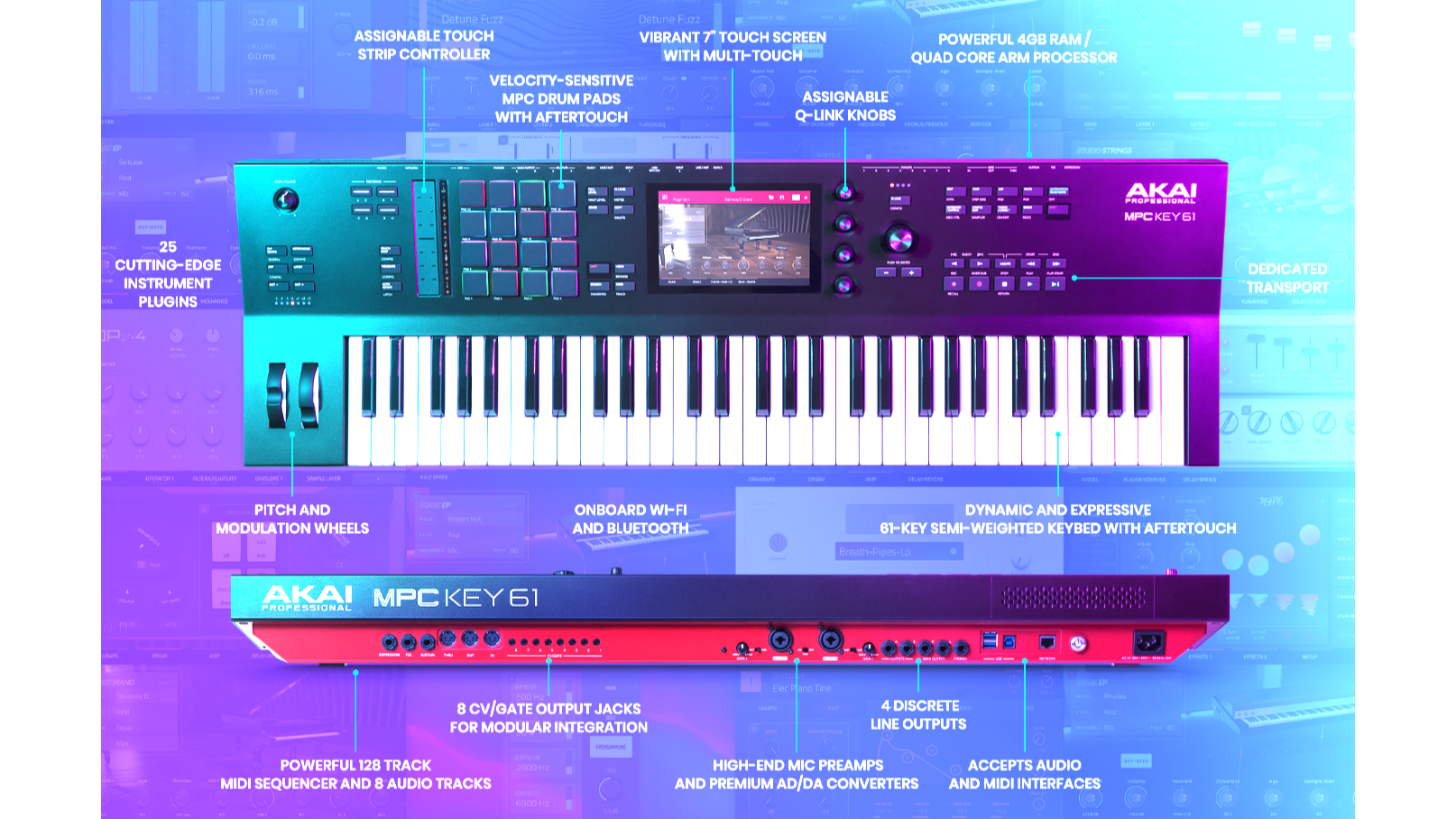
Powered by a quad-core ARM processor and 4GB of RAM, the MPC Key 61 runs a full OS capable of standalone operation—no computer required. It features a 61-key semi-weighted keybed and functions as both a self-contained beatmaking workstation and a controller for the included MPC2 desktop software. This flexibility allows producers to shift between isolation and integration without friction.
A 7-inch multi-touch display streamlines navigation and eliminates the layered menu fatigue typical of legacy workstations. With gesture-based editing for sampling, sequencing, and parameter control, the unit delivers a responsive and intuitive workflow that keeps creative momentum intact.
At the center of the MPC Key 61 are 16 velocity- and pressure-sensitive RGB drum pads—foundational to the production workflow that shaped decades of hip-hop and electronic music. Tools like Note Repeat, Quantize, and "16 Levels" (which maps a single sample across varying pitches) offer immediate access to beat-making staples that would require multiple layers of menu diving on legacy workstations.
The semi-weighted 61-key keybed adds melodic nuance to the percussive core. Rather than relegating drums to a secondary role, the MPC Key 61 positions finger drumming and sampling as central, with keyboard input serving as a dynamic complement.
A quad-core processor enables the MPC Key 61 to run more than 25 plugin instrument engines in standalone mode. The included library spans synths like Fabric XL, acoustic textures from Stage Piano, FM synthesis via OPx-4, and orchestral layering through Session Strings. Each engine delivers studio-grade sound without latency or the hardware strain common in software-based setups.
The internal 32GB storage comes preloaded with 6,000+ presets and Akai's legacy content. A built-in SATA bay supports SSD or HDD expansion, allowing for deep sample library growth without hardware limitations.
The AIR Vocal Suite sets the MPC Key 61 apart from every other standalone keyboard in its class. Built-in pitch correction, harmonizers, and modern vocal FX eliminate the need for external plugins or processors. Dual XLR-1/4" combo inputs with phantom power handle condenser microphones directly—removing the usual dependence on preamps or audio interfaces.
This integration turns the unit from instrument to recording studio, enabling full vocal production entirely within the hardware environment.
The MPC Key 61's I/O configuration delivers studio-grade flexibility: four discrete audio outputs, eight CV/Gate outputs for modular integration, and full MIDI In/Out/Thru support. This setup positions the unit as a control hub capable of bridging digital software, analog gear, and modular systems in a single workflow.
USB ports accommodate external storage and MIDI controllers, while modular synth outputs offers routing options rarely seen in standalone keyboards. Sequencing an entire modular rack directly from the touchscreen interface closes the gap between modern DAW precision and analog unpredictability.
The multi-touch display overhauls the way producers interact with hardware functions. Gesture-based controls streamline tasks like sample slicing, parameter automation, and navigation, replacing layered menus and button combinations with a fluid, smartphone-like experience.
Four assignable Q-Link knobs and a responsive touch strip offer real-time control over plugin parameters. With intelligent pre-mapping baked into the system, essential adjustments remain within reach—eliminating workflow interruptions and supporting uninterrupted creative sessions.
User feedback consistently points to the MPC Key 61's focused, distraction-free workflow as a defining strength. The ability to complete full tracks without a computer appeals to producers seeking immersion without digital noise. Despite its mostly plastic build, the unit earns praise for durability in both studio and live settings.
Sound quality is another standout. Electric pianos in particular have drawn favorable comparisons to higher-end workstations like the Yamaha Montage and Roland Fantom. Seamless integration between sampling, synthesis, and sequencing enables a fluid production process that traditional workstations often struggle to replicate.
Actual use reveals performance ceilings not obvious on spec sheets. While the quad-core processor and 4GB RAM deliver capable standalone power, running multiple instances of high-demand plugins—such as the detailed Stage Piano—can introduce CPU strain and longer load times. Pushing the system too hard may require compromise between ambition and available resources.
Initial software versions were also marked by notable stability issues. Reports of crashes during critical sessions underscored the challenges of packing full production capability into compact hardware. While subsequent updates have resolved many early problems, the experience highlighted the tradeoffs involved in moving to an all-in-one system.
The MPC Key 61 excels in workflows centered on sampling, chopping, and finger drumming. Its pad-forward design and visual sample editing offer a more intuitive experience than the layered menu systems of traditional workstations; particularly for producers in hip-hop, R&B, and electronic genres.
Standalone vocal processing, extensive I/O, and hybrid software integration position it as a complete studio centerpiece. The dedicated CV/Gate outputs cater to modular setups, while the touchscreen interface simplifies tasks that typically require complex button combinations on other systems.
The Roland Fantom caters to producers prioritizing realistic acoustic instruments and classic synth architecture. Its ROMpler-based engine delivers instant access to pianos, strings, and organs—without the plugin load times or CPU constraints associated with software-driven systems.
For live performance environments, the Fantom offers stable, low-latency switching and a predictable setup that favors quick transitions and reliability. Its familiar interface appeals to keyboardists with previous Roland experience or those seeking a traditional synthesis workflow
The MPC Key 61 is designed for producers seeking an all-in-one system that eliminates computer dependence without compromising on professional tools. For existing MPC users, it offers a natural progression; adding melodic expression to a familiar workflow. Beatmakers and samplers in hip-hop, R&B, and electronic spaces will find the pad-first design and integrated sampling engine especially effective.
Studio setups combining digital and analog gear benefit from the unit’s extensive I/O and modular-friendly architecture. Live performers managing real-time, multi-layered sets are drawn to the tactile combination of keys, pads, and touchscreen controls.
That said, producers already locked into computer-based workflows might see limited advantages in transitioning to hardware. But for those ready to embrace its hybrid design, the MPC Key 61 delivers a focused production environment that bridges hardware reliability with software freedom.


