If you’ve ever felt like your deep tissue massage *almost* gets there but not quite, there’s a measurable reason why. Hands max out at 24.6 lbs of pressure, while a single foot can deliver 109.1 lbs with minimal effort.
For massage therapists who regularly work with athletes or clients seeking genuinely deep pressure, there is a frustrating ceiling that hands - no matter how skilled - simply cannot break through. The numbers tell that story clearly, but the why behind them matters just as much as the gap itself.
The difference is not subtle. When a therapist pushes as hard as possible with a thumb, the output tops out around 24.6 lbs of force. Switch to a single foot applying casual, gravity-assisted pressure, and that number jumps to 109.1 lbs - a more than fourfold increase.
That data comes from direct measurement by practitioners at Affinity Massages, a barefoot massage clinic that has spent years documenting the mechanical differences between foot-based and hand-based massage. The numbers reflect what actually happens when therapists max out their thumb force versus what a foot delivers with minimal effort.
For clients who have always felt like deep tissue massage almost gets there, this gap explains a lot. For therapists fielding requests for more pressure, it reframes what is actually possible.
Hands are incredibly precise tools - but precision and load-bearing are different demands. The joints, tendons, and small muscles of the hand and wrist are not built for sustained high-force compression across an entire session. Over time, the repetitive strain of deep tissue work accumulates. Thumb fatigue, wrist inflammation, and joint pain are common reasons therapists cut back their hours or leave the profession early. The deeper a therapist tries to go with their hands, the faster that toll compounds. That is an anatomy problem, not a technique problem.
When hands run out of leverage, the go-to tools become thumbs and elbows. Both can generate meaningful force, but that force gets concentrated into a very small contact point. For clients with dense musculature - runners, cyclists, strength athletes - this often means the pressure either fails to penetrate deeply enough, or it creates a sharp, guarding sensation that triggers the tissue to tense up rather than release. Neither outcome is ideal.
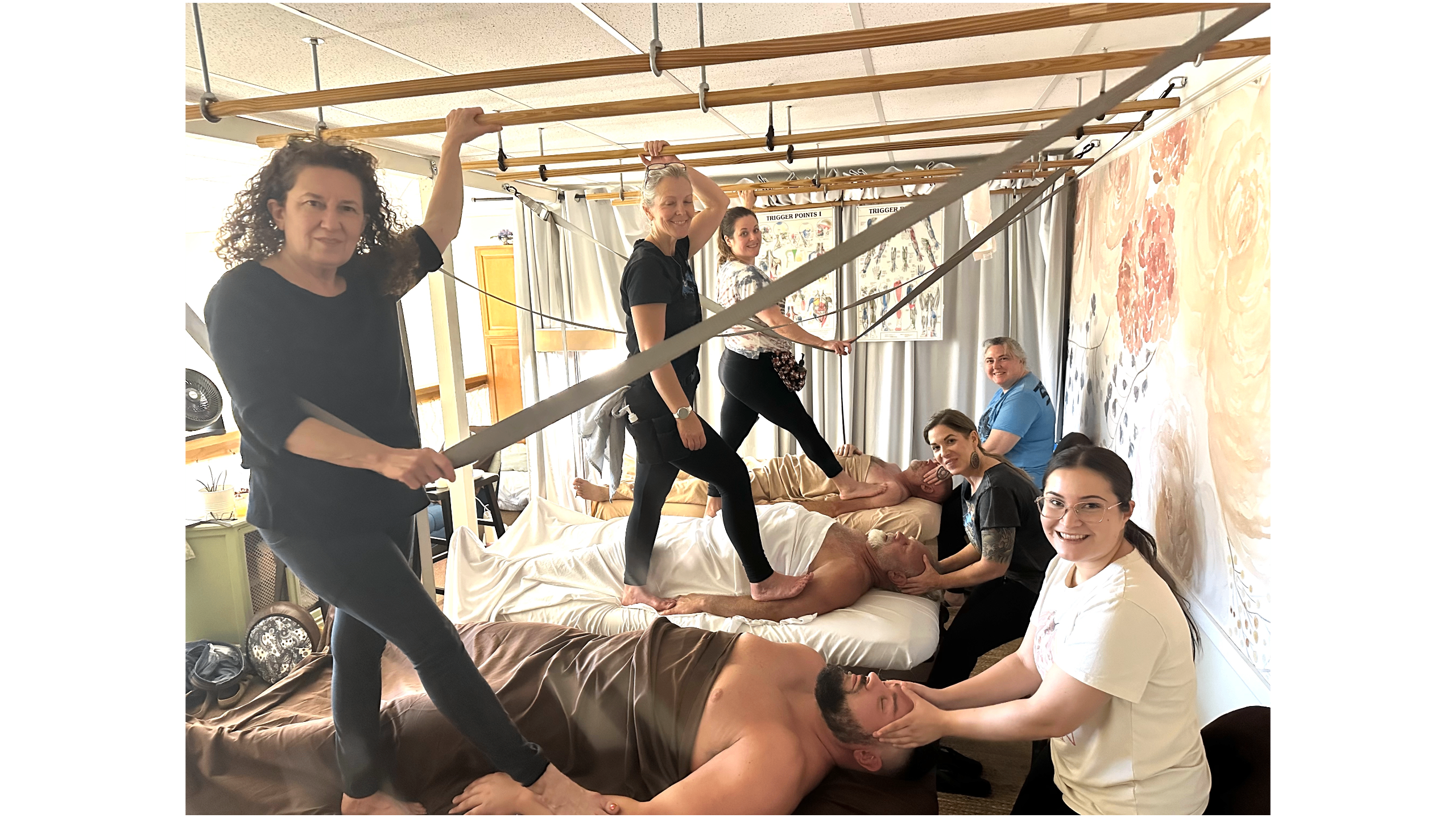
Barefoot Massage uses overhead bars or straps that let the therapist control how much body weight they transfer into each stroke. Rather than pushing against the client with muscular effort, the therapist leans or shifts weight, and gravity does the work. The result is consistent, sustained force that does not fatigue the way hand-based pressure does. The therapist can hold deep compressions longer, with more control, and less physical cost.
The foot's surface area is the other half of the equation. When 109 lbs of pressure is spread across the arch or heel of a foot rather than the tip of a thumb, the force-per-square-inch drops dramatically - even though the total force is much higher. That is why clients often describe Barefoot Massage as feeling powerful but not painful. The tissue is not being impaled by a point load; it is being compressed broadly and evenly, which allows muscles to accept the pressure rather than guard against it. The long, flowing strokes that define the technique also help broaden and lengthen muscle fibers rather than simply compressing them vertically.
Athletes carry the bulk of their tension in exactly the areas where barefoot massage excels. The back, glutes, hamstrings, and calves are large, dense muscle groups that respond well to broad, sustained compression. The long, flushing strokes of Barefoot Massage are particularly effective at interrupting the cycle of chronic tightness that accumulates over training blocks, helping tissue reset between sessions rather than compounding over time.
Barefoot Massage's deep, gravity-assisted strokes help broaden and lengthen muscle fibers, restoring natural flexibility - which is especially relevant for athletes managing range-of-motion restrictions. Deep tissue work at this level also supports circulation to fatigued tissue, accelerating the removal of metabolic waste. The net effect is faster recovery between training sessions and better movement quality going into the next one.
Compared to traditional deep tissue massage, Barefoot Massage also produces minimal bruising and less post-session soreness, because the broad surface distributes compression without breaking capillaries the way a concentrated elbow or thumb can. For athletes with packed training schedules, that distinction matters.
The comfort advantage of Barefoot Massage maps cleanly onto what pain science tells us about how the nervous system responds to pressure. Narrow, concentrated contact points are more likely to trigger a threat response, activating the sympathetic nervous system and causing tissue to guard. Broad, even compression tends to do the opposite - calming sympathetic activation and encouraging the body to receive rather than resist the work. For athletes who often have a complicated relationship with pain tolerance and recovery, this changes the entire experience of a deep session.
Feet are engineered for exactly what Ashiatsu asks of them. They carry full body weight every day, across varied terrain, for decades. The bones, joints, and connective tissue of the foot are built for load-bearing in a way that hands simply are not. When a therapist shifts pressure delivery to their feet, the demand on hands, wrists, and thumbs drops significantly - and so does cumulative injury risk.
Therapists who add barefoot technique to their practice report being able to work longer sessions and more sessions per week without the joint strain that limits hand-based deep tissue work. For an LMT who loves doing deep work but is already feeling the wear, Ashiatsu is a sustainable path forward - not just a new modality.
The pressure gap between barefoot and hand-based massage is measurable, the mechanism is well understood, and the benefits for athletic clients are specific and practical. More force, better distributed, with less discomfort - and less wear on the therapist delivering it. Athletes who struggle to find therapists who can actually meet their pressure needs represent an underserved segment of the market, and Barefoot Massage is well positioned to fill that gap.
Adding this skill does not require abandoning existing technique. It expands what is possible within a session and opens the door to a client base that keeps coming back because they are finally getting what they need.
Find Barefoot Massage training resources and take the next step toward deeper, more sustainable practice at Learn Barefoot Massage.


