Healthcare administrators juggling language access requirements with tight budgets face a critical decision: when does video remote interpreting save money versus in-person services? One regional chain’s strategic approach cut costs by 65% while maintaining quality.
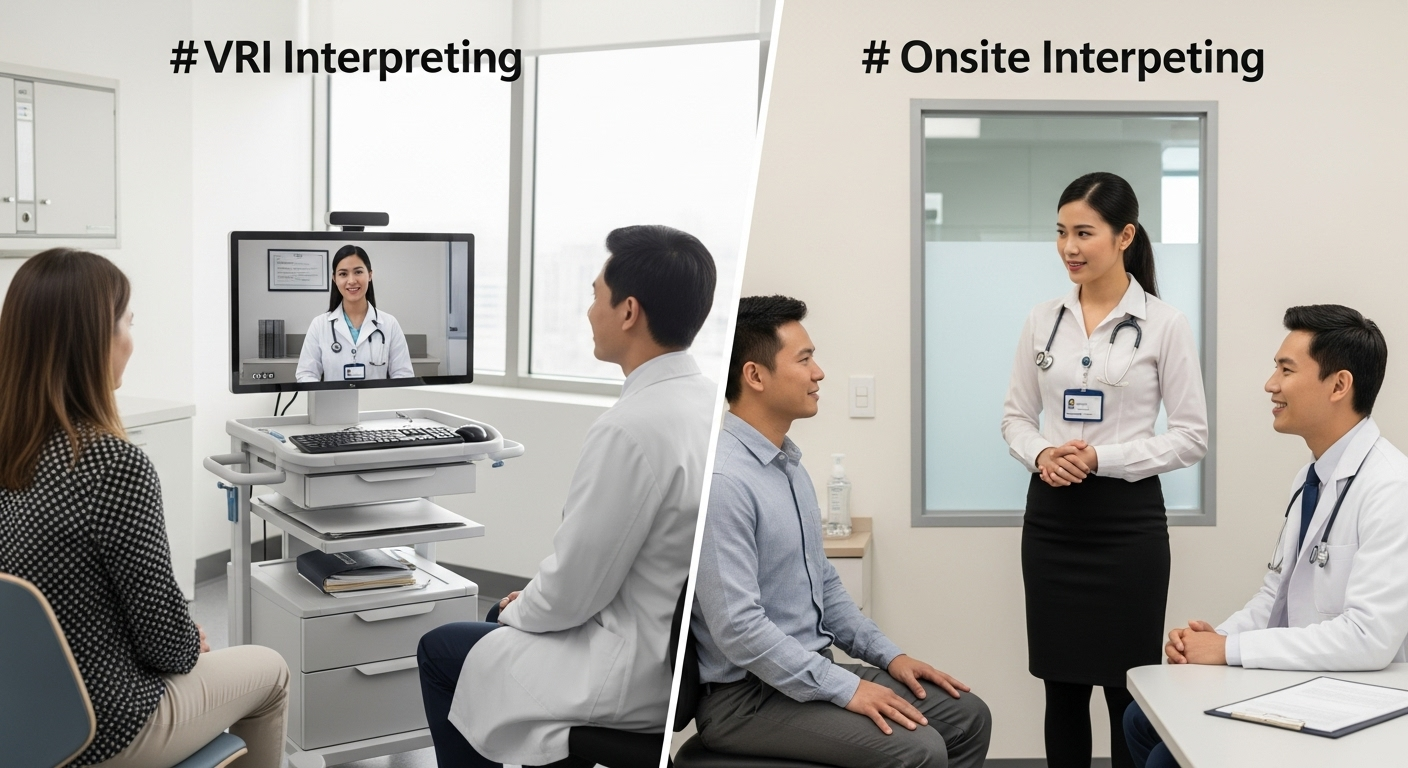
Healthcare administrators face mounting pressure to reduce costs while maintaining high-quality patient care. With over 68 million Americans speaking a language other than English at home and federal mandates requiring qualified interpretation services, language access represents both a compliance necessity and significant budget consideration. The challenge lies in balancing cost-effectiveness with clinical outcomes across diverse patient encounters.
Video Remote Interpreting transforms healthcare economics through its per-minute billing model, with rates typically ranging from $0.99 to $7.00 per minute, although some services may have minimum time requirements. This pricing structure eliminates the traditional hourly minimums and travel expenses associated with in-person services, creating substantial savings for routine encounters.
Healthcare facilities report enhanced throughput with VRI connection times averaging under 30 seconds, reducing patient wait times and increasing revenue potential through higher volume capacity. For a typical 15-minute medication review or triage assessment, VRI costs approximately $15-105 compared to $100-450 for in-person interpreters with two-hour minimums plus travel fees.
The immediate availability of VRI proves particularly valuable in emergency departments and urgent care settings where delays compromise patient flow and outcomes. Gateway Languages reports sub-10-second average connect times across 500+ languages, enabling healthcare providers to access qualified interpreters instantly without scheduling constraints or geographic limitations.
Despite VRI's cost advantages, certain clinical scenarios require the nuanced communication and human presence that only in-person interpreters can provide. These situations justify the higher expense through improved patient outcomes and reduced liability risks.
Oncology consultations, surgical consent processes, and end-of-life discussions benefit significantly from the rapport-building capabilities of in-person interpreters. The physical presence enables interpreters to observe subtle non-verbal cues, mediate cultural dynamics, and provide emotional support during vulnerable moments. For appointments exceeding 30 minutes, the per-minute VRI costs can actually surpass hourly in-person rates, making on-site services more economical for extended encounters.
Radiology procedures present unique challenges where electronic devices may interfere with sensitive imaging equipment, necessitating in-person interpretation for patient safety and clear communication during procedures.
DeafBlind patients requiring tactile interpretation cannot be served through remote modalities. Hand-over-hand communication and physical guidance for conveying meaning demand the presence of specially trained interpreters who can provide immediate, tactile feedback. These specialized services represent a critical access point that technology cannot replicate.
Mental health therapy, family counseling, and pediatric visits often require the trust-building and cultural mediation that in-person interpreters facilitate. The physical presence helps establish therapeutic relationships and enables interpreters to navigate gender preferences, family hierarchies, and indirect communication styles that are vital for treatment success.
Understanding the true cost comparison requires examining both base rates and additional expenses. In-person interpreting typically charges $50-$150 per hour and often includes a two or three-hour minimum, plus travel time, mileage, and potential no-show fees. This structure makes short appointments particularly expensive, with a 15-minute encounter potentially costing $200-400 including all fees.
VRI's per-minute model aligns costs directly with usage, eliminating waste from idle time or missed appointments. However, the crossover point occurs around 45-60 minutes of interpretation time, where hourly in-person rates become more economical than accumulated per-minute charges.
In-person services carry numerous ancillary costs that administrators often overlook. Travel reimbursement, parking fees, last-minute scheduling premiums, and cancellation charges can increase total costs by 25-50%. Additionally, interpreter unavailability can delay appointments, reducing facility efficiency and patient satisfaction.
VRI eliminates these hidden expenses while providing 24/7 availability, but requires investment in reliable technology infrastructure and staff training to ensure optimal performance.
Healthcare systems with high interpretation volumes achieve greater savings through strategic VRI deployment. Facilities processing 100+ monthly interpretation requests report significant cost reductions when using VRI for encounters under 30 minutes while reserving in-person services for complex cases.
The ROI calculation must also factor improved patient throughput, reduced delays, and enhanced compliance with federal language access requirements. These operational benefits often justify VRI implementation beyond direct cost savings.
The most successful healthcare facilities implement hybrid models that use both VRI and in-person interpreters based on clinical context. A regional urgent care chain achieved 65% expense reduction through this approach while maintaining compliance and satisfaction scores above 90%.
Strategic deployment guidelines help administrators maximize value from their interpretation budgets. VRI works well for intake appointments, pharmacy consultations, discharge instructions, and routine follow-ups. In-person interpreters provide optimal value for surgical consents, mental health sessions, family conferences, and culturally sensitive discussions.
Emergency departments benefit from VRI's immediate availability for triage and initial assessments, transitioning to in-person interpreters for complex cases requiring extended consultation. This tiered approach ensures appropriate resource allocation while maintaining quality care standards.
Research indicates no significant difference in patient-reported satisfaction between remote and in-person interpretation for routine medical encounters. However, patients express stronger preferences for in-person services during emotionally charged or lengthy consultations where relationship-building proves vital.
Compliance outcomes remain consistently high across both modalities when professional interpreters are utilized, supporting the viability of blended approaches for meeting federal language access requirements.
Successful VRI deployment requires robust technical infrastructure and staff training programs. These investments ensure optimal performance and maximize the return on interpretation service expenses.
Healthcare facilities must implement encrypted, secure platforms that meet HIPAA privacy and security standards. The technology stack should include backup internet connections, device redundancy, and clear protocols for technical troubleshooting to prevent service disruptions during critical patient encounters.
Integration with existing electronic health record systems streamlines documentation and billing processes while maintaining compliance with audit requirements for language access services.
Reliable VRI performance requires a stable internet connection. While some services may function with minimum speeds of 1.5 Mbps, 3-5 Mbps is recommended for high-definition clarity, and some providers may suggest even higher speeds for optimal performance. Healthcare facilities should conduct network assessments and implement quality-of-service protocols to prioritize interpretation traffic during peak usage periods.
Equipment standards include tablets with front-facing cameras, adjustable stands for optimal positioning, and noise-canceling capabilities to ensure clear communication in busy clinical environments.
Gateway Languages delivers language access solutions that enable healthcare administrators to implement cost-effective, compliant interpretation services. Their platform supports both immediate VRI connections and scheduled in-person interpreters, providing the flexibility needed for strategic deployment across diverse clinical contexts.
The service includes specialized support for American Sign Language, rare language dialects, and culturally sensitive interpretation needs. Healthcare facilities benefit from transparent per-minute pricing, 24/7 availability, and seamless integration with existing clinical workflows to optimize both cost management and patient care outcomes.
Visit Gateway Languages to learn about customized interpretation solutions that balance cost-effectiveness with clinical quality for your healthcare organization.


