Most Irish SMEs are investing heavily in their own websites while AI engines like ChatGPT and Claude are citing their competitors instead—and the gap is widening. Research shows exactly where 84-89% of AI citations actually come from, and it’s not where you think.
Something quietly shifted in how AI engines decide which brands to mention — and most Irish marketing budgets haven't caught up. The research is now clear: AI tools like ChatGPT, Claude, and Google AI are not pulling from your website first. They're pulling from everywhere else. Understanding why — and what to do about it — is the most important pivot an Irish SME marketing manager can make in 2026.
When someone asks ChatGPT, Claude, or Google AI a question related to your industry, the answer they receive is built from citations. Those citations determine which brands get named, which businesses get recommended, and which companies effectively don't exist in the conversation. The data on where those citations come from is striking.
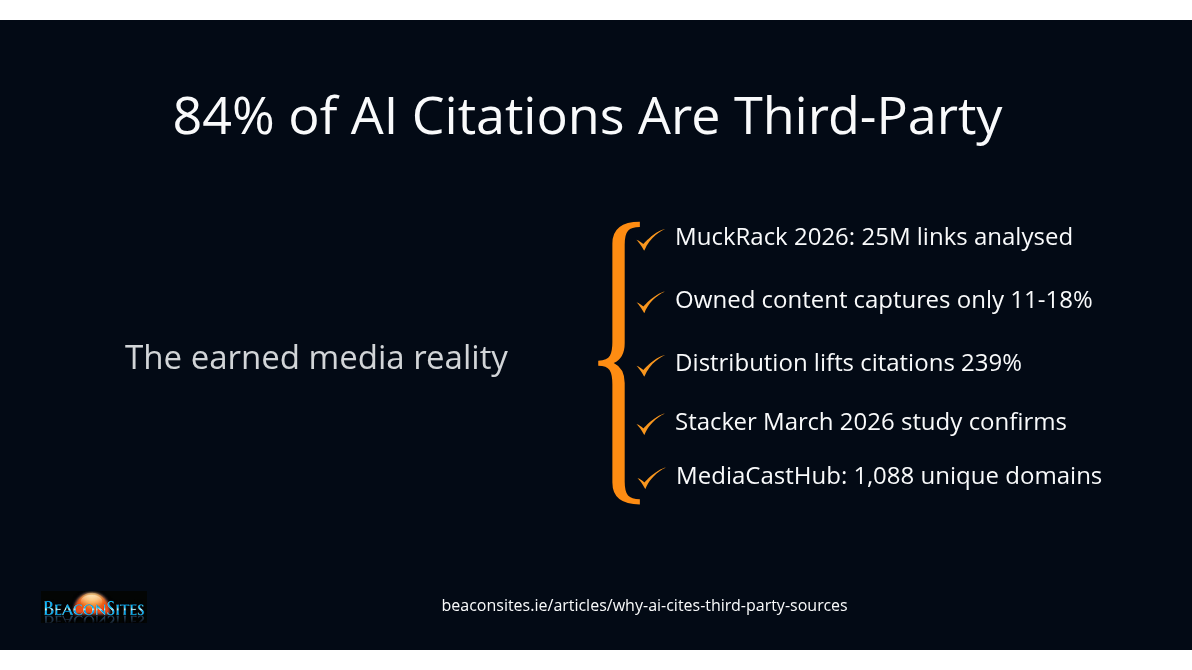
Multiple independent studies published in 2025 and 2026 have analysed AI citation behaviour across major engines. Their consistent finding: the large majority of AI citations — figures ranging from 84% to 89% across studies — come from earned media: independent editorial coverage in third-party publications, not a brand's own website. The range across studies runs from 82% to 95%, but the pattern doesn't waver: third-party sources dominate the AI citation graph.
For Irish SMEs, the implication is structural. A business publishing content only on its own domain is competing for the 11-18% of AI citations that come from owned content. The other 82-89% are earned across third-party publishers — allocated not by ranking algorithms, but by editorial coverage, syndication footprint, and review-platform presence. BeaconSites has examined this shift in detail, and the conclusion for Irish brands is clear: the citation surface has moved, but most marketing strategies haven't moved with it.
The available research on AI citation behaviour isn't a forecast or a projection — it's a direct analysis of how AI engines already behave. Studies examining source links cited across ChatGPT, Claude, and Google AI have mapped exactly where AI-generated answers draw their information from. The results are consistent across independent methodologies.
The 84-89% earned media figure has appeared consistently across multiple independent studies since mid-2025, confirming this isn't a spike or an anomaly — it's the settled behaviour of AI citation systems. Journalism and editorial coverage consistently rank among the top cited source types across AI engines, highlighting the continued importance of traditional news outlets even as the media landscape shifts.
The consistency across multiple reports and independent methodologies matters because it removes doubt. Marketers sometimes wait for a trend to stabilise before acting. This one has. The practical reality for an Irish SME is the same regardless of which study you reference: the large majority of AI citations flow through third-party sources, and that share has been stable long enough to plan around it.
If third-party editorial coverage sits at the top of the AI citation hierarchy, paid content sits at the very bottom. Across the studies surveyed, paid and advertorial content accounts for a negligible share of AI citations — a finding that should prompt a hard rethink for any Irish brand currently spending on sponsored placements in the hope of AI visibility.
AI engines can detect advertorial signals, press-release-only sources, and obvious paid placements, and they discount them accordingly. This is the inverse of what SEO trained most marketing teams to expect. In paid search, money buys placement. In AI citation, money buys almost nothing. The citation graph rewards independent, credible coverage — and penalises content that looks like it was placed rather than earned.
Understanding why AI engines weight third-party sources so heavily makes the solution far more obvious. It's not editorial bias or an arbitrary design choice — it's a logical consequence of how AI systems verify information during generation.
AI engines synthesise answers by aggregating information across many sources and weighting facts by how consistently those sources agree. The mechanism is called cross-source corroboration. The term BeaconSites uses for it is consensus signal. Consensus signal is the operational backbone of every citation decision made by ChatGPT, Claude, Perplexity, Google AI Overviews, and Microsoft Copilot.
A brand mentioned on its own website provides exactly one data point. The AI engine has nothing to verify it against. That same brand mentioned consistently across hundreds of independent sources provides hundreds of corroborating data points — confirming the brand exists, what it does, where it operates, and what its reputation looks like. Higher corroboration produces higher confidence, and higher confidence produces higher citation probability. A business that exists only on its own domain is simply not a resolved entity in the AI citation graph — it's a single data point waiting to be verified by sources that don't exist yet.
While third-party dominance holds across all major platforms, each AI engine has distinct sourcing preferences worth knowing. Machine Relations Research found in 2026 that ChatGPT draws roughly 51 per cent of its source citations from earned and news media, while Claude sits at 43 per cent. Perplexity gives community-driven sources a notably high share — 46.7 per cent of its citations come from Reddit alone, according to AILabsAudit. Google AI Overviews draws on Google's index plus the knowledge graph, weighting schema markup and traditional SEO signals more heavily than the other engines.
The type of query also matters. Industry trend questions tend to generate more journalism citations than how-to queries. This means an Irish SME appearing in trade press or industry news coverage is particularly well positioned for the query types that drive commercial discovery. Knowing these differences helps in targeting the right distribution channels rather than treating AI citation as a single monolithic system.
The phrase "third-party source" covers more ground than most marketers realise. Lumping all non-owned sources together leads to misallocated budgets and wasted effort. There are three distinct categories, each with a different weight in AI citation graphs — and understanding the difference is where effective strategy begins.
Editorial third-party sources are independent news articles, industry publications, podcasts, expert roundups, comparative reviews, and syndicated press coverage. This is the category AI engines weight most heavily, and it's the true engine behind the 84-89% figure. The reason is straightforward: independent editorial coverage requires a journalist, a publication, or an aggregator to find the brand credible enough to cover. AI engines treat that editorial filter as a hard-to-fake credibility signal.
Earning coverage in this category is the core challenge — and the core opportunity — for Irish SMEs in 2026. It requires structured content that third-party publishers want to pick up, distributed at scale across publisher networks. When done systematically, the results are measurable: coverage in this category directly increases the corroboration footprint AI engines use to decide who gets cited.
Brand-managed third-party sources sit in the middle of the citation hierarchy. These are listings on independent platforms where the brand controls the data but the platform itself is external — Google Business Profile, Trustpilot, G2, Apple Maps, Bing Places. The brand manages the listing, but the platform's independence gives the listing more credibility than owned content.
Research into review-platform presence and AI citation behaviour indicates that brands with active profiles on independent review platforms are cited meaningfully more often than brands with none. For Irish SMEs, this is among the fastest available gains — the technical setup is minimal, and the credibility signal accumulates with every customer review collected.
Owned content — a brand's website, blog, and social channels — is the lowest-weighted category in most AI citation graphs. That's a difficult fact for marketing teams who have spent years building and optimising owned channels, but the research is consistent across every major study. A business publishing solely on its own domain is competing for the 11-18% share of citations that owned content can earn.
This doesn't mean owned content is irrelevant. It means its role has changed. A brand's website is the source of structured content that third-party publishers can pick up and distribute — it's the engine of content creation, not the primary citation surface. Understanding this distinction shifts the strategic focus from publishing more to your own domain, to publishing in ways that reach the third-party surfaces AI engines actually weight.
Knowing that earned media drives AI citation is only half the picture. The operational question is how a brand earns it at the scale needed to build a genuine corroboration footprint. Content syndication research gives the clearest available answer — and the numbers are significant.
Controlled studies comparing AI citation rates for identical articles in two conditions — published only on a brand's own domain versus distributed across third-party publisher networks — have found substantial lifts in citation rates for the distributed version across ChatGPT, Claude, and Google AI. The mechanism behind this is direct: a single source article published on one domain provides one citation surface, while the same article syndicated across hundreds of unique publisher domains provides hundreds of corroborating surfaces, each one another data point AI engines weight when deciding who to cite.
BeaconSites' own verified distribution data illustrates the operational scale: a single source article distributed via the MediaCastHub infrastructure yielded 1,566 syndicated placements across 1,088 unique publisher domains, with an average Domain Authority of 41.9 and 27 placements on DA-80+ properties including AP News and Markets Business Insider. This is presented as an internal case study of what the distribution footprint looks like in practice.
Beyond the initial citation lift, distributed content has a durability advantage. Research into source decay suggests that content distributed through third-party publishers maintains AI citation authority for longer than brand-only content before decaying. For an Irish SME running a monthly distribution rhythm, this means a continuously refreshed citation footprint — new placements added each month while previous placements continue to hold citation authority. The citation surface never goes dark.
There is one scenario where owned content consistently outperforms earned media in AI citation rates — and it's specific enough that it won't apply to generic blog posts or product page updates. Original research and proprietary data published on a brand's own domain achieve substantially higher citation rates — the only owned-content category that reliably competes with earned media.
The mechanism is uniqueness. When a brand publishes data that doesn't exist anywhere else — a customer survey, an internal benchmark study, platform metrics, original analytical work — AI engines have to cite the original source because no third-party publisher has the same information. Third-party coverage may reference the data, but the original domain remains the primary citation target. The data's exclusivity forces the citation.
For Irish SMEs, this translates into a practical publishing priority: identify what only your business can report. Anonymised client outcomes, sector-specific survey results, original market observations from your own operations — these are the content types that earn AI citation through uniqueness rather than corroboration. The mistake is publishing the same generic industry commentary that dozens of other sites already cover; AI engines will simply cite the higher-authority third-party source instead. Publishing what no one else has is the owned-domain exception that genuinely works.
The research describes the problem clearly. What follows is a sequenced approach that Irish SMEs can implement without rebuilding their entire marketing operation — each step building logically on the one before it.
Most Irish brands have no idea whether ChatGPT, Claude, Perplexity, Google AI Overviews, or Microsoft Copilot are citing them today — or what those AI engines are saying about their competitors. An AI citation audit benchmarks current citation rate against a defined set of buyer prompts in the brand's category, with a direct comparison to competitors across all five major engines.
Without this baseline, every subsequent investment is unmeasured. The audit identifies the highest-leverage gaps — whether that's a missing review-platform presence, insufficient third-party coverage, or a competitor dominating the citation graph in a specific topic area. It's a one-off exercise that pays for itself by directing resources toward the actions most likely to move the needle rather than the actions that feel most familiar.
Review-platform presence is the fastest available gain in the entire AI visibility playbook. Research into AI citation behaviour consistently shows that brands with active profiles on independent review platforms are cited significantly more often than brands with no review-platform presence at all.
The technical setup is straightforward — creating the profiles takes days, not months. The longer build is collecting genuine customer reviews that give the platform's credibility signal real substance. Irish SMEs that haven't started this yet are leaving the single most accessible citation lever on the table. It's brand-managed third-party presence at its most practical, and AI engines weight it consistently across every major platform studied.
This is the editorial third-party investment — and the most operationally significant step in the playbook. Source content engineered for AI extraction (FAQ schema, definition-first paragraphs, explicit named-entity reinforcement) is distributed across hundreds of independent publisher domains using a syndication infrastructure. A single well-structured source article becomes the cross-source corroboration footprint AI engines weight when deciding who to cite.
The structure of the content matters as much as its distribution. An article that opens with a direct answer, uses summary tables, and calls out named entities clearly is far more likely to be lifted verbatim into AI-generated answers than one that buries key information in narrative prose. Distribution without structure gets republished but not cited. Structure without distribution gets cited once but not across the corroboration footprint AI engines require. Both elements need to work together, ideally on a sustained monthly cadence rather than as a one-off exercise.
The final step targets the owned-domain exception. Identify the data, benchmarks, or analytical work that exists only within your business — and publish it in structured form on your own domain. Customer survey results, anonymised case outcomes, sector-specific observations from your own operations: these are the content types that earn AI citation through uniqueness, because AI engines have no alternative source to cite.
For most Irish SMEs, this is a focused 90-day project rather than an ongoing investment. Publishing three to five genuinely proprietary pieces — structured for AI extraction, clearly attributed, and covering topics where your business has data no competitor can replicate — creates a citation surface that can persist for years. It complements distribution rather than competing with it, addressing the one scenario where your own domain can outperform the earned media ecosystem.
The shift in AI citation behaviour isn't waiting for marketing budgets to realign. Every week that ChatGPT, Claude, and Google AI answer buyer questions without citing a brand is a week that brand's competitors — who are being cited — are building familiarity, credibility, and commercial presence in the spaces where purchasing decisions are increasingly shaped.
AI adoption in Irish business is accelerating rapidly — and with it, the proportion of commercial conversations that flow through AI engines rather than traditional search. A brand invisible in AI citation today isn't merely missing a channel; it's ceding ground in a system where citation authority compounds over time. Brands that accumulate corroboration footprint now become progressively harder to displace, because AI engines learn credibility through repetition, consistency, and context — not overnight.
The practical reality for Irish marketing managers is this: the 82-89% of AI citations flowing through third-party sources won't wait for a budget review cycle. The brands doing the work in 2026 — auditing citation rates, building review-platform presence, distributing structured source content, and publishing proprietary data — are accumulating an advantage that isn't easily reversed. Those still concentrating investment in owned content alone are competing for the smaller share of citations while the larger share accrues elsewhere.
AI visibility isn't a future consideration — it's the current operating reality. The citation graph is already being written, and the brands written into it earliest will be the hardest to displace.
For Irish SMEs ready to understand exactly where they stand across ChatGPT, Claude, and Perplexity — and what to do about it — BeaconSites is a Dublin-based AEO and web design agency helping Irish businesses build the third-party citation presence that AI search now demands.


