Running a ventilator in the ICU isn’t a task for just anyone—it’s specialized, high-stakes work that determines whether critically ill patients survive. If you’re drawn to direct patient care that measurably saves lives, here’s what the path actually looks like.
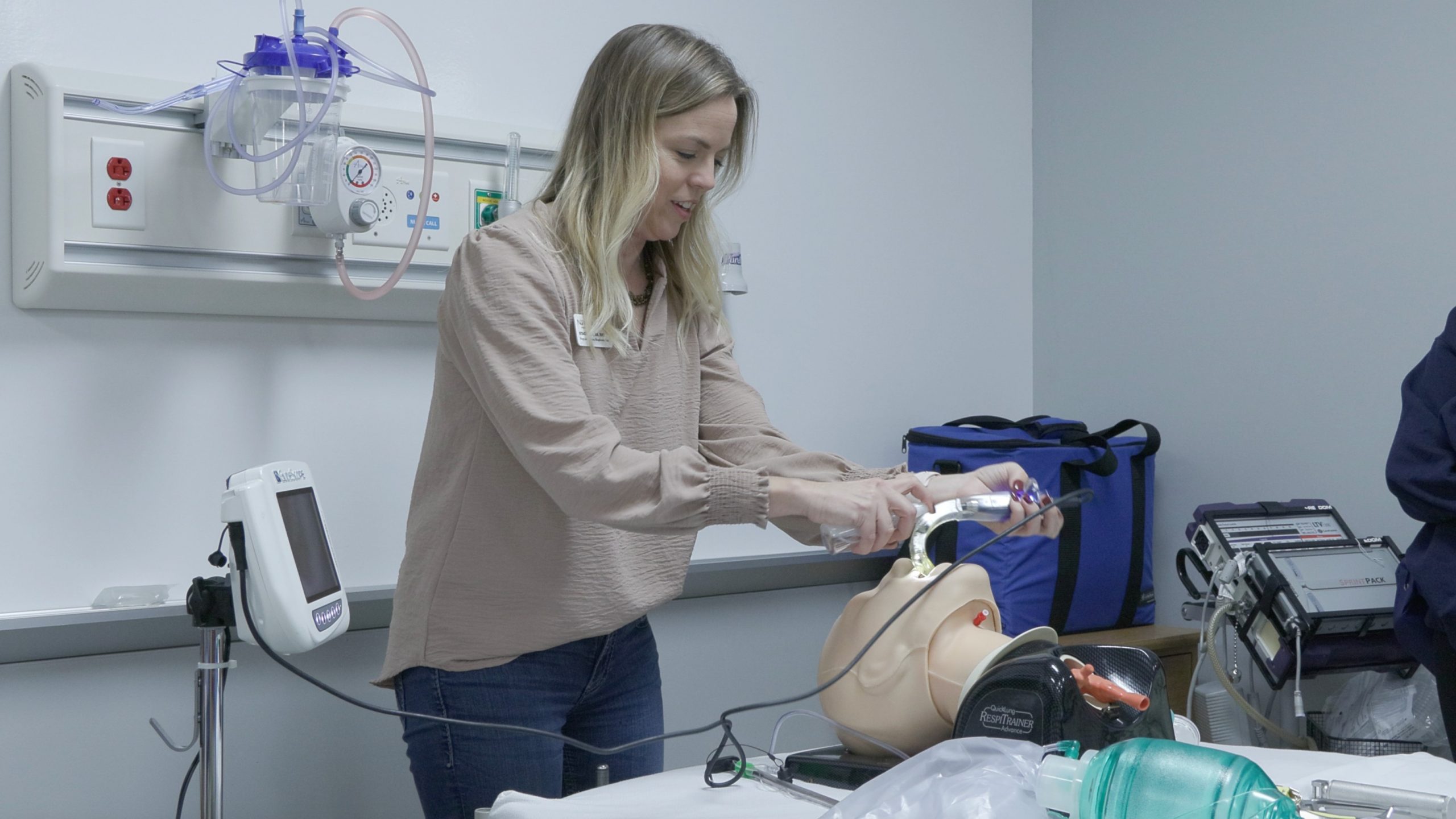
Not every healthcare career puts you at the ICU bedside doing work that determines whether a patient survives the night. Respiratory therapy is one of the few that does. If direct, high-stakes patient care sounds like the right fit, understanding exactly what this profession demands — and what a 2-year degree can unlock — is the right place to start.
When a patient in the intensive care unit can no longer breathe on their own, a machine takes over that job. But the machine doesn't run itself. Respiratory therapists are the clinicians responsible for setting up, managing, and adjusting mechanical ventilators — calibrating oxygen delivery, monitoring carbon dioxide removal, and keeping the patient's respiratory system stable in real time.
This is high-tech, high-touch work happening around the clock. RTs collaborate directly with physicians and nurses, functioning as the cardiopulmonary specialists on the team. Ventilator management isn't a task that can be handed off casually — it requires specialized training that goes deep into pulmonary physiology, pharmacology, and equipment mechanics.
During the COVID-19 pandemic, respiratory therapists became a visible symbol of frontline critical care, managing ventilators for some of the sickest patients hospitals had ever seen. That spotlight revealed something the profession had always known: when breathing fails, RTs are the ones who respond.
Respiratory therapy is broader than ventilator management alone, though that remains the most critical piece. RTs evaluate patients with cardiopulmonary disorders across the entire lifespan — from premature infants in neonatal units to elderly patients in long-term care — and they treat those patients using a wide range of tools and interventions.
Day-to-day responsibilities typically include:
In emergency settings, RTs' skills in airway management, pulmonary disease assessment, and resuscitation are considered essential for stabilizing compromised patients. This isn't background support work — it's front-of-the-room, hands-on intervention.
The ICU is where respiratory therapy is most visible and most critical. Patients in intensive care are often sedated, post-surgical, or in multi-organ failure — any of whom may be entirely dependent on a ventilator to deliver every breath. RTs optimize those settings continuously, adjusting pressure, volume, and respiratory rate as the patient's condition changes.
This requires both technical precision and clinical judgment. An RT managing a ventilated patient isn't simply monitoring numbers — they're interpreting trends, anticipating complications like ventilator-associated pneumonia, and collaborating with the medical team on the plan to eventually wean the patient off the machine. Faster, safer weaning is one of the most measurable ways RTs improve patient outcomes, and it's a skill developed through both rigorous coursework and supervised clinical hours.
While the ICU represents the most intense environment, respiratory therapists work across a wide range of settings. Hospitals employ the majority, but the profession has expanded significantly into outpatient and community care. Common practice settings include:
This range matters for prospective students: a respiratory therapy degree doesn't lock someone into one environment. Graduates can shift between acute care and outpatient roles as their careers develop, or specialize early in areas like neonatal care or transport respiratory therapy.
Healthcare is full of roles that matter. Respiratory therapy is one where the impact can be quantified in ways that are hard to ignore.
Respiratory therapy care is widely recognized for significantly contributing to improved patient outcomes, reduced morbidity and mortality, and enhanced patient safety across acute, chronic, and critical care settings. The study-level data behind that recognition is striking.
Research has shown that increasing respiratory therapist staffing in the ICU is associated with meaningful reductions in ICU and hospital-wide mortality. The mechanism is straightforward: more RTs means more consistent monitoring, faster response to deterioration, and tighter management of ventilator settings and protocols. When RTs are stretched across too many patients, small problems become big ones. When staffing is adequate, the precision of care improves — and patients survive at higher rates.
Beyond mortality outcomes, respiratory therapist-driven protocols have been shown to speed up weaning from mechanical ventilation. Every day a patient remains on a ventilator carries risk — primarily ventilator-associated pneumonia, a serious hospital-acquired infection. Faster weaning means:
RT-driven weaning protocols aren't experimental — they're an established, evidence-backed standard of care in high-functioning ICUs. For anyone entering this field, that's meaningful context: the skills learned in training directly translate to outcomes that researchers and hospitals can measure.
Newman University's Associate of Science in Respiratory Care is built around a clear goal: preparing graduates to function as competent, credentialed respiratory therapists from day one of their careers. The program covers the cognitive knowledge, hands-on skills, and professional behaviors expected of a Registered Respiratory Therapist.
Students work through coursework that includes Cardiopulmonary and Renal Physiology, Neonatal Respiratory Care, Pediatric Respiratory Care, and Mechanical Ventilation — the technical core of the profession. Class sizes are intentionally small, with a maximum of 20 students per cohort, which means students get personalized instruction rather than disappearing in a lecture hall. One graduate described the environment directly: "Newman provided me with the educational learning and clinical practice skills that jump-started my career."
For prospective students researching programs, the Newman University Respiratory Care program page outlines the full curriculum structure, prerequisites, and clinical requirements in detail.
CoARC — the Commission on Accreditation for Respiratory Care — is the single accrediting body for respiratory therapy education programs in the United States. Graduating from a CoARC-accredited program isn't a nice-to-have; it's a prerequisite for sitting for the National Board for Respiratory Care (NBRC) credentialing exams, which are required for state licensure in 49 of 50 states.
Newman's program (Program #200117) holds full CoARC accreditation. Beyond the baseline requirement, Newman has received CoARC's Distinguished RRT Credentialing Success Award — an honor that requires documenting RRT credentialing success of 90% or above, holding accreditation without a progress report, and meeting CoARC's benchmarks for TMC high-cut score performance and program retention. That award is objective, third-party evidence of program quality, not a self-reported claim.
Newman's location in Wichita, Kansas, is a genuine program asset. The urban setting creates affiliations with both large medical centers and smaller community hospitals, giving students exposure to a wide variety of patient populations and care environments before they graduate.
Clinical rotations span the major areas of respiratory practice:
Students log approximately 1,000 clinical hours during the program, working alongside respiratory therapists and physicians who bring real-world experience into the teaching relationship. Proximity to clinical sites like Via Christi and Wesley is a practical advantage students notice immediately, as one current student noted: "The Respiratory Care program is really close to clinical sites like Via Christi and Wesley, which helps prepare you for the future even further."
Graduating from a CoARC-accredited program is the starting point for credentialing, not the finish line. The National Board for Respiratory Care (NBRC) administers a two-exam pathway that leads to the Registered Respiratory Therapist (RRT) credential — widely recognized as the standard of excellence in the profession. Newman graduates are eligible to begin this process immediately after graduation, with no required waiting period.
The first exam is the Therapist Multiple-Choice (TMC) Examination. Every graduate takes this test, and it has two possible outcomes:
Nationally, TMC high-cut pass rates for new candidates have generally fallen in the mid-to-upper 60% range in recent reporting years, according to NBRC data. Newman's historically documented RRT credentialing success rates at or above 90% indicate strong performance relative to those national figures — a meaningful distinction when choosing a program.
Graduates who achieve the TMC high-cut score move on to the Clinical Simulation Examination (CSE). The CSE tests clinical decision-making through simulated patient scenarios — it's designed to mirror the judgment calls RTs make at the bedside. Passing the CSE earns the Registered Respiratory Therapist (RRT) credential.
Nationally, new-candidate CSE pass rates have generally ranged from the mid-60s to low 70s percent in recent reporting years, according to NBRC data — though candidates should consult NBRC's official publications for the most current figures. The RRT credential is what most employers consider the professional standard. Prospective students should also be aware that the NBRC has announced changes to credentialing pathways taking effect after January 1, 2027 — making graduation from a CoARC-accredited program like Newman's increasingly important for anyone entering the field. Candidates are encouraged to consult NBRC's official announcements for the latest details.
Strong credentials matter most when there are jobs that need them. For respiratory therapy, the labor market data is straightforward and favorable.
The U.S. Bureau of Labor Statistics projects employment of respiratory therapists to grow 13% from 2023 to 2033 — a rate described as much faster than the average for all occupations. That translates to thousands of new positions and roughly 8,200 to 8,800 job openings annually, driven by both growth and the retirement of existing practitioners.
Several converging trends are fueling that demand:
That last point is worth noting: the profession is simultaneously growing and losing experienced practitioners at high rates. New graduates entering the field aren't walking into a crowded market — they're walking into a gap.
The median annual wage for respiratory therapists was $77,960 as of May 2023, according to BLS data, with an associate's degree serving as the standard entry-level education requirement. Entry-level salaries can start around $59,000 per year, though averages vary meaningfully by location and specialty. Experienced RTs in specialized settings can earn upwards of $100,000 or more annually.
Compared to other healthcare professions requiring doctoral-level education — physical therapy, occupational therapy — respiratory therapy offers a notably strong return on a 2-year educational investment. Less debt, faster entry to the workforce, and a salary trajectory that rewards specialization and experience rather than mandatory advanced degrees.
The timeline from starting a respiratory care program to standing at an ICU bedside managing a ventilator is shorter than most people expect. Two years of focused, accredited education — combining physiology, pharmacology, mechanical ventilation coursework, and approximately 1,000 clinical hours — is the bridge between where a student starts and where a credentialed RT stands.
The work is demanding, technically sophisticated, and genuinely consequential. The evidence base for RT impact on patient outcomes is well-established across acute, chronic, and critical care settings. The job market reflects that value with above-average growth and competitive pay accessible at the associate degree level. And the credentialing path, while rigorous, is structured and achievable, especially from programs with documented outcomes above the national average.
For anyone drawn to high-stakes, hands-on patient care without a decade of training ahead of them, respiratory therapy represents one of the most direct paths available in healthcare — two years to a career that literally keeps people breathing.
Learn more about the programs and approach to healthcare education at Newman University, where the Respiratory Care program is preparing the next generation of critical care specialists in Wichita, Kansas.


